Structural, Optical, and Electrical Characterization of Yttrium-Substituted BiFeO3 Ceramics Prepared by Mechanical Activation

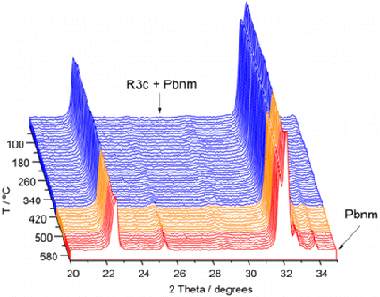
Ceramics of Bi1-xYxFeO3 solid solutions (x = 0.02, 0.07, and 0.10) have been prepared by mechanical activation followed by sintering. The effect of yttrium content on the structural, electrical, and optical properties of the materials has been studied. Thus, single-phase solid solutions with rhombohedral R3c structure have been achieved for x = 0.02 and 0.07,…

Amperometric magnetobiosensors using poly(dopamine)-modified Fe3O4 magnetic nanoparticles for the detection of phenolic compounds

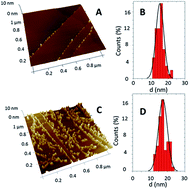
The synthesis of poly(dopamine)-modified magnetic nanoparticles (MNPs) and their application in preparing electrochemical enzyme biosensors that are useful to detect phenolic compounds is reported in this work. MNPs of about 16 nm were synthesized by a co-precipitation method and conveniently modified with poly(dopamine). Non-modified and modified MNPs were characterized using X-ray photoelectron spectroscopy (XPS), Raman…

Full solution processed mesostructured optical resonators integrating colloidal semiconductor quantum dots

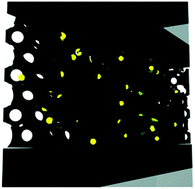
Herein we show a solution based synthetic pathway to obtain a resonant optical cavity with embedded colloidal semiconductor quantum dots (CSQDs). The optical cavity pore network, surrounded by two dense Bragg mirrors, was designed ad hoc to selectively host the quantum dots, while uncontrolled infiltration of those in the rest of the layered structure was prevented. Coupling…

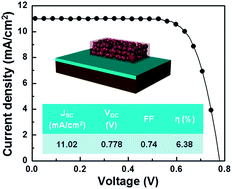
Synergistic strategies for the preparation of highly efficient dye-sensitized solar cells on plastic substrates: combination of chemical and physical sintering

Preparation of well-interconnected TiO2 electrodes at low temperature is critical for the fabrication of highly efficient dye-sensitized solar cells (DSCs) on plastic substrates. Herein we explore a synergistic approach using a combination of chemical and physical sintering. We formulate a binder-free TiO2 paste based on “nanoglue” as the chemical sintering agent, and use it to…

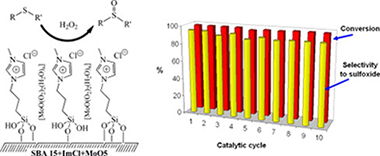
Oxodiperoxomolybdenum complex immobilized onto ionic liquid modified SBA-15 as an effective catalysis for sulfide oxidation to sulfoxides using hydrogen peroxide

A supported ionic-liquid-phase (SILP) was prepared by the reaction of 1-methyl-3-(3-(triethoxysilyl) propyl)-1H-imidazol-3-ium chloride with a mesoporous SBA-15 silica and then an oxodiperoxomolybdenum complex was immobilized onto the obtained SILP. The resulting material, identified as SBA-15 + ImCl+ MoO5, was characterized by solid state NMR (H-1, C-13 and Si-29), and their textural and thermogravimetric properties were…

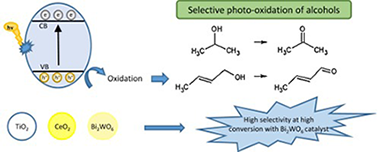
A comparative study of Bi2WO6, CeO2, and TiO2 as catalysts for selective photo-oxidation of alcohols to carbonyl compounds

Several semiconductors based on ceria or bismuth tungstate were tested for selective oxidation of alcohols to carbonyl compounds in a search for photocatalysts more selective than TiO2. Gas-phase selective photo-oxidation of propan-2-ol to acetone and liquid-phase transformation of 2-buten-1-ol (crotyl alcohol) to 2-butenal (crotonaldehyde) were studied as test reactions. In both processes the highest selectivities…

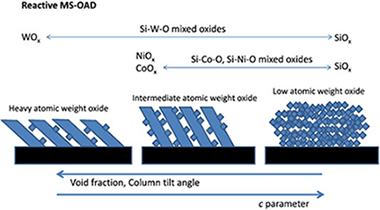
Microstructure of mixed oxide thin films prepared by magnetron sputtering at oblique angles

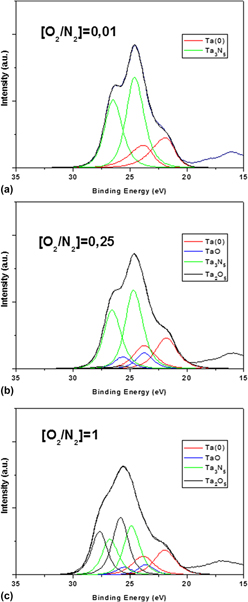
Several mixed oxide thin film series of samples (Si–Co–O, Si–Ni–O, Si–W–O) have been prepared by reactive magnetron sputtering at oblique angle geometries. The paper focuses on the description of microstructure of the films as a function of their stoichiometry. It is found that for identical process parameters (gas mixture, pressure, magnetron-substrate distance, incidence angle of…

Uniform Poly(acrylic acid)-Functionalized Lanthanide-Doped LaVO4 Nanophosphors with High Colloidal Stability and Biocompatibility

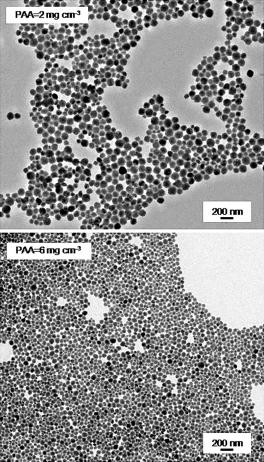
Ln-doped (Ln = Eu or Nd) LaVO4 nanoparticles functionalized with poly(acrylic acid) (PAA) were prepared from lanthanide and vanadate precursors in the presence of PAA by a simple one-pot method that consists of a homogeneous precipitation reaction in ethylene glycol/water at a moderate temperature (120 degrees C). The size of the nanoparticles could be modified…