Photocatalytic propylene epoxidation on Bi2WO6-based photocatalysts

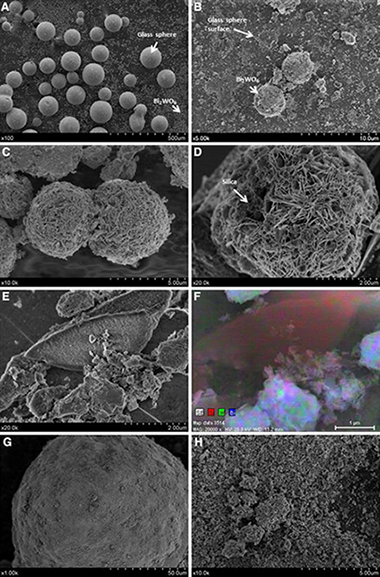
The photocatalytic epoxidation of propylene (PR) with molecular oxygen was carried out in a fluidized-bed reactor with several Bi2WO6-based materials under UV-A illumination. Three different photocatalysts were tested: one of single Bi2WO6 and two of coupled Bi2WO6-TiO2 heterostructures, thus showing that a mixed system of Bi2WO6 with commercial TiO2 Degussa-P25 leads to the best combination…

Nanocolumnar 1-dimensional TiO2 photoanodes deposited by PVD-OAD for perovskite solar cell fabrication

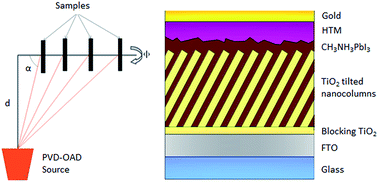
Perovskite solar cells have attracted increasing interest among the photovoltaic community in the last few years owing to their unique properties and high efficiency. In the present work, we report the fabrication of perovskite solar cells based on highly ordered 1-dimensional porous TiO2 photoanodes, which are uniform on a large area. These nanocolumnar porous TiO2…

Fabrication of Optical Multi layer Devices from Porous Silicon Coatings with Closed Porosity by Magnetron Sputtering

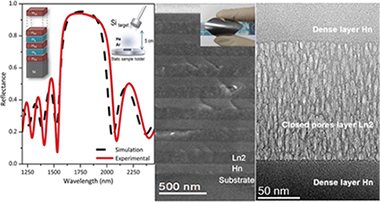
The fabrication of single-material photonic-multilayer devices is explored using a new methodology to produce porous silicon layers by magnetron sputtering. Our bottom-up methodology produces highly stable amorphous porous silicon films with a controlled refractive index using magnetron sputtering and incorporating a large amount of deposition gas inside the closed pores. The influence of the substrate…

On the origin of the photocatalytic activity improvement of BIVO4 through rare earth tridoping

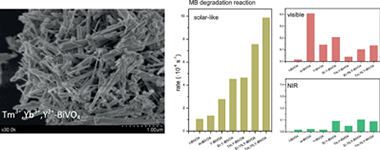
Rare earth (Tm3+/Er3+,Yb3+,Y3+) tri-doped BiVO4 have been synthesized by means of a surfactant free hydrothermal method having good photoactivities under sun-like excitation for the degradation of methylene blue and O-2 evolution reactions. The improved photocatalytic performance has been attained by multiple approach of the overall photocatalytic mechanism. From the structural and morphological characterization it has…

Study of coatings by thermal analysis in a monument built with calcarenite

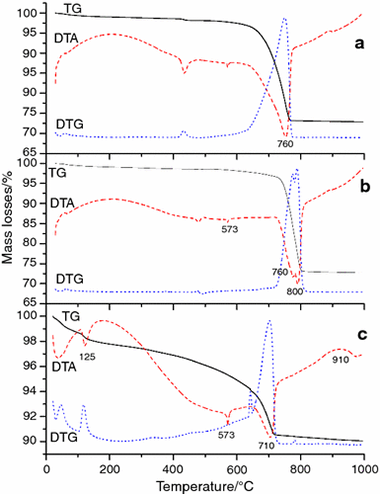
In this research, characterization of materials either added during restoration or formed by environmental contamination in the Seville City Hall, built with calcarenite stone, was investigated by thermal methods. Three different mortars for restoration have been characterized: (a) lime micro-mortar for internal consolidation of mortar itself, (b) mortar for reconstruction of deteriorated areas and (c)…

New Copper wide range nanosensor electrode prepared by physical vapor deposition at oblique angles for the non-enzimatic determination of glucose

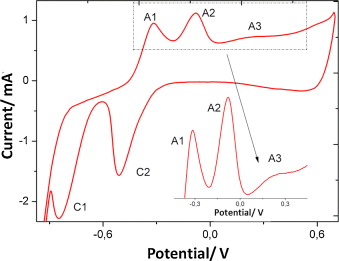
In this work a novel Cu nanostructured electrode is presented. Cu tilted nanocolumnar and porous thin films have been prepared by physical vapor deposition (PVD) in an oblique angle configuration and characterized by different techniques. Cyclic voltammetry and amperometry were used to study the sensing ability of the copper films deposited on ITO to quantitatively…

A novel and improved surfactant-modified Prussian Blue electrode for amperometric detection of free chlorine in water

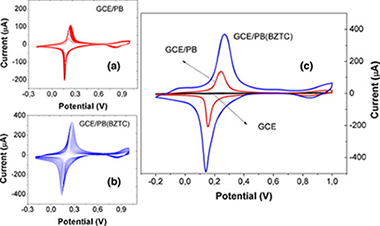
A surfactant-modified Prussian Blue (PB) electrochemical sensor has been developed. Benzethonium was used to assist the electrodeposition of PB onto a glassy carbon electrode (GCE). The surface coverage ( [View the MathML source] ) was 7.75 × 10−8 mol cm−2, five times higher than the value obtained in the absence of surfactant, and the film thickness of ca. 123 nm.…

Island-type growth of Au–Pt heterodimers: direct visualization of misfit dislocations and strain-relief mechanisms

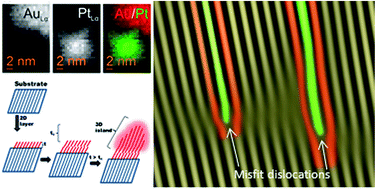
Structural and analytical characterization related to the formation mechanism of Au–Pt heterodimers from polyhedral Pt nanocrystals is reported. The observation of specific lattice strain effects and the emergence of misfit dislocations point to the relevance of the Stranski–Krastanov growth mode as a means of explaining the previously reported dimerisation reaction between Au and Pt. Two…