


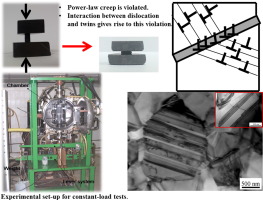
Boron carbide ceramics are the hardest material in Nature after diamond and the cubic phase of boron nitride. Due to this fact, their room-temperature fracture properties are the object of intense research. Paradoxically, high-temperature deformation is essentially unknown, because very high temperatures and stresses are necessarily required and high-quality specimens have not been available until recently. In this paper, the high-temperature compressive creep of fine-grained boron carbide polycrystals is reported. The breakdown of the classical power-law for high-temperature plasticity in ceramics is found. An analytical model is proposed. The model assumes that deformation is produced by dislocation glide. However, since the formation of twins is energetically favorable in this material and they act as strong barriers for dislocation glide, their motion turns to become progressively more difficult as elongation proceeds. The combination of increasing twin barriers and dislocations in mutual interaction is proposed to be the mechanism for high-temperature plasticity in this material. The model is validated with the experimental results. Final elongation of boron carbide specimens is reported to be over 100%, although this material cannot be described as a superplastic ceramic.