


Gold-Based Nanomaterials for Applications in Nanomedicine

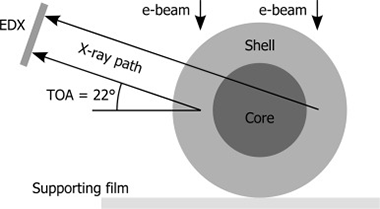
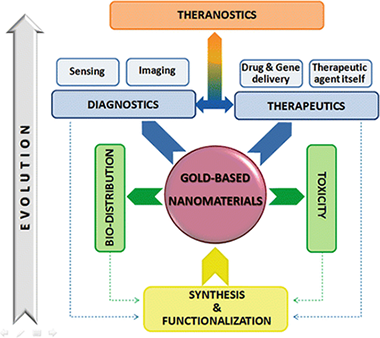
In this review, an overview of the current state-of-the-art of gold-based nanomaterials (Au NPs) in medical applications is given. The unique properties of Au NPs, such as their tunable size, shape, and surface characteristics, optical properties, biocompatibility, low cytotoxicity, high stability, and multifunctionality potential, among others, make them highly attractive in many aspects of medicine.…
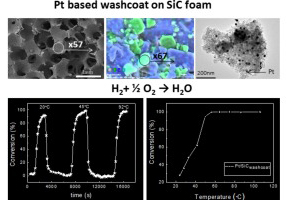
Investigation of a Pt containing washcoat on SiC foam for hydrogen combustion applications

A commercial Pt based washcoat, used for catalytic methane combustion, was studied supported on a commercial SiC foam as catalytic material (Pt/SiC) for catalytic hydrogen combustion (CHC). Structural and chemical characterization was performed using Electron Microscopy, X-Ray Diffraction (XRD) and X-Ray Photoelectron Spectroscopy (XPS). The reaction was monitored following water concentration by Fourier Transform Infrared…

The Calcium-Looping technology for CO2 capture: On the important roles of energy integration and sorbent behavior

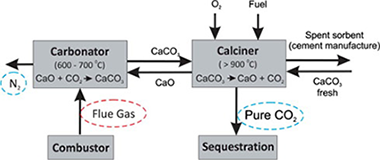
The Calcium Looping (CaL) technology, based on the multicyclic carbonation/calcination of CaO in gas-solid fluidized bed reactors at high temperature, has emerged in the last years as a potentially low cost technology for CO2 capture. In this manuscript a critical review is made on the important roles of energy integration and sorbent behavior in the…

Optofluidic Modulation of Self-Associated Nanostructural Units Forming Planar Bragg Microcavities

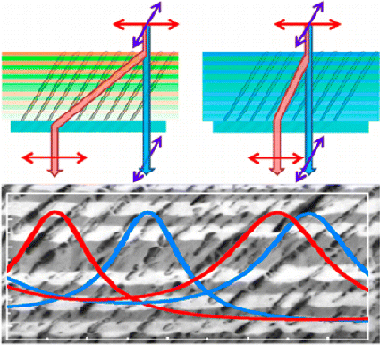
Bragg microcavities (BMs) formed by the successive stacking of nanocolumnar porous SiO2 and TiO2 layers with slanted, zigzag, chiral, and vertical configurations are prepared by physical vapor deposition at oblique angles while azimuthally varying the substrate orientation during the multilayer growth. The slanted and zigzag BMs act as wavelength-selective optical retarders when they are illuminated…

Application of Prussian Blue electrodes for amperometric detection of free chlorine in water samples using Flow Injection Analysis

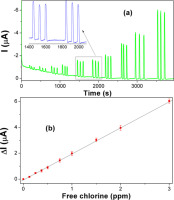
The performance for free chlorine detection of surfactant-modified Prussian Blue screen printed carbon electrodes (SPCEs/PB-BZT) have been assessed by cyclic voltammetry and constant potential amperometry. The characterization of SPCEs/PB-BZT by X-ray photoemission, Raman and infrared spectroscopies confirmed the correct electrodeposition of the surfactant-modified PB film. These electrodes were incorporated in a Flow Injection device and…

Ceramics from the Alcazar Palace in Seville (Spain) dated between the 11th and 15th centuries: Compositions, technological features and degradation processes

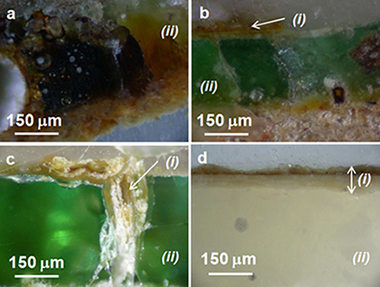
For the purpose of chemical characterization, a selection of 29 ceramic fragments from the 11th to 15th century has been made from materials excavated in the Seville Alcazar Palace. The PIXE elemental analysis results indicated that the ceramic bodies can be divided into four groups. The XRD identification of the phases present in the bodies…