Navigating the Legislative Interventions, Challenges, and Opportunities in Revolutionizing Textile Upcycling/Recycling Processes for a Circular Economy

Embracing a circular economy in the textile industry represents a crucial step toward sustainability, where fashion and textile sectors contribute significantly to CO2 emissions. However, transitioning from a linear “take-make-waste” model to circularity, poses multifaceted challenges, that highlight the staggering volume of annual textile waste surpassing industry predictions, thus emphasizing the urgent need for comprehensive strategies.…

Revisiting plant cuticle biophysics

The plant cuticle is located at the interface of the plant with the environment, thus acting as a protective barrier against biotic and abiotic external stress factors, and regulating water loss. Additionally, it modulates mechanical stresses derived from internal tissues and also from the environment. Recent advances in the understanding of the hydric, mechanical, thermal,…

Oxygen vacancy-dependent low-temperature performance of Ni/CeO2 in CO2 methanation

The transformative power of CO2 methanation can efficiently transform greenhouse gases into high-value products, aligning with the carbon neutrality goals. However, achieving this target at low temperature requires cumbersome efforts in designing catalysts that possess high reactivity and selectivity. Focusing on understanding the pivotal role of alkaline (such as Ca) sites in catalyzing these reactions…

Role of Inter-Particle Connectivity in the Photo-Carrier Cooling Dynamics in Perovskite Quantum Dot Solids

Intraband carrier relaxation in quantum dots (QDs) has been a subject of extensive spectroscopic investigation for several decades, and have been used to optimize the efficiency of opto-electronic processes. In the past few years, metal halide perovskites-based QDs have been shown to exhibit slow hot-carrier cooling characteristics that are desirable for photo-energy harvesting technologies. While…

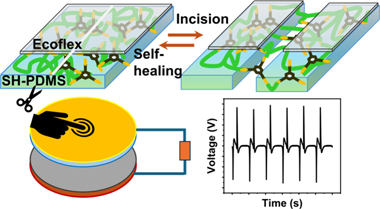
Tailoring of Self-Healable Polydimethylsiloxane Films for Mechanical Energy Harvesting

Triboelectric nanogenerators (TENGs) have emerged as potential energy sources, as they are capable of harvesting energy from low-frequency mechanical actions such as biological movements, moving parts of machines, mild wind, rain droplets, and others. However, periodic mechanical motion can have a detrimental effect on the triboelectric materials that constitute a TENG device. This study introduces…

Elucidating the Mechanism of Iron-Catalyzed Graphitization: The First Observation of Homogeneous Solid-State Catalysis

Carbon is a critical material for existing and emerging energy applications and there is considerable global effort in generating sustainable carbons. A particularly promising area is iron-catalyzed graphitization, which is the conversion of organic matter to graphitic carbon nanostructures by an iron catalyst. In this paper, it is reported that iron-catalyzed graphitization occurs via a…

Amber provenance as a Chrono-Cultural Proxy: Insights from FTIR analysis in the Iberian Peninsula

  In recent years, significant advancements have occurred in our comprehension of amber consumption patterns in the Iberian Peninsula. This progress stems from the increasing volume of FTIR data related to both archaeological and geological amber. Consequently, a chronological model has been established, delineating amber consumption in the Iberian Peninsula from the Late Paleolithic to…

Reactive Surface Explored by NAP-XPS: Why Ionic Conductors Are Promoters for Water Gas Shift Reaction

Near-ambient pressure X-ray photoelectron spectroscopy (NAP-XPS) experiments have been carried out in N-2 and N-2-H2O atmospheres on a Pt-based catalyst physically mixed with an Eu-doped ZrO2 ionic conductor as a function of temperature under realistic conditions of the water gas shift (WGS) reaction. This work aims to demonstrate the significant effect of having active H2O…

In situ XRD and operando XRD-XANES study of the regeneration of LaCo0.8Cu0.2O3 perovskite for preferential oxidation of CO

Combinations of perovskite-type oxides with transition and precious metals exhibit remarkable regenerating properties that can be exploited for catalytic applications. The objective of the present work was to study the structural changes experienced by LaCo0.8Cu0.2O3 under reducing/oxidizing atmosphere (redox) and Preferential Oxidation of CO (PrOx, with high H2 concentration) conditions and their reversibility. LaCo0.8Cu0.2O3 was prepared by ultrasonic…

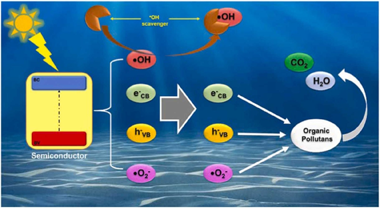
A critical view about use of scavengers for reactive species in heterogeneous photocatalysis

In heterogeneous photocatalysis, different reactive species generated from the excitation of the semiconductor are responsible for the degradation of different contaminants in aqueous solution. In order to evaluate the influence of each of these reactive species on the photocatalysis process, it is common to perform an analysis using different chemical compounds, which (in theory) react…