Nanometer-Scale Precision Tuning of 3D Photonic Crystals Made Possible Using Polyelectrolytes with Controlled Short Chain Length and Narrow Polydispersity

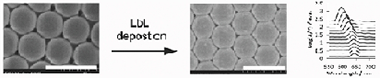
Nanometer-scale tuning of the optical properties of prefabricated photonic crystals is achieved via layer-by-layer assembly of polyelectrolytes in the interstitial spaces of the photonic lattice. The key to the approach is using polyelectrolytes with controlled short chain lengths. This ensures they do not block the air voids, thereby maintaining uniform coating and thus precise and reproducible…

Dye sensitized solar cells as optically random photovoltaic media

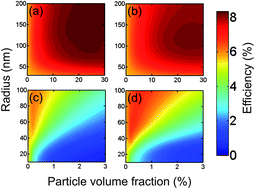
In order to enhance optical absorption, light trapping by multiple scattering is commonly achieved in dye sensitized solar cells by adding particles of a different sort. Herein we propose a theoretical method to find the structural parameters (particle number density and size) that optimize the conversion efficiency of electrodes of different thicknesses containing spherical inclusions…

Gold supported on CuOx/CeO2 catalyst for the purification of hydrogen by the CO preferential oxidation reaction (PROX)

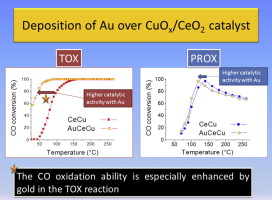
Hydrogen produced from the conversion of hydrocarbons or alcohols contains variable amounts of CO that should be removed for some applications such as feeding low-temperature polymer electrolyte membrane fuel cells (PEMFCs). The CO preferential oxidation reaction (PROX) is particularly well-suited for hydrogen purification for portable and on-board applications. In this work, the synthesis and characterization…

Comparative Study of Micro- and Nano-structured Coatings for High-Temperature Oxidation in Steam Atmospheres

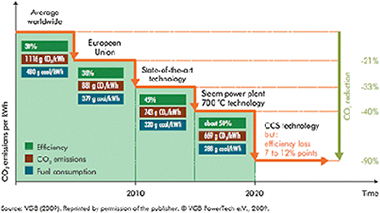
For many high-temperature applications, coatings are applied in order to protect structural materials against a wide range of different environments: oxidation, metal dusting, sulphidation, molten salts, steam, etc. The resistance achieved by the use of different kind of coatings, such as functionally graded material coatings, has been optimized with the latest designs. In the case…

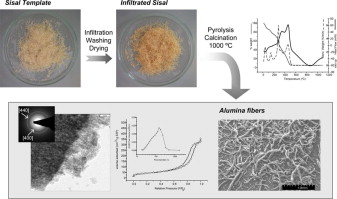
Characterization of thermally stable gamma alumina fibres biomimicking sisal

Mesoporous gamma alumina fibres of high surface area, stable up to 1000 °C, were synthesized by bioreplica technique using sisal fibres as templates. Alumina formation during pyrolysis and calcination of fibres infiltrated with aluminium chloride solution has been studied, paying special attention to the interaction between the precursor and sisal fibres, using several experimental techniques…

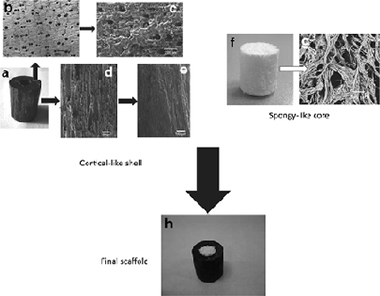
New Bio-Ceramization Processes Applied to Vegetable Hierarchical Structures for Bone Regeneration: An Experimental Model in Sheep

Bone loss is still a major problem in orthopedics. The purpose of this experimental study is to evaluate the safety and regenerative potential of a new scaffold based on a bio-ceramization process for bone regeneration in long diaphyseal defects in a sheep model. The scaffold was obtained by transformation of wood pieces into porous biomorphic…

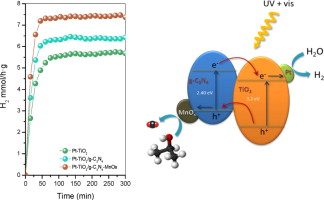
Improved H2 production of Pt-TiO2/g-C3N4-MnOx composites by an efficient handling of photogenerated charge pairs

Pt-TiO2/g-C3N4-MnOx hybrid structures are synthesized by means of a simple impregnation method of Pt-TiO2 and g-C3N4-MnOx. From the wide structural and surface characterization we have stated that TiO2/g-C3N4 composites are formed by an effective covering of g-C3N4 by TiO2. The modification of composite by Pt and/or MnOx leads to improved photoactivities for phenol degradation reaction.…

Competitive effect of the metallic canister and clay barrier on the sorption of Eu3+ under subcritical conditions

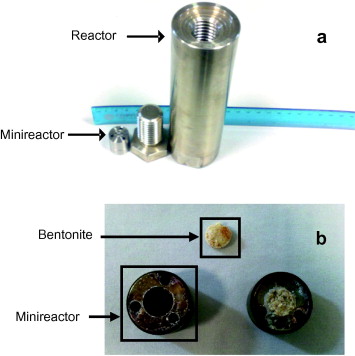
An in depth knowledge and understanding of high activity radionuclide (HLRW) immobilization processes on the materials composing the engineered barrier (clay and metallic canister) is required to ensure the safety and the long-term performance of radioactive waste disposal procedures. Therefore, the aim of this study was to understand the mechanisms involved in the retention of…