Structural and kinetic study of phase transitions in LaYSi2O7

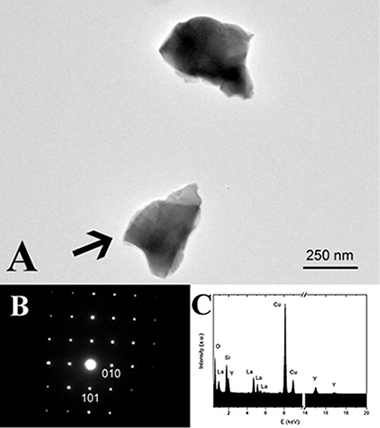
Phase transitions in LaYSi 2O 7 have been investigated as a function of temperature using XRD, NMR and TEM. Previously described empirical crystal structure guidelines based on average cation radius in rare-earth RE 2Si 2O 7-type disilicates predict a stable tetragonal A-LaYSi 2O 7 polymorph at temperatures below 1500°C. This study demonstrates that A-LaYSi 2O…

High-temperature mechanical behavior of polycrystalline yttrium-doped barium cerate perovskite

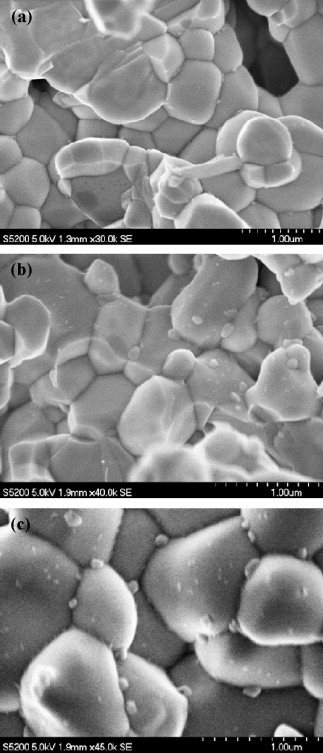
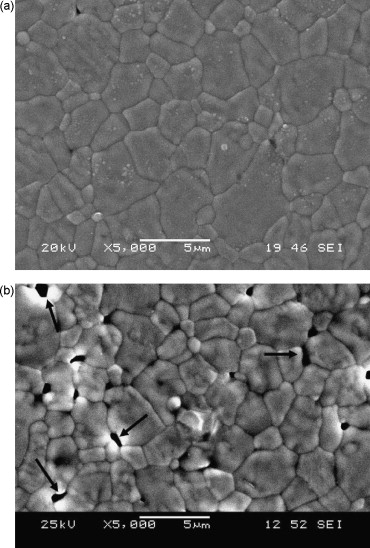
The high-temperature mechanical properties of the mixed ionic-electronic conductor perovskite BaCe0.95Y0.05O3−δ with average grain size of 0.40 μm have been studied in compression between 1100 and 1300 °C in air at different initial strain rates. The true stress–true strain curves display an initial stress drop, followed by an extended steady-state stage. As the temperature decreases…

Microstructural and mechanical evaluation of a Cu-based active braze alloy to join silicon nitride ceramics

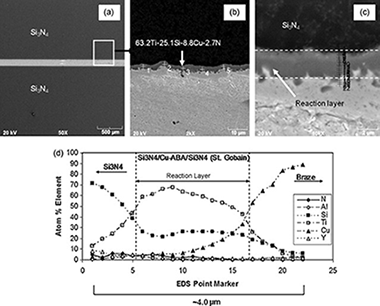
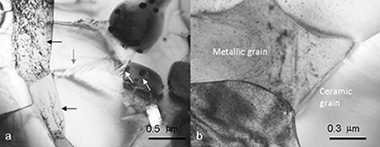
Self-joining of St. Gobain Si3N4 (NT-154) using a ductile Cu–Al–Si–Ti active braze (Cu-ABA) was demonstrated. A reaction zone (∼2.5–3.5 μm thick) developed at the interface after 30 min brazing at 1317 K. The interface was enriched in Ti and Si. The room temperature compressive shear strengths of Si3N4/Si3N4 and Inconel/Inconel joints (the latter created to…

Microstructural and mechanical evaluation of porous biomorphic silicon carbide for high temperature filtering applications

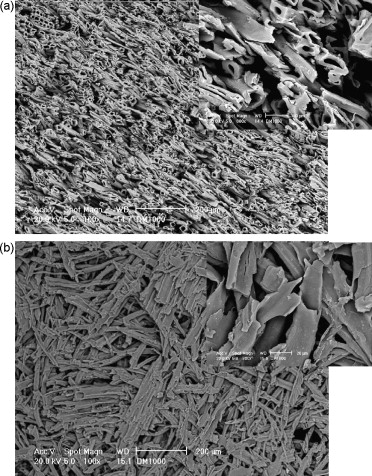
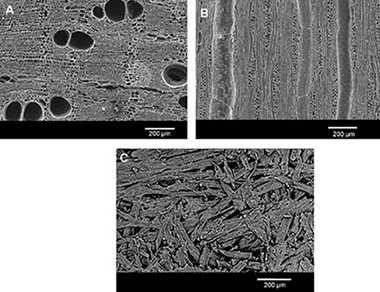
Biomorphic SiC (bioSiC) is a low cost SiC/Si composite obtained by melt infiltration of carbon preforms obtained from the pyrolysis of cellulose precursors. The porosity and pore size distribution of bioSiC can be tailored for specific applications by adequate selection of the wood precursor. Natural and artificial industrial woods were explored as possible bioSiC precursors.…

Compressive strength degradation in ZrB2-based ultra-high temperature ceramic composites

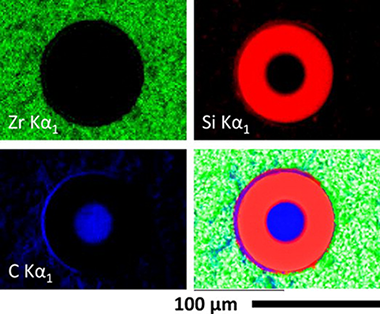
The high temperature compressive strength behavior of zirconium diboride (ZrB2)-silicon carbide (SiC) particulate composites containing either carbon powder or SCS-9a silicon carbide fibers was evaluated in air. Constant strain rate compression tests have been performed on these materials at room temperature, 1400, and 1550°C. The degradation of the mechanical properties as a result of atmospheric…

Creep behavior of TiCxN1-x-CoTi cermets synthesized by mechanically induced self-sustaining reaction

The plastic flow of TiCxN1-x-CoTi cermets has been investigated by uniaxial compression tests carried out in argon atmosphere at temperatures between 1100 and 1200°C. Two different cermets, with 5wt.% W or WC content as sintering additives, have been explored to assess the influence of the sintering additives on creep. The microstructural observations of deformed samples…

A first study of the high-temperature plasticity of ceria-doped zirconia polycrystals

Ceria zirconia ceramic alloys were sintered by high-temperature annealing, considering several synthesis temperatures to obtain a full-dense ceria zirconia ceramic material using a temperature as low as possible. It was found that fully density is achieved at temperatures of 1450 degrees C. Monolithic specimens were crept under compression at high temperatures. The creep results fitted…

Mechanochemical synthesis of vanadium nitride

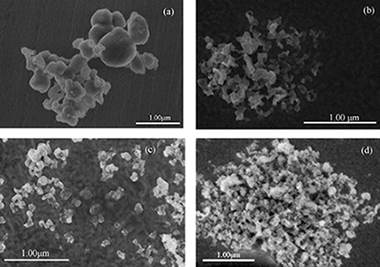
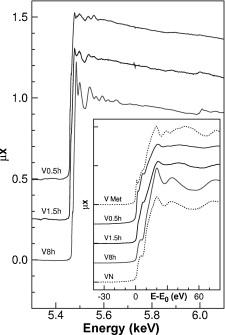
Vanadium nitride (VN) has been prepared by mechanosynthesis from vanadium metal under a pressurized nitrogen atmosphere in a short milling time. The characterization of the final product by X-ray diffraction, scanning electron microscopy, electron energy loss (EELS), and X-ray absorption spectroscopy (XAS) is presented. The final product, VN with 96% of purity, is obtained at…