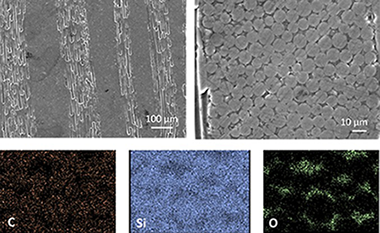
Mg2SiO4-MgAl2O4 directionally solidified eutectics: Hardness dependence modelled through an array of screw dislocations

Mg2SiO4-MgAl2O4 eutectic ceramics have been fabricated by means of the laser floating zone (LFZ) technique. The microstructure has revealed as an unusual one at lower growth rate, composed of broken lamellae of MgAl2O4 distributed randomly along one matrix, composed of Mg2SiO4. At higher growth rates, a cell structure with intra-cell lamella structure is dominant. Contrary…

Graphene nanoplatelets for electrically conductive 3YTZP composites densified by pressureless sintering

3 mol% yttria tetragonal zirconia polycrystalline (3YTZP) ceramic composites with 2.5, 5 and 10 vol% graphene nanoplatelets (GNP) were pressureless sintered in argon atmosphere between 1350 and 1450 degrees C. The effects of the GNP content and the sintering temperature on the densification, microstructure and electrical properties of the composites were investigated. An isotropic distribution…

Electrical properties of bismuth ferrites: Bi2Fe4O9 and Bi25FeO39

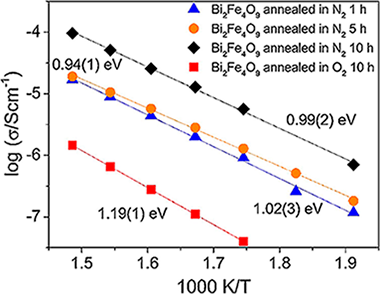
Bi2Fe4O9 was prepared by solid-state reaction and the electrical properties measured by impedance spectroscopy. After annealing in O-2 at 900 degrees C, Bi2Fe4O9 is an electrically-homogeneous insulator. Its high frequency permittivity is constant (similar to 14.1) over the temperature range 300-400 degrees C and shows no evidence of incipient ferroelectricity at lower temperatures. On annealing…

Graphene or carbon nanofiber-reinforced zirconia composites: Are they really worthwhile for structural applications?

The use of allotropic phases of carbon (i.e. nanotubes, graphene or carbon nanofibers) as second phases to design ceramic composites is a hot topic at present. Researchers try to provide a remarkable improvement of the parent ceramic assuming that some of the outstanding mechanical properties of these phases migrate to the resultant composite. This reasonable…

High-temperature compressive creep of novel fine-grained orthorhombic ZrO2 ceramics stabilized with 12 mol% Ta doping

A novel fine-grained orthorhombic ZrO2 ceramic stabilized with 12 mol% Ta doping was fabricated by spark plasma sintering from home-made powders, and its high-temperature mechanical properties evaluated for the first time by compressive creep tests in both Ar and air. It was found that the high-temperature plasticity of the ceramic deformed in Ar, under which…

Is an alumina-whisker-reinforced alumina composite the most efficient choice for an oxidation-resistant high-temperature ceramic?

The search of a competitive ceramic material for structural applications demands several requisites: a simple microstructure with easy reproducibility, good intrinsic mechanical properties and most of all, an optimal oxidation resistance. This later point is a challenging point for most ultrahigh refractory materials.  In this work an alumina (Al2O3) whisker-reinforced Al2O3 composite prepared by spark…

Spark plasma sintering of titanium nitride in nitrogen: Does it affect the sinterability and the mechanical properties?

Titanium nitride ceramics have an intrinsic interest due to its optical and structural applications. However, the conditions for sintering of dense pieces are not still clarified. This research work is focused on the spark plasma sintering (SPS) of near-fully dense fine-grained TiN. The main goal is giving a response to a longstanding debate: can the…

High temperature compressive strength and creep behavior of Si-Ti-C-O fiber-bonded ceramics

Fiber bonded silicon carbide ceramic materials provide cost-advantage over traditional ceramic matrix composites and require fewer processing steps. Despite their interest in extreme environment thermostructural applications no data on long term mechanical reliability other than static fatigue is available for them. We studied the high temperature compressive strength and creep behavior of a fiber bonded…