Mechanical performance of sub-stoichiometric titanium carbide ceramics synthesized by a hybrid SHS and SPS methodology

Sub-stoichiometric titanium carbide ceramics were synthesized via a hybrid route combining self-propagating high-temperature synthesis (SHS) and spark plasma sintering (SPS). TiC1-x powders were produced through a single, rapid SHS step by the direct reaction of titanium and graphite, followed by attrition milling to achieve an average particle size of 3-5 mu m. Particular attention was…

Structural, Mössbauer and magnetic study of (Mn0.2Co0.2Ni0.2Cu0.2X0.2) Fe2O4 (X=Fe, Mg) spinel high-entropy oxides fabricated via reactive flash sintering

Herein, it is reported the concomitant synthesis and sintering in a single step of (Mn0.2Co0.2Ni0.2Cu0.2X0.2)Fe2O4 (X=Fe, Mg), a spinel-structured high-entropy oxides, by the reactive flash sintering technique. A single phase, identified with a spinel crystal structure Fd3m, was obtained in just 30 min at a furnace temperature of 1173 K. The structural and magnetic properties…

BN nanosheets reinforced zirconia composites: An in-depth microstructural and mechanical study

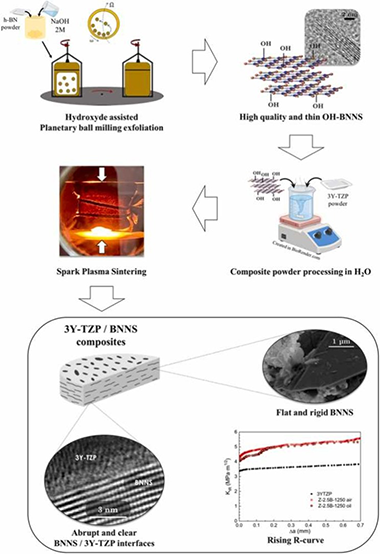
This paper deals with the effect of hydroxylated boron nitride nanosheets (BNNS) incorporation on the microstructural and mechanical features of zirconia ceramics. Few-layered BNNS were synthesized via a simple hydroxide-assisted planetary ball milling exfoliation technique. 3 mol% yttria tetragonal zirconia polycrystal (3Y-TZP) with 2.5 vol% BNNS powders were prepared by an environmentally friendly process in…

In situ study on enhanced plastic deformability of Lanthanum-doped Bismuth ferrite processed by flash sintering

BiFeO3 is a promising multiferroic material for versatile device applications due to its co-existence of magnetic (i.e., antiferromagnetic) and ferroelectric ordering at room temperature. While its functional properties have been extensively investigated, the exploration of its mechanical behavior was limited mostly to the thin-film form of BiFeO3. In this work, we conducted in situ micropillar…

R-curve evaluation of 3YTZP/graphene composites by indirect compliance method

This work addresses the crack growth resistance of 3 mol% Yttria-doped Tetragonal Zirconia Polycrystalline (3YTZP) spark-plasma sintered (SPS) composites containing two types of graphene-based nanomaterials (GBN): exfoliated graphene nanoplatelets (e-GNP) and reduced graphene oxide (rGO). The crack growth resistance of the composites is assessed by means of their R-Curve behavior determined by three-point bending tests…

Electrical performance of orthotropic and isotropic 3YTZP composites with graphene fillers

3 mol% yttria tetragonal zirconia polycrystal (3YTZP) composites with orthotropic or isotropic microstructures were obtained incorporating few layer graphene (FLG) or exfoliated graphene nanoplatelets (e-GNP) as fillers. Electrical conductivity was studied in a wide range of contents in two configurations: perpendicular (sigma(perpendicular to)) and parallel (sigma(//)) to the pressing axis during spark plasma sintering (SPS).…

Highly efficient electrical discharge machining of yttria-stabilized zirconia ceramics with graphene nanostructures as fillers

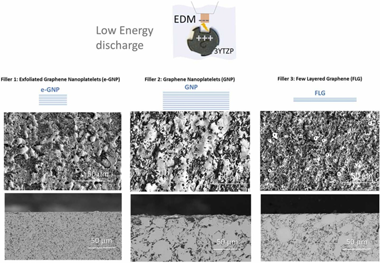
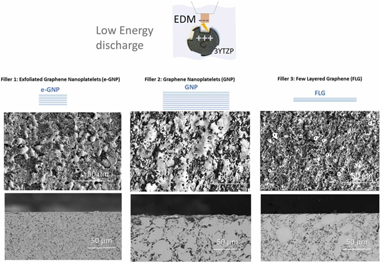
Electrical-discharge machining (EDM) of advanced ceramics allows the miniaturization of parts with complex shapes. Since electrical conductivity is required, non-conductive ceramics need a conductive second phase. This work assesses the feasibility of industrial EDM in advanced yttria-stabilized tetragonal zirconia (3YTZP) composites with 20 vol% graphene nanostructures with different morphology using different EDM energies. The structural integrity of the graphene nanostructures,…

Highly efficient electrical discharge machining of yttria-stabilized zirconia ceramics with graphene nanostructures as fillers

Electrical-discharge machining (EDM) of advanced ceramics allows the miniaturization of parts with complex shapes. Since electrical conductivity is required, non-conductive ceramics need a conductive second phase. This work assesses the feasibility of industrial EDM in advanced yttria-stabilized tetragonal zirconia (3YTZP) composites with 20 vol% graphene nanostructures with different morphology using different EDM energies. The structural integrity of the graphene nanostructures,…

Ageing-resistant zirconia/graphene-based nanostructures composites for use as biomaterials

This work explores the incorporation of graphene-based two-dimensional nanostructures as moisture barriers to delay hydrothermal ageing of yttria-stabilized zirconia and strengthen its use in biomedical applications. Two sets of highly dense zirconia composites incorporating multilayered graphene with very different lateral dimensions, few layer graphene and exfoliated graphene nanoplatelets, were prepared. The effect of the addition of graphene nanostructures on…

Unravelling the optimization of few-layer graphene crystallinity and electrical conductivity in ceramic composites by Raman spectroscopy

Zirconia composites with few-layer graphene (FLG) were prepared by two powder processing routines-ultrasonic agitation or planetary ball milling-and spark plasma sintered at 1250 and 1300 degrees C. An in-depth study of the crystallinity of FLG, in terms of presence and nature of defects, was performed by Raman spectroscopy, revealing enhanced FLG crystallinity after sintering. This…