Carbon nanofibers replacing graphene oxide in ceramic composites as a reinforcing-phase: Is it feasible?

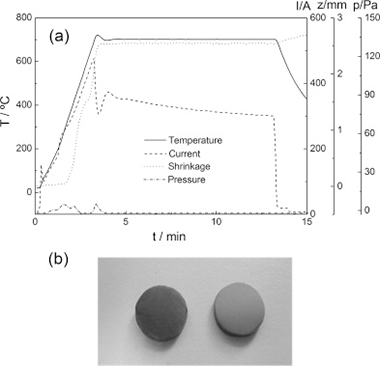
In recent years, the interest of graphene and graphene-oxide has increased extraordinarily due to the outstanding properties concurring in this material. In ceramic science, the possibility of combining excellent electrical conductivities together with an enhancement of mechanical properties has motivated the research in fabrication of graphene oxide-reinforced ceramic composites despite the intrinsic difficulties for sintering.…

Metallization of ceramic substrates by laser induced decomposition of coordination complexes

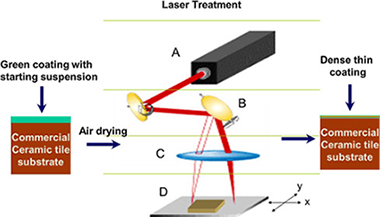
This work describes an in-situ Nd:YAG laser-assisted coating method to modify industrial glazed ceramic surfaces. The method makes use of a Cu polymer coordination complex, transformed via 1064 nm continuos wave (cw) laser irradiation, into a lustre-type glassy coating covering the ceramic substrate. The obtained coatings, with typical thicknesses ranging between 4 and 14 μm, become integrated…

Ceramics from the Alcazar Palace in Seville (Spain) dated between the 11th and 15th centuries: Compositions, technological features and degradation processes

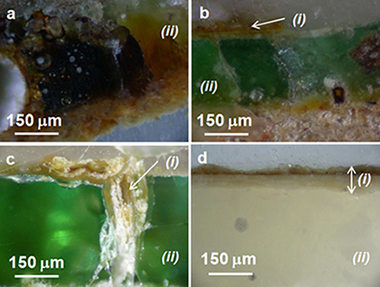
For the purpose of chemical characterization, a selection of 29 ceramic fragments from the 11th to 15th century has been made from materials excavated in the Seville Alcazar Palace. The PIXE elemental analysis results indicated that the ceramic bodies can be divided into four groups. The XRD identification of the phases present in the bodies…

Preparation of phase pure, dense fine grained ceramics by conventional and spark plasma sintering of La-substituted BiFeO3 nanoparticles

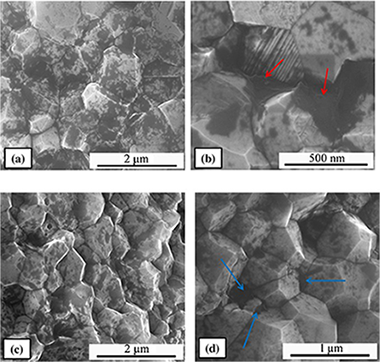
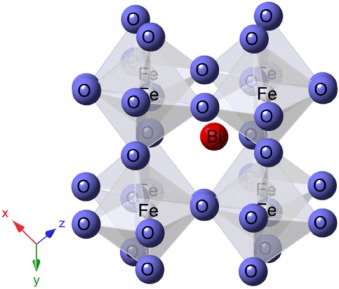
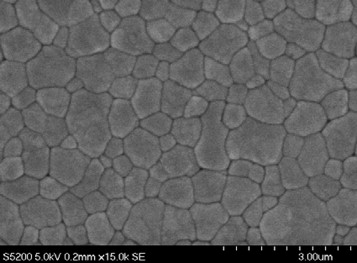
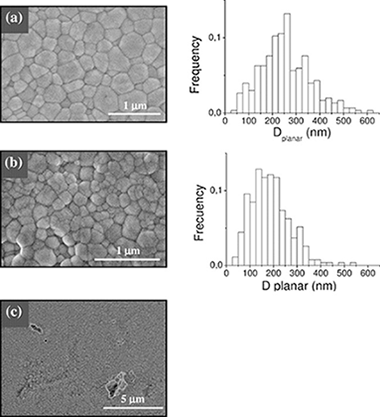
High density ceramics of the system Bi1-xLaxFeO3, 0 <= x <= 0.15, have been prepared starting from nanoparticles obtained by mechanosynthesis. The ceramics have been sintered conventionally at 850 degrees C and by spark plasma sintering (SPS). Sintering conditions have been optimized to obtain single phase ceramics, and the microstructure of the ceramics has been…

High temperature internal friction measurements of 3YTZP zirconia polycrystals. High temperature background and creep

This work focuses on the high-temperature mechanic properties of a 3 mol% yttria zirconia polycrystals (3YTZP), fabricated by hot-pressureless sintering. Systematic measurements of mechanical loss as a function of temperature and frequency were performed. An analytical method, based on the generalized Maxwell rheological model, has been used to analyze the high temperature internal friction background…

Improvement of Vickers hardness measurement on SWNT/Al2O3 composites consolidated by spark plasma sintering

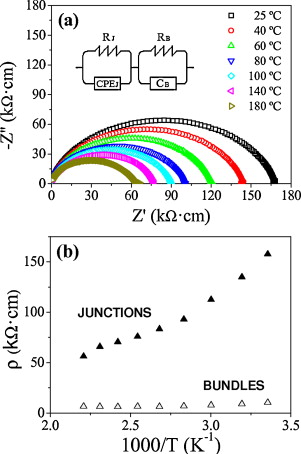
Dense alumina composites with different carbon nanotube content were prepared by colloidal processing and consolidated by Spark Plasma Sintering (SPS). Single-wall carbon nanotubes (SWNTs) were distributed at grain boundaries and also into agglomerates homogeneously dispersed. Carrying out Vickers hardness tests on the cross-section surfaces instead of top (or bottom) surfaces has shown a noticeable increase…

Effect of high SWNT content on the room temperature mechanical properties of fully dense 3YTZP/SWNT composites

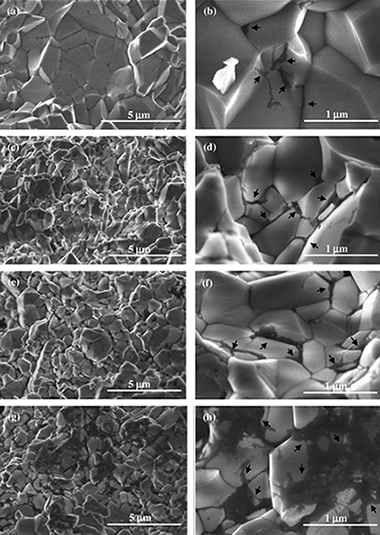
This paper is devoted to correlate the microstructure and room temperature mechanical properties of single-wall carbon nanotube (SWNT) reinforced 3 mol% yttria stabilized tetragonal zirconia with high SWNT content (2.5, 5 and 10 vol%). Fully dense composites were prepared by using a combination of aqueous colloidal powder processing and Spark Plasma Sintering. SWNTs were located…

Additive-free superhard B4C with ultrafine-grained dense microstructures

A unique combination of high-energy ball-milling, annealing, and spark-plasma sintering has been used to process superhard B4C ceramics with ultrafine-grained, dense microstructures from commercially available powders, without sintering additives. It was found that the ultrafine powder prepared by high-energy ball-milling is hardly at all sinterable, but that B2O3 removal by gentle annealing in Ar provides…