Microstructural characterization of ceramic-intermetallic composites using TEM related techniques

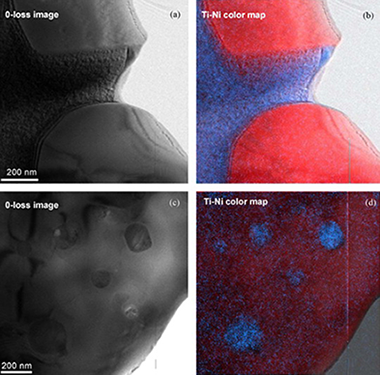
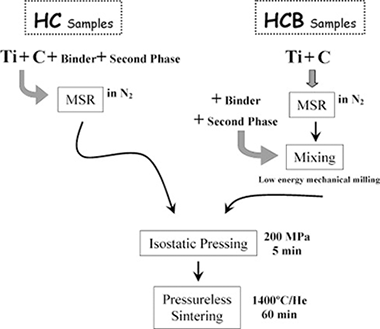
TiCxVy/Ni and TiCxNy/Ti-Co composites formed by ceramic and intermetallic binder phases were produced by pressureless sintering at 1400 degrees C from powders synthesized by a mechanically induced self-sustaining reaction (MSR) process. Four different composites were characterized using high-resolution electron microscopic techniques, in both scanning (SEM, HRSEM) and transmission (TEM, HRTEM, ED, EDS and EELS) modes…

Synthesis by pyrolysis of aerosols and ceramic application of Cr-doped CaYAlO4 red–orange pigments

The synthesis of red–orange Cr-doped YCaAlO4 pigments has been improved (softer thermal conditions and lower environmental impact) and optimised by using the pyrolysis of aerosols method. We also study the crystallochemical features of the Cr chromophore with special emphasis on its oxidation state which has not been yet clarified, finding that Cr(III) and Cr(IV) species…

Properties of Ti(C,N) cermets synthesized by mechanically induced self-sustaining reaction

The properties of TiCxN1−x/(Ni or Co) cermets sintered by a pressureless method from powder mixtures, and obtained for the first time by a mechanically induced self-sustaining reaction process (MSR), were studied. The hardness, toughness, friction and wear coefficients, and oxidation resistance were determined. It was shown that cermets obtained from powdered materials synthesized in one…

New production of TiCxN1-x-based cermets by one step mechanically induced self-sustaining reaction: Powder synthesis and pressureless sintering

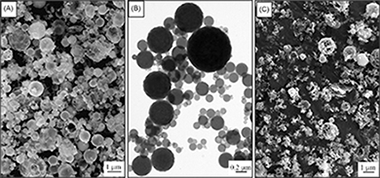
TiCxN1-x-based powdered cermets were synthesized by a one step mechanically induced self-sustaining reaction (MSR) process from mixtures of elemental powders, and subsequently sintered by a pressureless method. The composition and microstructure of the ceramic and binder phases before and after the sintering process were studied by X-ray diffraction, scanning and transmission electron microscopy, and electron…

Crystallographic texture in Al2O3-ZrO2 (Y2O3) directionally solidified eutectics

Directionally solidified Al2O3-based eutectics are in situ composites grown from the melt. The directional nature of the solidification process makes these materials highly anisotropic and therefore the measurement and quantification of their crystallographic texture is necessary to understand their physical properties. We studied the texture of Al2O3-ZrO2 (12 mol% Y2O3) eutectic rods by means of…

High-temperature mechanical properties of porous NaMgF3 derived from directionally solidified NaMgF3-NaF eutectics

Porous NaMgF3 ceramics have been fabricated by leaching a NaF-NaMgF3 eutectic in distilled water, producing NaMgF3 with 53% of connected porosity. The eutectic was fabricated using the Bridgman technique at growth rates of 8, 10 and 15 mm/h. The microstructure and composition of the resulting material has been studied by means of X-ray diffraction and SEM. Compression mechanical tests have been performed at different temperatures up to 750 degrees C,…