


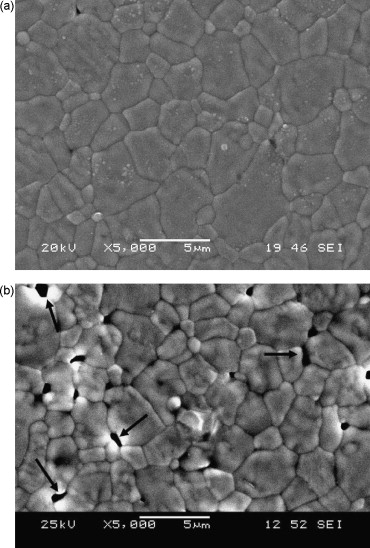
Ceria zirconia ceramic alloys were sintered by high-temperature annealing, considering several synthesis temperatures to obtain a full-dense ceria zirconia ceramic material using a temperature as low as possible. It was found that fully density is achieved at temperatures of 1450 degrees C. Monolithic specimens were crept under compression at high temperatures. The creep results fitted an empirical constitutive equation consistent with a classical Ratchinger mechanism for grain switching. This result was confirmed through microstructural characterization of as-received and post-mortem specimens. Since the conventional Ashby-Verrall model is contrary to the mechanism controlling creep in other zirconia alloys, the results are considered in the framework of a new grain boundary sliding model, with particular discussion of the validity of that model for the ceria zirconia case.