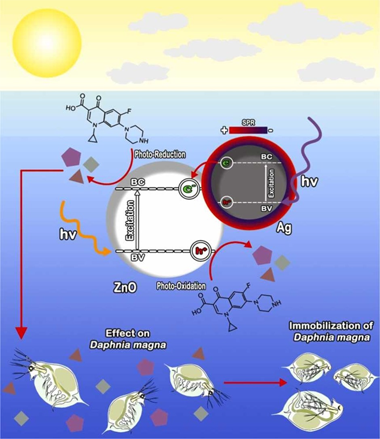
Efficient degradation of ciprofloxacin by photocatalytic activity of Ag-modified ZnO

Ciprofloxacin (CIP) is a highly persistent antibiotic whose presence in natural aquatic matrices represents a critical challenge for public health and environmental protection. In this study, the photocatalytic efficiency of ZnO and its Ag-modified counterpart, synthesized by coprecipitation and photodeposition, respectively, was evaluated in the ciprofloxacin elimination in distilled water and in a real matrix…

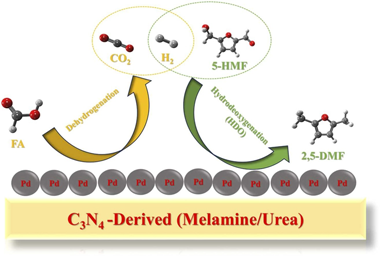
Formic acid dehydrogenation and use as H-donor in 5-hydroxymethylfur-fural hydrodeoxygenation over Pd/C3N4 catalysts

This work studies the behavior of a series of Pd/C3N4 catalyst in the reaction of formic acid dehydrogenation and the use of the latter as H-donor for 2,5-hydroxymethyl furfural hydrodeoxygenation. Firstly, a series of supports have been synthesized from melamine and urea as a function of precursors ratio and temperature of their condensation. The different…

Towards the effective removal of environmental strains of bacteria from real wastewater by heterostructured photocatalysts

Access to clean water is crucial for human health, yet microbial contamination poses significant challenges. This study investigates the effectiveness of novel photocatalytic catalysts: heterostructured TiO2/AgBr and faceted titanium dioxide, for microbial inactivation under ultraviolet and visible light. Both catalysts were synthesized and characterized. Performance was evaluated using real wastewater samples and saline solutions, targeting…

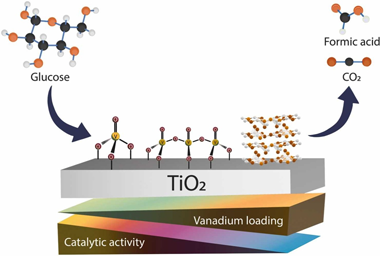
Influence of vanadium species on the catalytic oxidation of glucose for formic acid production

VOx/TiO2 catalysts with various theorical monolayer values have been prepared and used to study, for the first time, the effect of vanadium loading in the selective oxidation of glucose to formic acid. Monomeric or isolated vanadia species dominate at low loadings, evolving into polymeric chains at higher concentrations, while crystalline V2O5 is observed at loadings over the…

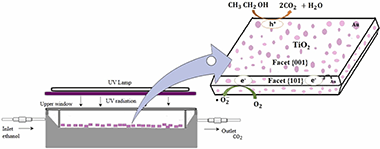
Photocatalytic activity enhancement by noble metal deposition on faceted F-TiO2 synthesised by microwave assisted method. A study of selective oxidation of gas-phase ethanol in a FBPR reactor

In the present work, fluorinated titanium dioxide (TiO2-F) with high exposition of facet {001} was prepared by following a facile and high yield hydrothermal method assisted by microwave. This faceted TiO2 was then modified by Au or Ag deposition at two different metal loadings (0.125 and 0.25 wt%). A wide physicochemical characterisation of the materials was performed.…

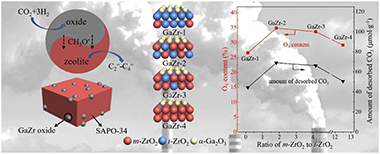
Effects of ZrO2 crystalline phase on oxygen vacancy of GaZr oxides and their properties for CO2 hydrogenation to light olefins

A bifunctional catalyst, comprising GaZr oxide and SAPO-34 zeolite, manifests enhanced catalytic activity in CO2 hydrogenation to light olefins; nonetheless, the comprehensive analysis of the pivotal role played by the underlying structure of ZrO2 in Ga-Zr oxide has not been investigated. Herein, different crystalline structures of ZrO2 were prepared by the co-precipitation method and adopted as a support…

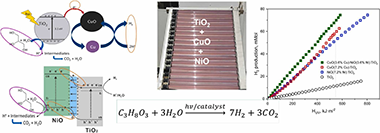
H2 production based on a ternary mixture of commercial CuO-NiO-TiO2 in a solar pilot plant

Glycerol is a by-product in biodiesel production (in the range of g·L−1), so its photoreforming by photocatalysis is a way of valorising it. TiO2 in photocatalysis has been widely studied, although its efficiency is limited by the high energy band gap, and the electron-hole recombination. Its combination with different semiconductors should improve charge separation, extending also…

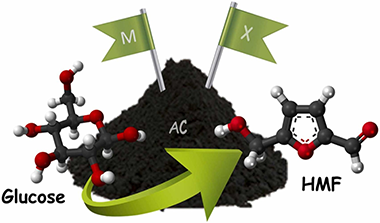
Glucose dehydration reaction over metal halides supported on activated charcoal catalysts

Different metal halide catalysts supported on a commercial active charcoal have been synthesized, activated, characterized and tested in glucose dehydration to 5-hydroxymethylfurfural using a biphasic water/methyl isobutyl ketone media. The influence of the cation nature (K+, Ca2+, Sr2+, Mg2+) and anion nature (F–, Cl–, Br–) on the catalytic performance of the solid is discussed in…

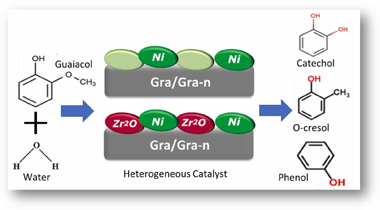
Multicomponent graphene based catalysts for guaiacol upgrading in hydrothermal conditions: Exploring «H2-free» alternatives for bio-compounds hydrodeoxygenation

  Catalytic hydrodeoxygenation (HDO) is a critical technique for upgrading biomass derivatives to deoxygenated fuels or other high-value compounds. Phenol, guaiacol, anisole, p-cresol, m-cresol and vanillin are all monomeric phenolics produced from lignin. Guaiacol is often utilised as a model lignin compound to deduce mechanistic information about the bio-oil upgrading process. Typically, a source of H2 is supplied as reactant for the HDO reaction. However, the H2…