


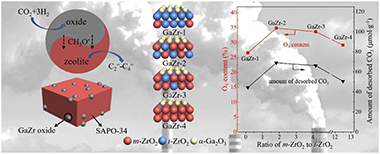
A bifunctional catalyst, comprising GaZr oxide and SAPO-34 zeolite, manifests enhanced catalytic activity in CO2 hydrogenation to light olefins; nonetheless, the comprehensive analysis of the pivotal role played by the underlying structure of ZrO2 in Ga-Zr oxide has not been investigated. Herein, different crystalline structures of ZrO2 were prepared by the co-precipitation method and adopted as a support to deposit Ga to obtain ZrO2 with different ratios of monoclinic ZrO2 (m-ZrO2) to tetragonal ZrO2 (t-ZrO2) in GaZr oxides for CO2 hydrogenation to light olefins. Various characterizations demonstrated that the interface between Ga and the mixed phase of (m-t) ZrO2 produces more oxygen vacancies which favors the adsorption and activation of CO2, and the larger specific surface area and stronger H2 adsorption and dissociation capacity promote CO2 conversion. Interestingly, the GaZr oxide with high m-ZrO2 content exhibits superior catalytic activity than the GaZr oxide with high content of t-ZrO2. The highest light olefins yield (9.0%) and selectivity (77.9%) (CO free) with 27.9% CO2 conversion was achieved. In-situ DRIFT spectra further elaborated that the GaZr oxides with different ZrO2 crystalline phases follow the same reaction pathway to hydrogenate CO2 first to HCOO* and then to CH3O* on GaZr oxide surface. While compared with sole ZrO2, the introduction of Ga significantly promotes the hydrogenation of HCOO* to CH3O*, acting as a crucial reaction intermediate that subsequently diffuses into SAPO-34 pores to enhance the desired light olefins selectivity.