Au/Al2O3 – Efficient catalyst for 5-hydroxymethylfurfural oxidation to 2,5-furandicarboxylic acid

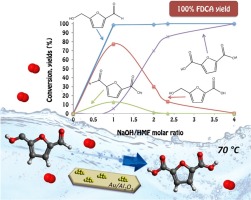
The catalytic activity of a simple Au/Al2O3 catalytic system prepared by the direct anionic exchange (DAE) method was evaluated in the selective 5-hydroxymethylfurfural (HMF) oxidation under mild conditions, using molecular oxygen as the oxidant. The influence of the HMF/NaOH ratio and reaction time on product yield and distribution were studied and discussed in detail. Extremely…

BixTiyOz-Fe multiphase systems with excellent photocatalytic performance in the visible

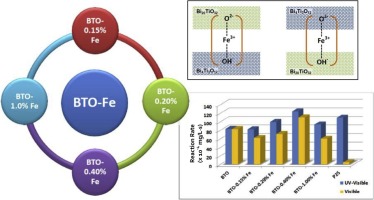
New photocatalysts based on bismuth titanates doped with iron with outstanding visible photocatalytic activity were prepared by a facile hydrothermal method followed by incipient wetness impregnation. The starting material was composed by three phases; majority of Bi20TiO32 closely interconnected to Bi4Ti3O12 and amorphous TiO2. Fe doping increased the already very high visible activity of the original material.…

Coupling of WO3 with anatase TiO2 sample with high {001} facet exposition: Effect on the photocatalytic properties

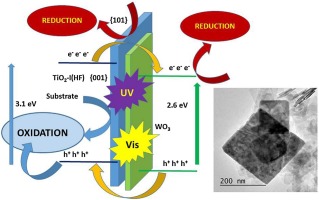
A highly faceted {001} TiO2 catalyst was hydrothermally synthesized by using Ti(IV)-isopropoxide precursor with aqueous HF addition. WO3 was synthesized by following a reported method. Coupled TiO2-WO3 samples were synthesized by adding the corresponding amount of WO3 to fluorinated TiO2 gel followed by a hydrothermal treatment. Additionally the synthesized systems were characterized by using X-ray powder diffraction (XRD), X-ray fluorescence spectrometry (XRF),…

ZnO and Pt-ZnO photocatalysts: Characterization and photocatalytic activity assessing by means of three substrates

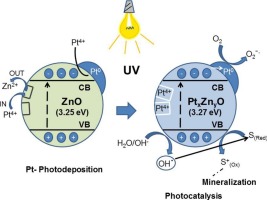
ZnO nanoparticles have been previously synthesized by a facile precipitation procedure by mixing aqueous solutions of Zn(II) acetate and dissolved Na2CO3 at pH ca. 7.0 without the addition of a template. The as-prepared ZnO material was anealed at 400 °C in air for 2 h. The Pt-ZnO catalysts (0.5 or 1.0 Pt wt.%) were obtained by photochemical deposition…

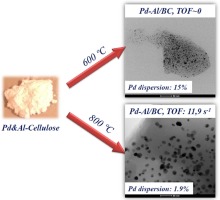
Synthesis of Pd-Al/biomorphic carbon catalysts using cellulose as carbon precursor

This work presents the results obtained with novel Pd and Pd-Al catalysts supported on carbon, which have been prepared using a biomorphic mineralization technique. The catalyst synthesis procedure includes a stage of thermal decomposition under reductive atmosphere of cellulose previously impregnated with the metallic precursors. We have studied the influence of the temperature and time…

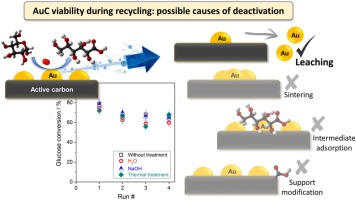
Gold catalyst recycling study in base-free glucose oxidation reaction

This work is devoted to the study of viability of immobilized gold colloids on carbon as catalysts for the base-free glucose oxidation reaction with a special emphasis made on catalysts’ recycling, operational life and possible routes for deactivation/reactivation under batch conditions. The observed catalytic behavior is related to all possible manners of deactivation, like gold…

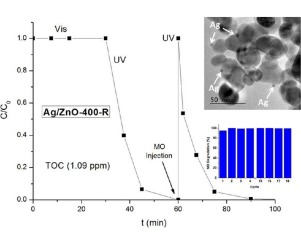
High UV-photocatalytic activity of ZnO and Ag/ZnO synthesized by a facile method

ZnO nanoparticles have been successfully synthesized by a facile precipitation procedure by mixing aqueous solutions of Zn(II) acetate and dissolved Na2CO3 at pH ca. 7.0 without template addition. We have investigated the effect of annealing temperature in the final surface and structural properties. Photocatalytic studies were performed using two selected substrates, Methyl Orange and Phenol, both…

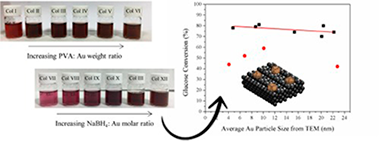
Gold catalysts screening in base-free aerobic oxidation of glucose to gluconic acid

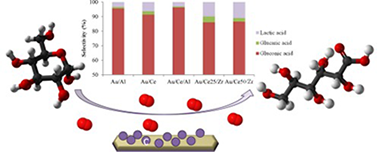
Base-free aerobic oxidation of glucose in presence of Au/Al2O3, Au/CeO2, Au/CeO2(20 wt%)/Al2O3, Au/CeO2(25 wt%)/ZrO2 and Au/CeO2(50 wt%)/ZrO2 catalysts using molecular oxygen at atmospheric pressure is studied. Within the whole series high conversion and selectivity to gluconic acid are observed after 18 h of reaction at 120 degrees C. The activity and especially the selectivity changes…

Selectivity control in oxidation of 1-tetradecanol on supported nano Au catalysts

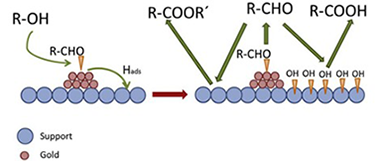
Selective oxidation of tetradecanol, a model higher fatty alcohol, on Au/CeO2-Al2O3 catalyst has been investigated to assess the factors that control selectivity. The analysis of the effect of operation conditions (temperature, run time and alcohol/metal (AIM) ratio) on catalytic performance revealed a quite complex reaction network, in which acid formation starts only after a certain…