Introducing structural colour in DSCs by using photonic crystals: interplay between conversion efficiency and optical properties

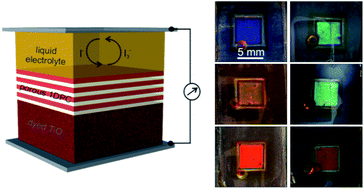
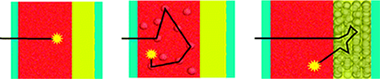
Herein we analyze experimentally the effect that introducing highly reflecting photonic crystals, operating at different spectral ranges, has on the conversion efficiency of dye sensitized solar cells. The interplay between structural colour and cell performance is discussed on the basis of the modified spectral response of the photogenerated current observed and the optical characterization of…

Novel approaches to flexible visible transparent hybrid films for ultraviolet protection

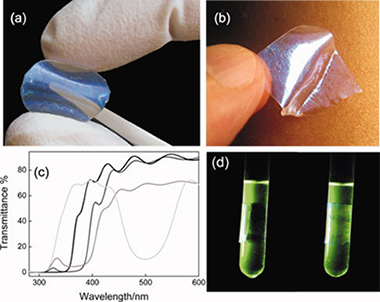
Herein, we present an overview of the most recent achievements and innovations regarding the development of flexible visible transparent films for selective ultraviolet (UV) shielding, with focus on those based on hybrid inorganic-organic materials. The main synthetic paths used nowadays to ensure a high degree of protection are reviewed. Polymers containing organic UV absorbing molecules,…

Effect of nanostructured electrode architecture and semiconductor deposition strategy on the photovoltaic performance of quantum dot sensitized solar cells

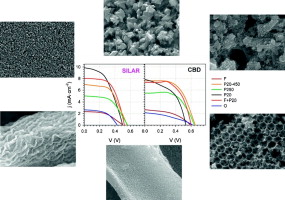
Here we analyze the effect of two relevant aspects related to cell preparation on quantum dot sensitized solar cells (QDSCs) performance: the architecture of the TiO 2 nanostructured electrode and the growth method of quantum dots (QD). Particular attention is given to the effect on the photovoltage, V oc, since this parameter conveys the main…

Integration of Gold Nanoparticles in Optical Resonators

The optical absorption of one-dimensional photonic crystal based resonators containing different types of gold nanoparticles is controllably modified by means of the interplay between planar optical cavity modes and localized surface plasmons. Spin-casting of metal oxide nanoparticle suspensions was used to build multilayered photonic structures that host (silica-coated) gold nanorods and spheres. Strong reinforcement and…

Effect of diffuse light scattering designs on the efficiency of dye solar cells: An integral optical and electrical description

Herein, we present an integral optical and electrical theoretical analysis of the effect of different diffuse light scattering designs on the performance of dye solar cells. Light harvesting efficiencies and electron generation functions extracted from optical numerical calculations based on a Monte Carlo approach are introduced in a standard electron diffusion model to obtain the…

Enhanced diffusion through porous nanoparticle optical multilayers

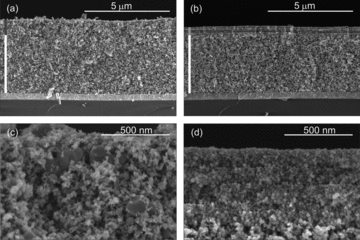
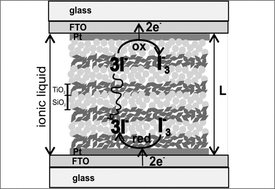
Herein we demonstrate improved mass transport through nano-particle one-dimensional photonic crystals of enhanced porosity. Analysis is made by impedance spectroscopy using iodine and ionic liquid based electrolytes and shows that newly created large pores and increased porosity improve the diffusion of species through the photonic crystal. This achievement is based on the use of a…

Láminas flexibles nanoestructuradas de polímeros inorgánicos para el control de la luz

El proyecto POLIGHT se centra en la integración de una serie de materiales inorgánicos nanoestructurados que poseen propiedades plasmónicas y/o fotónicas en películas poliméricas, los cuales constituyen un avance significativo con respecto al estado actual de la técnica en materiales fotónicos flexibles. Estas láminas, altamente adaptables, pueden actuar como espejos o filtros pasivos, selectivos en…

Control de la Absorcion y la Emisión Ópticas de Nanomateriales integrados en Estructuras Fotónicas Porosas Multifuncionales

En este proyecto se estudiarán las modificaciones que tienen lugar tanto en la absor-ción como en la emisión ópticas de nanomateriales de diverso tipo (nanopartículas dopadas con tierras raras, nanopartículas semiconductoras, nanopartículas metálicas, films de coloran-tes orgánicos de grosor nanométrico) por el hecho de encontrarse éstos formando parte de una estructura fotónica en la que…

Collective osmotic shock in ordered materials

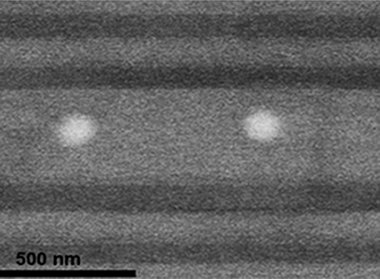
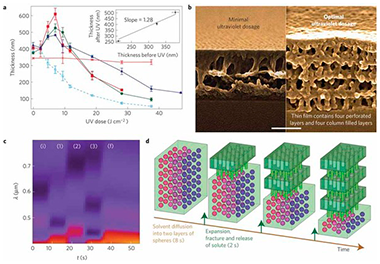
Osmotic shock in a vesicle or cell is the stress build-up and subsequent rupture of the phospholipid membrane that occurs when a relatively high concentration of salt is unable to cross the membrane and instead an inflow of water alleviates the salt concentration gradient. This is a well-known failure mechanism for cells and vesicles (for…