The Role of the Atmosphere on the Photophysics of Ligand-Free Lead-Halide Perovskite Nanocrystals

Lead halide perovskite (LHP) nanocrystals (NCs) have gained attention over the past decade due to their outstanding optoelectronic properties, making them a suitable material for efficient photovoltaic and light emitting devices. Due to its soft nature, these nanostructures undergo strong structural changes upon irradiation, where these light-induced processes are strongly influenced by the environment. Since…

Self-preserving ice layers on CO2 clathrate particles: Implications for Enceladus, Pluto, and similar ocean worlds

Context. Gas hydrates can be stabilised outside their window of thermodynamic stability by the formation of an ice layer – a phenomenon termed self-preservation. This can lead to a positive buoyancy for clathrate particles containing CO2 that would otherwise sink in the oceans of Enceladus, Pluto, and similar oceanic worlds.Aims. Here we investigate the implications…

Highly Versatile Upconverting Oxyfluoride-Based Nanophosphor Films

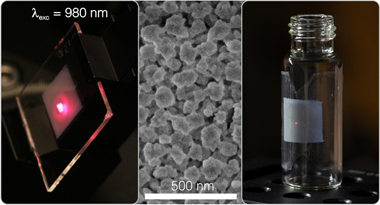
Fluoride-based compounds doped with rare-earth cations are the preferred choice of materials to achieve efficient upconversion, of interest for a plethora of applications ranging from bioimaging to energy harvesting. Herein, we demonstrate a simple route to fabricate bright upconverting films that are transparent, self-standing, flexible, and emit different colors. Starting from the solvothermal synthesis of…

Toward Commercialization of Stable Devices: An Overview on Encapsulation of Hybrid Organic-Inorganic Perovskite Solar Cells

Perovskite solar cells (PSCs) represent a promising technology for energy harvesting due to high power conversion efficiencies up to 26%, easy manufacturing, and convenient deposition techniques, leading to added advantages over other contemporary competitors. In order to promote this technology toward commercialization though, stability issues need to be addressed. Lately, many researchers have explored several…

PERovskite SEmiconductors for PHOtoNics

Funded by the Marie Skłodowska-Curie programme, PERSEPHONe is a coordinated training network that aims to equip young researchers with new skills and knowledge regarding the development of a novel photonics technological platform based on metal-halide perovskite semiconductors. These materials present unrivalled optoelectronic properties and can be engineered to achieve a large set of desirable functionalities…

The Complex Interplay of Lead Halide Perovskites with Their Surroundings

Photoexcitation of lead halide perovskites induces a restructuration of the material that simultaneously enhances its emission properties and triggers its degradation. These concomitant processes are strongly dependent on the surroundings of the perovskite, both while and after being processed, underlining the relevance the environment and the interfacial design have in the stability and performance of…

Impact of Tb4+ and morphology on the thermal evolution of Tb-doped TiO2 nanostructured hollow spheres and nanoparticles

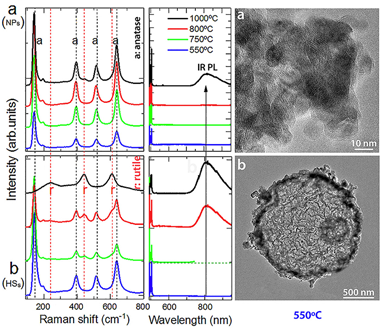
Tb-doped TiO2 hollow spheres (HSs) in the range 0.0-2.0 at.% have been synthesized by the first time to the best of our knowledge. The HSs are compared with nanoparticles (NPs) to evaluate the impact of morphology on their physicochemical and photoluminescence (PL) behavior upon increasing calcination temperature. After calcination at 550 degrees C, the particles…

Enhanced Directional Light Extraction from Patterned Rare-Earth Phosphor Films

The combination of light‐emitting diodes (LEDs) and rare earth (RE) phosphors as color‐converting layers comprises the basis of solid‐state lighting. Indeed, most LED lamps include a photoluminescent coating made of phosphor material, i.e., crystalline matrix suitably doped with RE elements, to produce white light from a blue or ultraviolet LED chip. Transparent phosphor‐based films constitute…