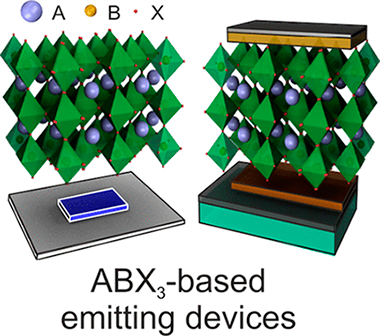
The Role of Metal Halide Perovskites in Next-Generation Lighting Devices

The development of smart illumination sources represents a central challenge for current technology. In this context, the quest for novel materials that enable efficient light generation is essential. Metal halide compounds with perovskite crystalline structure (ABX(3)) have gained tremendous interest in the last five years since they come as easy-to-prepare high performance semiconductors. Perovskite absorbers…

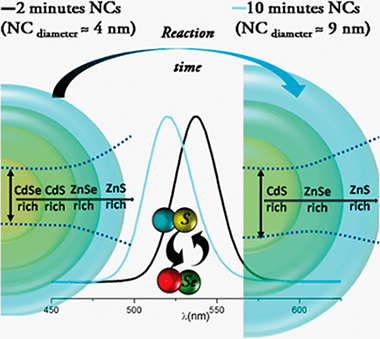
Unexpected Optical Blue Shift in Large Colloidal Quantum Dots by Anionic Migration and Exchange

Compositional changes taking place during the synthesis of alloyed CdSeZnS nanocrystals (NCs) allow shifting of the optical features to higher energy as the NCs grow. Under certain synthetic conditions, the effect of those changes on the surface/interface chemistry competes with and dominates over the conventional quantum confinement effect in growing NCs. These changes, identified by…

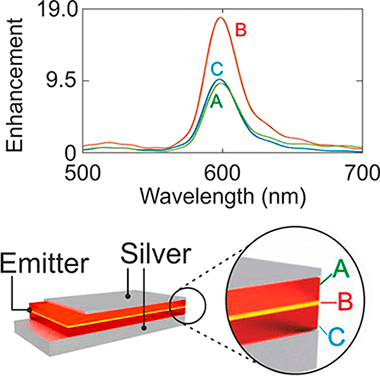
Absorption and Emission of Light in Optoelectronic Nanomaterials: The Role of the Local Optical Environment

Tailoring the interaction of electromagnetic radiation with matter is central to the development of optoelectronic devices. This becomes particularly relevant for a new generation of devices offering the possibility of solution processing with competitive efficiencies as well as new functionalities. These devices, containing novel materials such as inorganic colloidal quantum dots or hybrid organic-inorganic lead…

Flexible and Adaptable Light-Emitting Coatings for Arbitrary Metal Surfaces based on Optical Tamm Mode Coupling

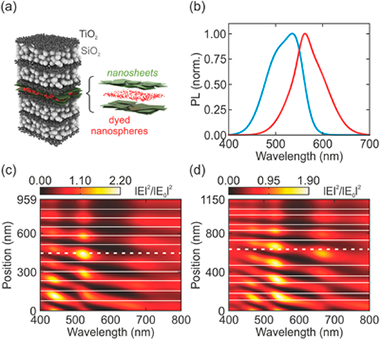
This study demonstrates a design that maximizes the power radiated into free space from a monolayer of nanoemitters embedded in a flexible distributed Bragg reflector conformably attached to a metal surface. This is achieved by positioning the light source at the precise depth within the multilayer for which optical Tamm states provide enhanced quantum yield…

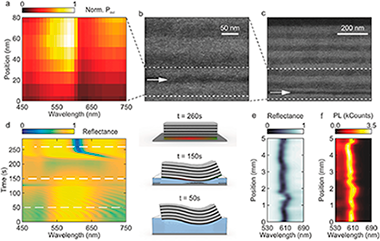
Fluorescent Humidity Sensors Based on Photonic Resonators

Among the different approaches to humidity sensing available, those based on fluorescent signals are gathering a great deal of attention due to their fast response and versatility of detection and design. So far, all proposals have focused on the use of luminescent probes whose emission is either triggered or inhibited by the presence of water…

Facile Synthesis of Hybrid Organic–Inorganic Perovskite Microcubes of Optical Quality Using Polar Antisolvents

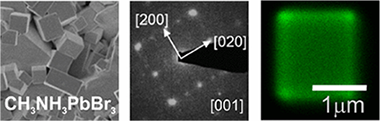
Herein, we demonstrate a synthetic approach producing highly crystalline methylammonium lead bromide perovskite (MAPbBr3) microcubes at room temperature by injecting a perovskite precursor solution into an environmentally friendly antisolvent (isopropyl alcohol). Confirmed by X-ray and electron diffraction, as well as electron microscopy, these MAPbBr3 microcubes are single crystals and have perfect cubic structure, with sizes varying…

Materials chemistry approaches to the control of the optical features of perovskite solar cells

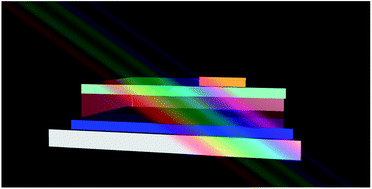
Perovskite solar cells have revolutionized the field of photovoltaics. Apart from their impressive photo-conversion efficiencies, the ease of their fabrication – principally when carried out by solution processing – has permitted addition of new functionalities to the photovoltaic cell. Some of these features are related to the optical properties. In this review, the different materials…