


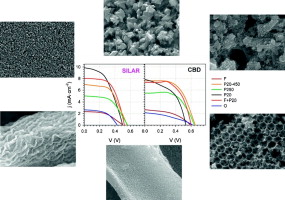
Here we analyze the effect of two relevant aspects related to cell preparation on quantum dot sensitized solar cells (QDSCs) performance: the architecture of the TiO 2 nanostructured electrode and the growth method of quantum dots (QD). Particular attention is given to the effect on the photovoltage, V oc, since this parameter conveys the main current limitation of QDSCs. We have analyzed electrodes directly sensitized with CdSe QDs grown by chemical bath deposition (CBD) and successive ionic layer adsorption and reaction (SILAR). We have carried out a systematic study comprising structural, optical, photophysical and photoelectrochemical characterization in order to correlate the material properties of the photoanodes with the functional performance of the manufactured QDSCs. The results show that the correspondence between photovoltaic conversion efficiency and the surface area of TiO 2 depends on the QDs deposition method. Higher V oc values are systematically obtained for TiO 2 morphologies with decreasing surface area and for cells using CBD growth method. This is systematically correlated to a higher recombination resistance of CBD sensitized electrodes. Electron injection kinetics from QDs into TiO 2 also depends on both the TiO 2 structure and the QDs deposition method, being systematically faster for CBD. Only for electrodes prepared with small TiO 2 nanoparticles SILAR method presents better performance than CBD, indicating that the small pore size disturb the CBD growth method. These results have important implications for the optimization of QDSCs.Elect