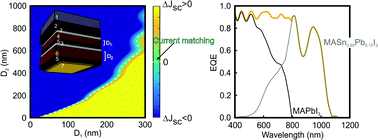
Optical analysis of CH3NH3SnxPb1−xI3 absorbers: a roadmap for perovskite-on-perovskite tandem solar cells

Organic–inorganic perovskite structures in which lead is substituted by tin are exceptional candidates for broadband light absorption. Herein we present a thorough analysis of the optical properties of CH3NH3SnxPb1−xI3 films, providing the field with definitive insights about the possibilities of these materials for perovskite solar cells of superior efficiency. We report a user’s guide based on…

Cellular Viscosity in Prokaryotes and Thermal Stability of Low Molecular Weight Biomolecules

Some low molecular weight biomolecules, i.e., NAD(P)H, are unstable at high temperatures. The use of these biomolecules by thermophilic microorganisms has been scarcely analyzed. Herein, NADH stability has been studied at different temperatures and viscosities. NADH decay increased at increasing temperatures. At increasing viscosities, NADH decay rates decreased. Thus, maintaining relatively high cellular viscosity in…

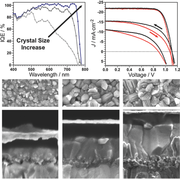
Unbroken Perovskite: Interplay of Morphology, Electro-optical Properties, and Ionic Movement

Hybrid organic-inorganic perovskite materials have risen up as leading components for light-harvesting applications. However, to date many questions are still open concerning the operation of perovskite solar cells (PSCs). A systematic analysis of the interplay among structural features, optoelectronic performance, and ionic movement behavior for FA(0.83)MA(0.17)Pb(I0.83Br0.17)(3) PSCs is presented, which yield high power conversion efficiencies…

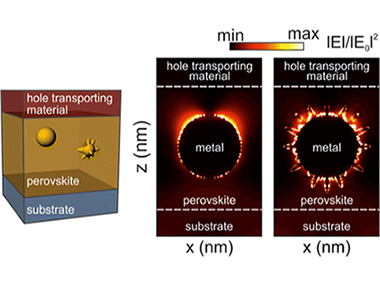
Plasmonic Nanoparticles as Light-Harvesting Enhancers in Perovskite Solar Cells: A User’s Guide

In this Perspective we discuss the implications of employing metal particles of different shape, size, and composition as absorption enhancers in methylammonium lead iodide perovskite solar cells, with the aim of establishing some guidelines for the future development of plasmonic resonance-based photovoltaic devices. Hybrid perovskites present an extraordinarily high absorption coefficient which, as we show…

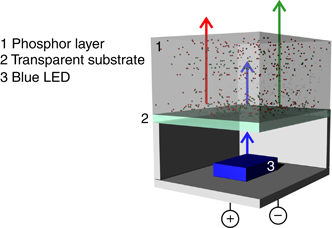
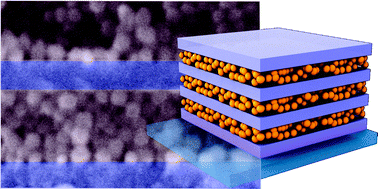
Metallic nanostructures for efficient LED lighting

Light-emitting diodes (LEDs) are driving a shift toward energy-efficient illumination. Nonetheless, modifying the emission intensities, colors and directionalities of LEDs in specific ways remains a challenge often tackled by incorporating secondary optical components. Metallic nanostructures supporting plasmonic resonances are an interesting alternative to this approach due to their strong light-matter interaction, which facilitates control over…

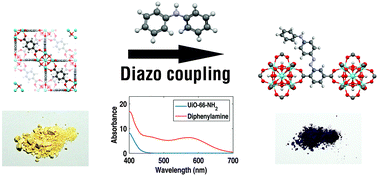
A panchromatic modification of the light absorption spectra of metal-organic frameworks

The optical absorption of UiO-66–NH2 MOF was red-shifted using a diazo-coupling reaction. The modifications performed with naphthols and aniline yielded reddish samples, and the modifications with diphenylaniline yielded dark violet ones. The photocatalytic activity of these modified MOFs was assessed for methylene blue degradation, showing a good performance relative to traditional TiO2. The degradation performance was…

Effect of temperature variations on equilibrium distances in levitating parallel dielectric plates interacting through Casimir forces

We study at thermal equilibrium the effect of temperature deviations around room temperature on the equilibrium distance (d(eq)) at which thin films made of Teflon, silica, or polystyrene immersed in glycerol levitate over a silicon substrate due to the balance of Casimir, gravity, and buoyancy forces. We find that the equilibrium nature (stable or unstable)…

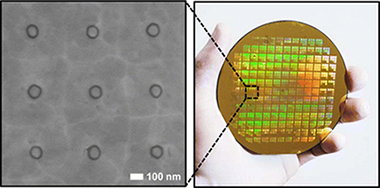
High-Throughput Fabrication of Resonant Metamaterials with Ultrasmall Coaxial Apertures via Atomic Layer Lithography

We combine atomic layer lithography and glancing angle ion polishing to create wafer-scale metamaterials composed of dense arrays of ultrasmall coaxial nanocavities in gold films. This new fabrication scheme makes it possible to shrink the diameter and increase the packing density of 2 nm-gap coaxial resonators, an extreme subwavelength structure first manufactured via atomic layer…

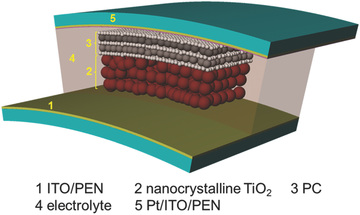
Integration of Photonic Crystals into Flexible Dye Solar Cells: A Route toward Bendable and Adaptable Optoelectronic Devices Displaying Structural Color and Enhanced Efficiency

Herein is presented what is believed to be the first example of integration of photonic structures in a flexible optoelectronic device. The resulting devices may be designed to display any color in the visible range and, simultaneously, present enhanced power conversion efficiency as a consequence of the increased light harvesting caused by the colored back…