Microstructural and chemical characterization of nanostructured Tialsin coatings with nanoscale resolution

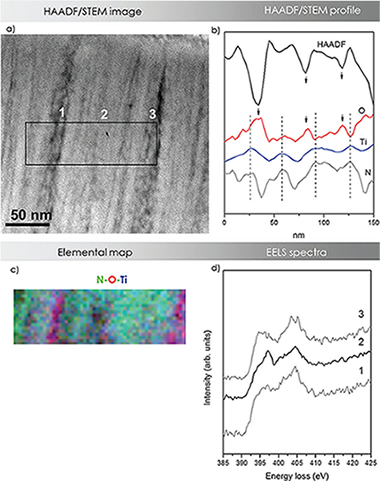
Nanoscale resolution electron microscopy analysis combined with ion beam assisted techniques are presented here, to give answers to full characterization of morphology, growth mode, phase formation, and compositional distribution in nanocomposite TiAlSiN coatings deposited under different energetic conditions. Samples were prepared by magnetron sputtering, and the effects of substrate temperature and bias were investigated. The…

Three-dimensional fabrication and characterisation of core-shell nano-columns using electron beam patterning of Ge-doped SiO2

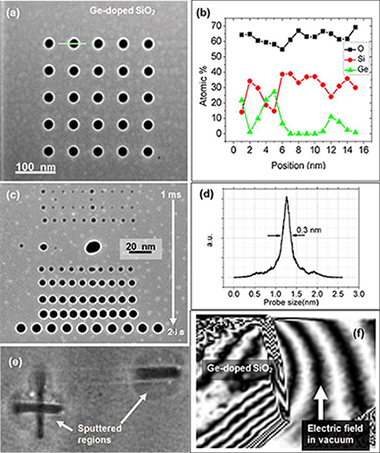
A focused electron beam in a scanning transmission electron microscope (STEM) is used to create arrays of core-shell structures in a specimen of amorphous SiO2 doped with Ge. The same electron microscope is then used to measure the changes that occurred in the specimen in three dimensions using electron tomography. The results show that transformations…

Development of multicomponent-multiphase materials based on (Ti,Ta,Nb)CxN1-x carbonitride solid solutions

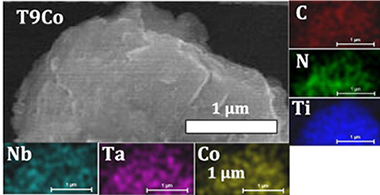
A set of powdered cermets based on (Ti,Ta,Nb)C xN 1-x carbonitride solid solutions were synthesized from mixtures of elemental powders by a mechanically induced self-sustaining reaction (MSR) method and subsequently sintered using a pressureless method. Differing nominal compositions of the hard phase were used, and the nature of the metallic-binder phase (Co, Ni, or Co-Ni)…

Roughness assessment and wetting behavior of fluorocarbon surfaces

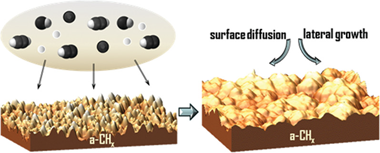
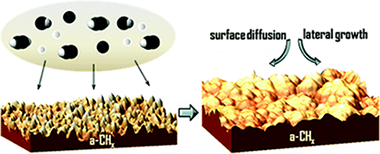
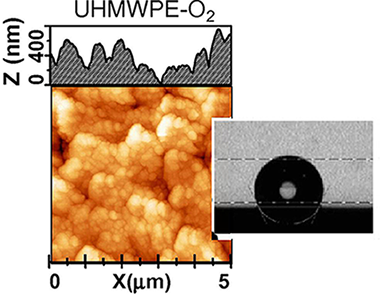
The wetting behavior of fluorocarbon materials has been studied with the aim of assessing the influence of the surface chemical composition and surface roughness on the water advancing and receding contact angles. Diamond like carbon and two fluorocarbon materials with different fluorine content have been prepared by plasma enhanced chemical vapor deposition and characterized by…

Interfacial characterization of silicon nitride/silicon nitride joints brazed using Cu-base active metal interlayers

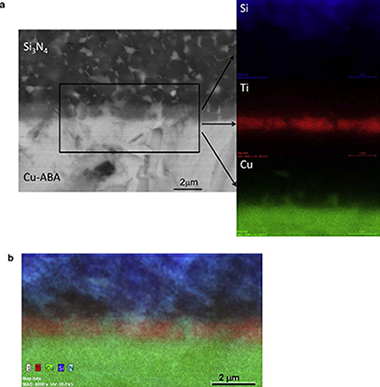
Silicon nitride/silicon nitride joints were vacuum brazed at 1317 K for 5 min and 30 min using ductile Cu-base active metal interlayers. The joints were characterized using scanning electron microscopy (SEM), energy dispersive spectroscopy (EDS), electron back scattered diffraction (EBSD), and transmission electron microscopy (TEM). An inhomogeneous Ti-rich reaction layer (similar to 2-3 mu m…

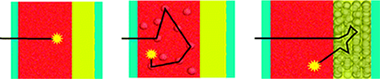
Effect of diffuse light scattering designs on the efficiency of dye solar cells: An integral optical and electrical description

Herein, we present an integral optical and electrical theoretical analysis of the effect of different diffuse light scattering designs on the performance of dye solar cells. Light harvesting efficiencies and electron generation functions extracted from optical numerical calculations based on a Monte Carlo approach are introduced in a standard electron diffusion model to obtain the…

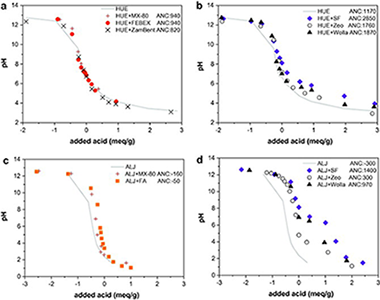
Remediation of metal-contaminated soils with the addition of materials – Part II: Leaching tests to evaluate the efficiency of materials in the remediation of contaminated soils

The effect of the addition of materials on the leaching pattern of As and metals (Cu, Zn, Ni, Pb, and Cd) in two contaminated soils was investigated. The examined materials included bentonites, silicates and industrial wastes, such as sugar foam, fly ashes and a material originated from the zeolitization of fly ash. Soil + material…