Thermal conductivity of high-porosity heavily doped biomorphic silicon carbide prepared from sapele wood biocarbon

The electrical resistivity and thermal conductivity of high-porosity (~52 vol %, channel-type pores) bio-SiC samples prepared from sapele wood biocarbon templates have been measured in the temperature range 5-300 K. An analysis has been made of the obtained results in comparison with the data for bio-SiC samples based on beech and eucalyptus, as well as…

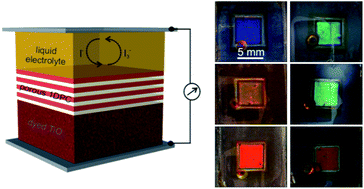
Introducing structural colour in DSCs by using photonic crystals: interplay between conversion efficiency and optical properties

Herein we analyze experimentally the effect that introducing highly reflecting photonic crystals, operating at different spectral ranges, has on the conversion efficiency of dye sensitized solar cells. The interplay between structural colour and cell performance is discussed on the basis of the modified spectral response of the photogenerated current observed and the optical characterization of…

Microstructural Characterization of Silver Nanoparticles for Bioimaging Applications

Silver nanoparticles are emerging as a powerful tool in bioimaging applications owing to their unique plasmonic properties i.e., extremely high molar extinction coefficients, resonant Rayleigh scattering and enhanced local electromagnetic fields. Through the optimization of these properties, by controlling composition, size, shape, and interparticle spacing of nanoparticles and their assemblies, highly enhanced local electromagnetic fields…

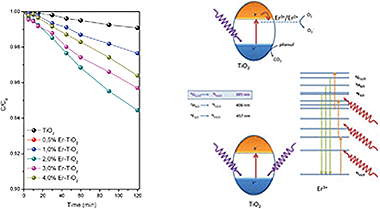
Evidence of upconversion luminescence contribution to the improved photoactivity of erbium doped TiO2 systems

Er3+–TiO2 synthesized by a surfactant free hydrothermal method exhibits good photoactivities under sun-like excitation for the degradation of phenol. The presence of Er3+ does not affect the structural and morphological features of the TiO2 significantly. The best photocatalytic performance was attained for the samples with 2 wt% of Er. Different photocatalytic runs indicated that the…

Charge collection properties of dye-sensitized solar cells based on 1-dimensional TiO2 porous nanostructures and ionic-liquid electrolytes

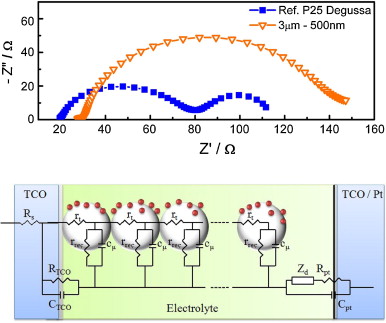
Dye solar cells consisting of mesoporous TiO 2 nanocolumnar films sensitized with a highly absorptive indoline dye were studied to estimate the charge collection efficiency provided by porous 1-dimensional (1-D) nanostructures in combination with viscous, fast-recombining electrolytes. The TiO 2 mesoporous nanostructured films were prepared by physical vapor deposition at glancing incidence (GLAD-PVD). Electrochemical Impedance…

Biomimetic mineralization of calcium phosphate on a functionalized porous silicon carbide biomaterial

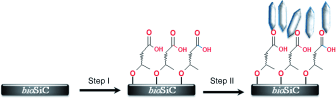
Porous biomorphic silicon carbide (bioSiC) is a structurally realistic, high-strength, and biocompatible material which is promising for application in load-bearing implants. The deposition of an osteoconductive coating is essential for further improvement of its integration with the surrounding tissue. A new strategy towards biomimetic calcium phosphate coatings on bioSiC is described. X-ray photoelectron spectroscopy (XPS)…

Thermal conductivity of high-porosity heavily doped biomorphic silicon carbide prepared from sapele wood biocarbon

The electrical resistivity and thermal conductivity of high-porosity (~52 vol %, channel-type pores) bio-SiC samples prepared from sapele wood biocarbon templates have been measured in the temperature range 5-300 K. An analysis has been made of the obtained results in comparison with the data for bio-SiC samples based on beech and eucalyptus, as well as…