Strong quantum confinement effects in SnS nanocrystals produced by ultrasound-assisted method

Nanocrystalline SnS powder has been prepared using tin chloride (SnCl2) as a tin ion source and sodium sulfide (Na2S) as a sulfur ion source with the help of ultrasound irradiation at room temperature. The as-synthesized SnS nanoparticles were quantitatively analyzed and characterized in terms of their morphological, structural, and optical properties. The detailed structural and…

New insights into the synergistic effect in bimetallic-boron catalysts for hydrogen generation: The Co–Ru–B system as a case study

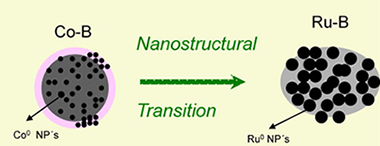
Catalysed sodium borohydride hydrolysis is a high-potential method to produce hydrogen for portable applications. Co–B catalysts are the most chosen because they are easily prepared, cheap and efficient. The addition of small amounts of Ru produces a significant enhancement in catalytic activity. In the present work a series of Co–Ru–B catalysts with variable Ru content…

Deactivation, reactivation and memory effect on Co–B catalyst for sodium borohydride hydrolysis operating in high conversion conditions

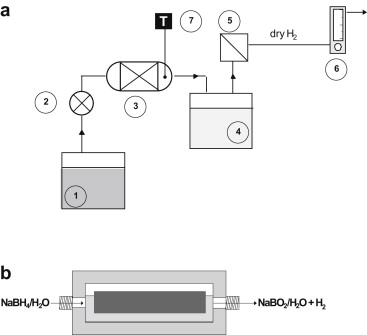
A system with a continuous reactor to produce hydrogen by sodium borohydride hydrolysis was designed and built. The purpose was to test a supported Co–B catalyst durability upon cycling and long life experiments in high conversion conditions. A Stainless Steel monolith was built and calcined to improve adherence. For comparison a Ru–B catalyst was tested…

Phase composition and tribomechanical properties of Ti-B-C nanocomposite coatings prepared by magnetron sputtering

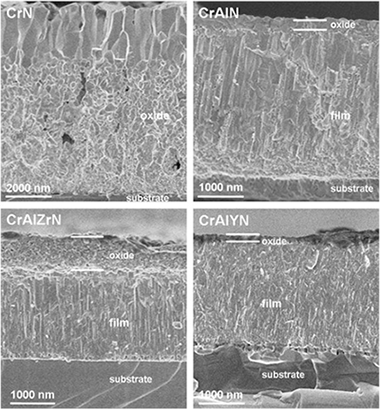
Protective nanocomposite coatings based on hard ceramic phases (TiC, TiB2) combined with amorphous carbon (a-C) are of interest because of their adequate balance between mechanical and tribological performances. In this work, Ti–B–C nanocomposite coatings were prepared by co-sputtering of graphite and TiB2 targets. Varying the discharge power ratio applied to the graphite and TiB2 targets…

Three-dimensional fabrication and characterisation of core-shell nano-columns using electron beam patterning of Ge-doped SiO2

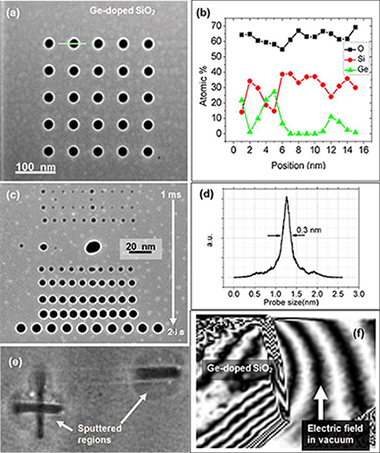
A focused electron beam in a scanning transmission electron microscope (STEM) is used to create arrays of core-shell structures in a specimen of amorphous SiO2 doped with Ge. The same electron microscope is then used to measure the changes that occurred in the specimen in three dimensions using electron tomography. The results show that transformations…

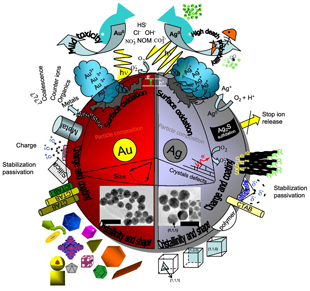
Nanoecotoxicity effects of engineered silver and gold nanoparticles in aquatic organisms

Engineered nanoparticles (ENPs) are increasingly being incorporated into commercial products. A better understanding is required of their environmental impacts in aquatic ecosystems. This review deals with the ecotoxicity effects of silver and gold ENPs (AgNPs and AuNPs) in aquatic organisms, and considers the means by which these ENPs enter aquatic environments, their aggregation status and…

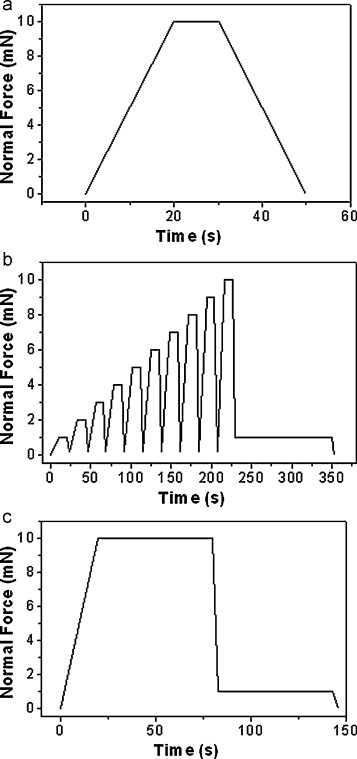
An international round-robin calibration protocol for nanoindentation measurements

Nanoindentation has become a common technique for measuring the hardness and elastic–plastic properties of materials, including coatings and thin films. In recent years, different nanoindenter instruments have been commercialised and used for this purpose. Each instrument is equipped with its own analysis software for the derivation of the hardness and reduced Young’s modulus from the…

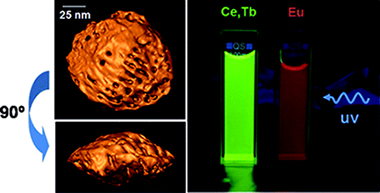
Microwave-Assisted Synthesis and Luminescence of Mesoporous REDoped YPO4 (RE = Eu, Ce, Tb, and Ce plus Tb) Nanophosphors with Lenticular Shape

Mesoporous tetragonal RE:YPO 4 nanophosphors (RE = Eu, Ce, Tb, and Ce + Tb) with a lenticular morphology, narrow size distribution, and high surface area have been prepared by an homogeneous precipitation procedure consisting of aging, at low temperature (80-120 °C) in a microwave oven, ethylene glycol solutions containing only yttrium acetylacetonate and phosphoric acid.…