Desarrollo de recubrimientos nanoestructurados protectores para su uso en condiciones extremas (NANOPROTEXT)

En muchas operaciones industriales, los componentes de las maquinas o piezas que están en contacto se hallan sometidos a condiciones extremas de carga, fricción, temperatura o atmósfera variable. La investigación dirige sus esfuerzos hacia al desarrollo de nuevos recubrimientos multicomponentes capaces de aumentar su eficiencia protegiendo su superficie contra el desgaste y la oxidación, que…

Nanoscale mechanically induced structural and electrical changes in Ge 2Sb 2Te 5 films

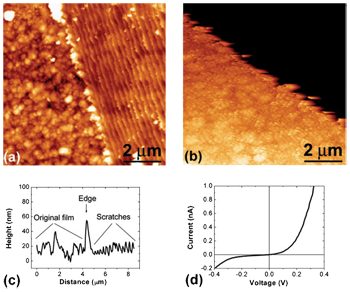
We demonstrate that the microstructure and electrical properties of Ge2Sb2Te5 films can be changed by a nanoscale mechanical process. Nanoscratching is used to define modified areas onto an as-deposited crystalline Ge2Sb2Te5 film. Scanning tunneling microscopy measurements show that the modified areas have a very low electrical conductivity. Micro-Raman measurements indicate that the mechanically induced microstructural…

Analysis and application of the theories that rationalize the crystalline structures of fluorite-related rare earth oxides

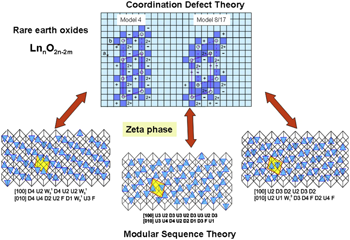
The main current theories dealing with the crystalline structures of the fluorite related rare earth oxides, including those corresponding to reduced oxides, one based on the distribution of the coordination defect inside the fluorite structure, and the other which proposes the establishment of modular sequences constituted by modules with fluorite structure, are presented and comparatively…

Influence of silver content on the tribomechanical behavior on Ag-TiCN bioactive coatings

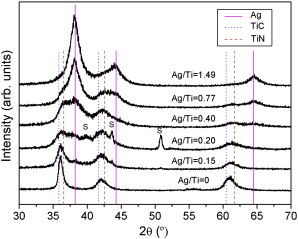
Surface modification of bulk materials used in biomedical applications has become an important prerequisite for better biocompatibility. In particular, to overcome the particle generation, low-wear coatings based on carbon (nitrogen) and containing antimicrobial elements such as silver are promising candidates. Thus, the present work explores the potentialities of silver-containing carbonitride-based (Ag-TiCN) thin films prepared by…

Electrical properties and applications of carbon based nanocomposite materials: An overview

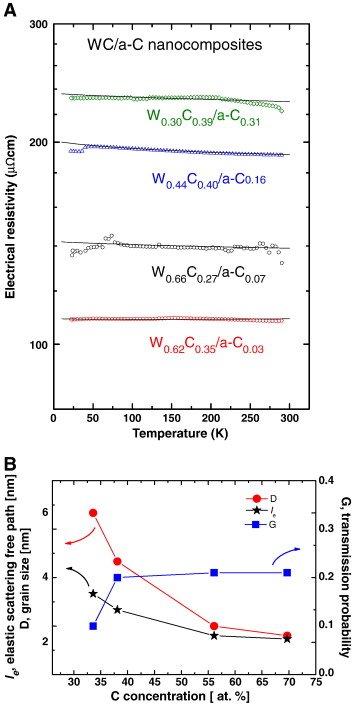
The allotropic forms of carbon (amorphous and polycrystalline graphite, carbon black, fullerenes, nanotubes, graphene) exhibit a large variety of charge transport properties which have been stimulating fundamental and applied research for the development of new devices based on micro and nano-sized electronic systems. Carbon based nanocomposites offer the possibility to improve the device performances and…

Laboratorio avanzado para el análisis de nanomateriales funcionales

El proyecto AL-NANOFUNC ha sido diseñado para poner en marcha en el Instituto de Ciencia de los Materiales de Sevilla (ICMS, CSIC-Univ.Sevilla, España) un laboratorio avanzado para el Nano-análisis de nuevos materiales funcionales. Las técnicas de Nanoscopía avanzada, basadas en equipos de microscopía electrónica de última generación, se dedicarán a la investigación de vanguardia en…

Recubrimientos nanoestructurados para operar en vacío

En este proyecto se desarrollarán recubrimientos nanoestructurados por la técnica de magnetron sputtering para lubricación de componentes mecánicos en aplicaciones aeroespa-ciales. Estos materiales deben proporcionar protección frente al desgaste y baja fricción cuando se usen en condiciones atmosféricas o vacío. Los sistemas elegidos para lograr este compromiso están formados por nanocristales de WC dispersados en…

Magnetic and fluorescent core-shell nanoparticles for ratiometric pH sensing

This paper describes the preparation of nanoparticles composed of a magnetic core surrounded by two successive silica shells embedding two fluorophores, showing uniform nanoparticle size (50-60nm in diameter) and shape, which allow ratiometric pH measurements in the pH range 5-8. Uncoated iron oxide magnetic nanoparticles (∼10nm in diameter) were formed by the coprecipitation reaction of…

Boron Compounds as Stabilizers of a Complex Microstructure in a Co-B-based Catalyst for NaBH4 Hydrolysis

Co-B-based materials are widely used as catalysts for hydrogen generation through sodium borohydride self-decomposition. In the mid 1990s, the aqueous and organic chemistry involved in Co-B synthesis and handling was studied. Nevertheless, the exact microstructure of these catalysts has remained unsolved. Herein we present an exhaustive study which shows a new and complete microstructural view…