A Nanoscale Characterization with Electron Microscopy of Multilayered CrAlYN Coatings: A Singular Functional Nanostructure

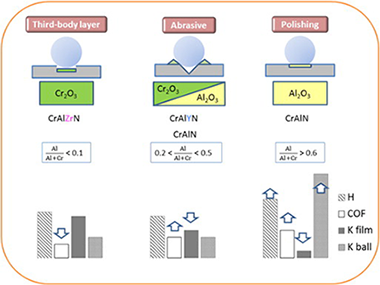
A combination of transmission electron microscopy techniques and spatially resolved microanalysis is used to investigate the nanostructure, constituting phases, and chemical elemental distribution in CrAlYN multilayered coatings. The location of the metallic elements and their chemical state are needed to understand their functional properties. Samples were prepared with variable Al (4-12 at%) and Y (2-5…

Comparative Study of Micro- and Nano-structured Coatings for High-Temperature Oxidation in Steam Atmospheres

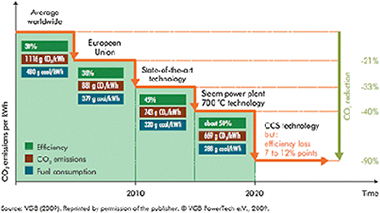
For many high-temperature applications, coatings are applied in order to protect structural materials against a wide range of different environments: oxidation, metal dusting, sulphidation, molten salts, steam, etc. The resistance achieved by the use of different kind of coatings, such as functionally graded material coatings, has been optimized with the latest designs. In the case…

Synthesis and tribological properties of WSex films prepared by magnetron sputtering

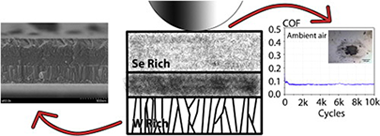
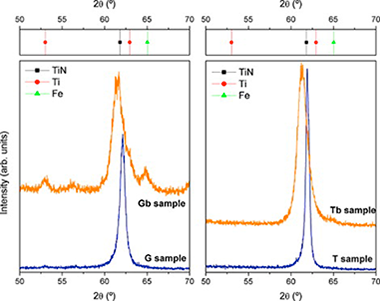
WSex films with variable Se/W ratio were deposited by non-reactive r.f. magnetron sputtering from WSe2 target changing the applied d.c. pulsed bias conditions and substrate temperature. The structural and chemical properties were measured by cross-sectional scanning electron microscopy (X-SEM), energy dispersive analysis (EDX), X-ray diffraction (XRD), Raman and X-ray photoelectron spectroscopy (XPS). The tribological properties…

Characterisation of Co@Fe3O4 core@shell nanoparticles using advanced electron microscopy

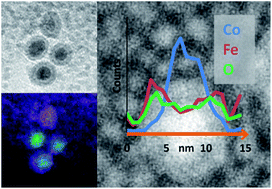
Cobalt nanoparticles were synthesised via the thermal decomposition of Co2(CO)8 and were coated in iron oxide using Fe(CO)5. While previous work focused on the subsequent thermal alloying of these nanoparticles, this study fully elucidates their composition and core@shell structure. State-of-the-art electron microscopy and statistical data processing enabled chemical mapping of individual particles through the acquisition…

Behaviour of Au-citrate nanoparticles in seawater and accumulation in bivalves at environmentally relevant concentrations

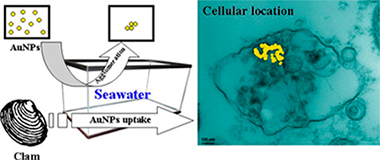
The degree of aggregation and/or coalescence of Au-citrate nanoparticles (AuNPs, mean size 21.5 ± 2.9 nm), after delivery in simulated seawater, are shown to be concentration-dependent. At low concentrations no coalescence and only limited aggregation of primary particles were found. Experiments were performed in which the marine bivalve (Ruditapes philippinarum) was exposed to AuNPs or…

Tribological properties of surface-modified Pd nanoparticles for electrical contacts

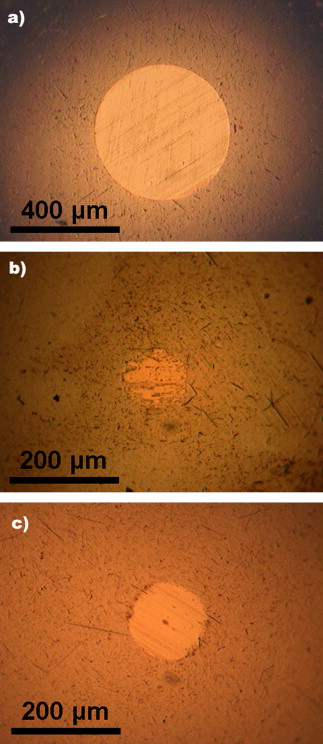
A fully comprehensive study of the tribological behavior of palladium nanoparticles (Pd NPs) capped by tetrabutylammonium chains using a ball-on-disk tribometer under different conditions of applied load, concentration, tribometer motion, linear speed and nature of the counterface is revised. A low concentration of NPs (2 wt%) in tetrabutylammonium acetate was found sufficient to improve the…