Combined reactive magnetron sputtering and plasma decomposition of non-volatile precursors to grow luminescent thin films

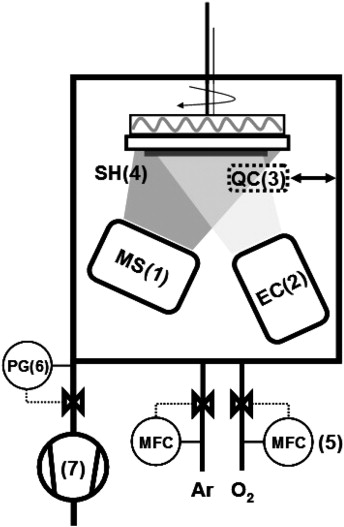
This paper reports a new procedure of the preparation of mixed oxide thin films that combines the traditional reactive magnetron sputtering deposition with the plasma activated decomposition of non-volatile precursors sublimated by means of an effusion cell. The possibilities of this new experimental procedure are illustrated with the preparation of luminescent thin films consisting of…

Steam reforming of methanol over supported Ni and Ni–Sn nanoparticles

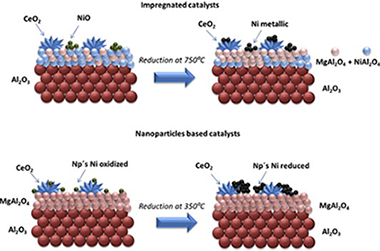
The influence of the synthesis method and Sn addition on Ni/CeO2–MgO–Al2O3 catalyst is correlated to its catalytic behavior in the reaction of methanol steam reforming. The catalysts prepared by impregnation method are compared to samples obtained by deposition of previously obtained nanoparticles by the polyol method. X-ray diffraction (XRD), specific surface area measurements and H2-temperature…

Structure and tribological properties of MoCN-Ag coatings in the temperature range of 25–700 °C

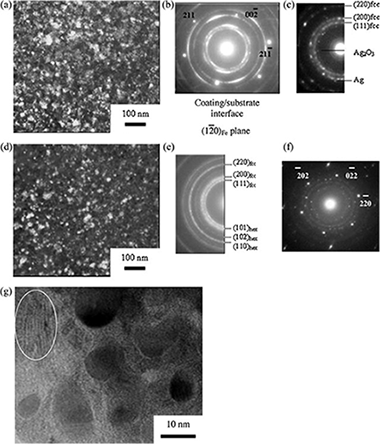
The preparation of hard coatings with low friction coefficient over a wide temperature range is still a challenge for the tribological community. The development of new nanocomposite materials consisting of different metal-ceramic phases, each of which exhibiting self-lubricating characteristics at different temperatures, may help to solve this problem. We report on the structure and tribological…

Effect of sintering time on the microstructure and mechanical properties of (Ti,Ta)(C,N)-based cermets

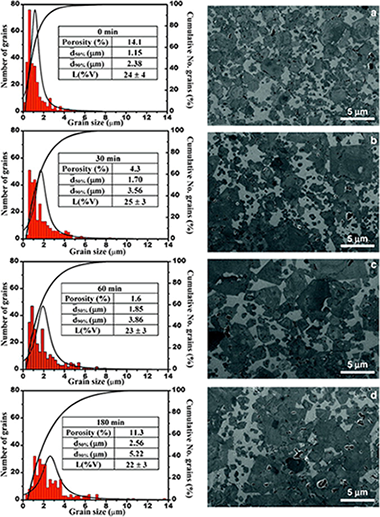
Complete solid-solution cermets based on titanium–tantalum carbonitride using a starting nominal composition with 80 wt.% of (Ti0.8Ta0.2)(C0.5N0.5) and 20 wt.% of Co were performed by pressure-less sintering at 1550 °C for different times (from 0 to 180 min) in an inert atmosphere. Chemical and phase analyses were conducted using X-ray diffraction (XRD), elemental analysis and…

Resonant Photocurrent Generation in Dye-Sensitized Periodically Nanostructured Photoconductors by Optical Field Confinement Effects

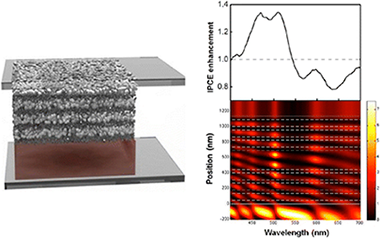
Herein we show experimental evidence of resonant photocurrent generation in dye-sensitized periodically nanostructured photoconductors, which is achieved by spectral matching of the sensitizer absorption band to different types of localized photon modes present in either periodic or broken symmetry structures. Results are explained in terms of the calculated spatial distribution of the electric field intensity…

Estudio in-situ de la transformación térmica de limonita utilizada como pigmento procedente de Perú

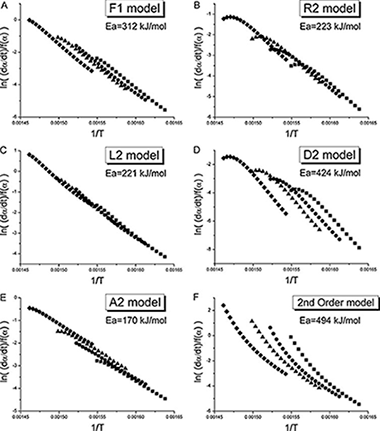
Se ha realizado un estudio cinético de la transformación térmica de limonita [FeO(OH).nH2O] mediante análisis térmico gravimétrico (TGA), termodifracción de rayos X (DRX) y espectroscopía μ-Raman. La muestra estudiada fue extraída de un yacimiento en el distrito de Taraco, provincia de Huancané, Región de Puno (Perú). La técnica DRX en polvo identificó la fase goetita…

Liquid-phase sintering of Ti(C,N)-based cermets. The effects of binder nature and content on the solubility and wettability of hard ceramic phases

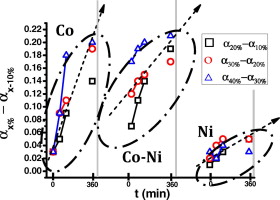
Different commercial TiC–TiN/Co/Ni mixtures were used as raw materials for Ti(C,N) cermets, and the effects of the sintering parameters (binder content, binder nature, sintering time and additives) on the final hard ceramic phase were studied at the sintering temperature of 1400 °C. When Co is used as the binder medium, it is possible to completely…

Solution Properties of the System ZrSiO4–HfSiO4: A Computational and Experimental Study

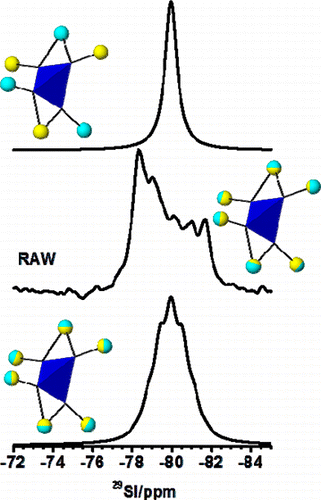
ZrSiO4 and HfSiO4 are of considerable interest because of their low thermal expansions, thermal conductivities, and the optical properties of HfSiO4. In addition, silicate phases of both are studied as model radioactive waste disposal materials. Previous first principles calculations reported near ideal mixing in the Zr1–xHfxSiO4 system, with a very weak propensity for phase separation.…