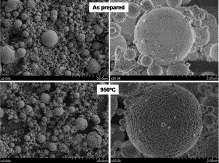
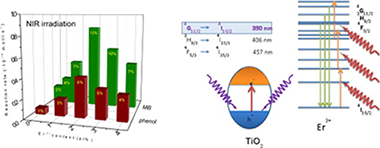
LaPO4:Er microspheres with high NIR luminescent quantum yield

Er-doped LaPO4 microspheres have been synthesized by spray pyrolysis and the near infrared (NIR) properties have been characterized. It has been found that, following an adequate post-annealing treatment, the emission properties are remarkably improved. The NIR luminescence intensity is highly enhanced and its decay time increases to a value almost coincident with the reported radiative…

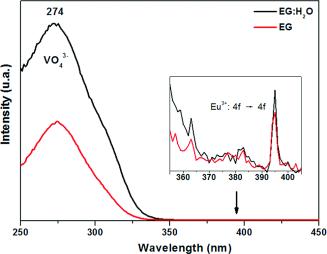
Solvent-Controlled Synthesis and Luminescence Properties of Uniform Eu:YVO4 Nanophosphors with Different Morphologies

A facile solvothermal route has been developed for the preparation of tetragonal europium-doped yttrium orthovanadate nanoparticles (Eu:YVO4) and is based on a homogeneous precipitation reaction at 120 °C from solutions of rare earth precursors (yttrium acetylacetonate and europium nitrate) and sodium orthovanadate in ethylene glycol or ethylene glycol/water mixtures. The nature of the solvent has…

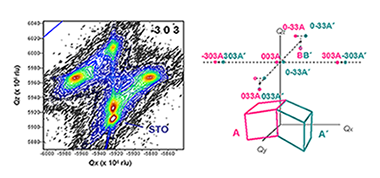
Competing Misfit Relaxation Mechanisms in Epitaxial Correlated Oxides

Strain engineering of functional properties in epitaxial thin films of strongly correlated oxides exhibiting octahedral-framework structures is hindered by the lack of adequate misfit relaxation models. Here we present unreported experimental evidence of a four-stage hierarchical development of octahedral-framework perturbations resulting from a progressive imbalance between electronic, elastic, and octahedral tilting energies in La0.7Sr0.3MnO3 epitaxial…

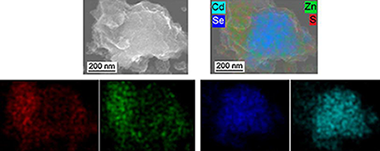
Cystine-capped CdSe@ZnS nanocomposites: mechanochemical synthesis, properties, and the role of capping agent

Cystine-capped CdSe@ZnS nanocomposites were synthesized mechanochemically with the aim to prepare a material which could be used in medicine for biosensing applications. Although synthesized CdSe@ZnS nanocomposites were capped with l-cysteine, cystine was formed from l-cysteine during the milling process. It was proven that water plays the key role in this oxidative transformation. The novel material…

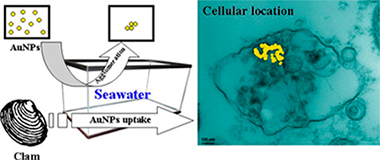
Behaviour of Au-citrate nanoparticles in seawater and accumulation in bivalves at environmentally relevant concentrations

The degree of aggregation and/or coalescence of Au-citrate nanoparticles (AuNPs, mean size 21.5 ± 2.9 nm), after delivery in simulated seawater, are shown to be concentration-dependent. At low concentrations no coalescence and only limited aggregation of primary particles were found. Experiments were performed in which the marine bivalve (Ruditapes philippinarum) was exposed to AuNPs or…

Hydration properties of synthetic high-charge micas saturated with different cations: An experimental approach

An understanding of the interaction mechanisms between exchangeable cations and layered silicates is of interest from both a basic and an applied point of view. Among 2:1 phyllosilicates, a new family of swelling high-charge synthetic micas has been shown to be potentially useful as decontaminant. However, the location of the interlayer cations, their acidity and…