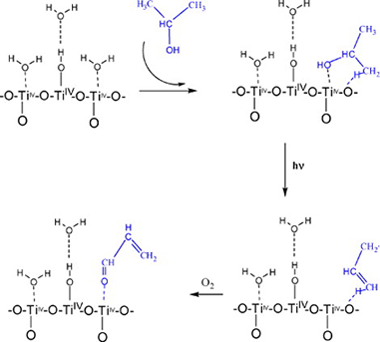
FTIR study of photocatalytic degradation of 2-propanol in gas phase with different TiO2 catalysts

The photocatalytic efficiency of different TiO 2 catalysts in the degradation of 2-propanol in gas phase has been studied. The obtained efficiencies have been compared considering the distribution of rutile-anatase phases, surface area, particle size, distribution of surface hydroxyl groups and Brönsted or Lewis acid centres. The catalysts used were Degussa-P25 (TiO 2-P25), Hombikat, Millennium,…

Gold/hydroxyapatite catalysts: Synthesis, characterization and catalytic activity to CO oxidation

This work reports the synthesis, characterization and catalytic activity for CO oxidation of gold catalysts supported on calcium hydroxyapatite. On both, the hydroxyapatite support and the gold-supported hydroxyapatite catalyst, the CO conversion shows a peak near 100% of conversion at room temperature. The generation of structural vacancies by interaction of CO with the solid provokes…

Functionalisation versus mineralisation of some N-heterocyclic compounds upon UV-illumination in the presence of un-doped and iron-doped TiO2 photocatalysts

Heterogeneous photocatalytic oxidation of some N-heterocyclic compounds (4-picoline, and 6- and 8-methylquinoline) in oxygenated solvents (water or acetonitrile), containing dispersed photocatalyst (un-doped or iron-doped titanium dioxide), was investigated under UV-illumination in a photochemical reactor. This work aimed to correlate experimental parameters such as structural aspects of the substrates, photocatalyst chemical and surface properties. illumination times,…

Functionalisation versus mineralisation of some N-heterocyclic compounds upon UV-illumination in the presence of un-doped and iron-doped TiO2 photocatalysts

Heterogeneous photocatalytic oxidation of some N-heterocyclic compounds (4-picoline, and 6- and 8-methylquinoline) in oxygenated solvents (water or acetonitrile), containing dispersed photocatalyst (un-doped or iron-doped titanium dioxide), was investigated under UV-illumination in a photochemical reactor. This work aimed to correlate experimental parameters such as structural aspects of the substrates, photocatalyst chemical and surface properties. illumination times,…

Study of the synergic effect of sulphate pre-treatment and platinisation on the highly improved photocatalytic activity of TiO2

An important improvement of the photocatalytic activity of sol-gel prepared TiO2 has been achieved by sulphate pre-treatment, calcination at high temperature and further platinisation of the samples. The presence of sulphuric acid clearly stabilised TiO2 surface area against sintering, maintaining at the same time anatase phase until higher calcination temperatures than in non-sulphated samples. Platinisation…

Modification of the photocatalytic activity of Pd/TiO2 and Zn/TiO2 systems through different oxidative and reductive calcination treatments

Two different solids consisting of Pd or Zn-containing titania systems (metal/titanium nominal ratio of 1%) were submitted to diverse oxidative and reductive calcination treatments and tested for gas-phase selective photooxidation of 2-propanol. As regards the Pd system, reduction at low temperature (<= 500 degrees) resulted in a gradual increase in catalytic activity which was ascribed…

Influence of amine template on the photoactivity of TiO2 nanoparticles obtained by hydrothermal treatment

TiO2 nanoparticles have been prepared by amine template-assisted sol-gel precipitation and further hydrothermal treatment. We have investigated the effect of different amines (hydrazine and triethylamine) in the final surface and structural properties. It has been stated that the different amounts of amine could act as an interesting template upon hydrothermal treatment. Further thermal treatment also…