Correlation study between photo-degradation and surface adsorption properties of phenol and methyl orange on TiO2 Vs platinum-supported TiO2

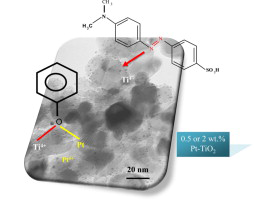
Adsorption of phenol and methyl orange on the surface of TiO2 and Pt–TiO2 photocatalysts was investigated by FT-IR spectroscopy. It was found that platinum plays an important role in the adsorption properties of the studied substrates on TiO2. Platinum deposits modified the phenol-photocatalyst interaction providing new adsorption sites on TiO2 surface. On Pt–TiO2 photocatalysts, phenol…

In situ XAS study of an improved natural phosphate catalyst for hydrogen production by reforming of methane

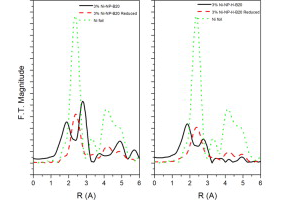
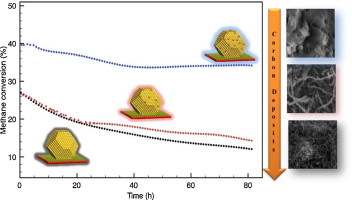
Some nickel catalysts supported on natural phosphate (NP) have been tested for the dry methane reforming reaction. Although the original impregnated 15%Ni/NP catalyst has no activity at all, the modification of the support by mechano-chemical and/or acid treatment strongly improved the catalytic performance, yielding a series of very active and stable catalysts. The chemical and…

Production of hydrogen by water photo-splitting over commercial and synthesised Au/TiO2 catalysts

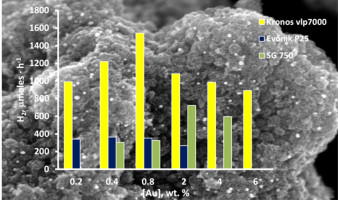
H2 production from methanol/water photo-splitting was compared using various commercial photocatalysts (Evonik P25 (P25), Hombikat UV-100 (HB) and Kronos vlp7000 (KR)) and others synthesised with a sol–gel-hydrothermal (HT) process and a sol–gel method followed by calcination (SG400 and SG750). All photocatalysts had been surface modified with Au at different concentrations, from 0.2 to 6.0 wt.%,…

Improved H2 production of Pt-TiO2/g-C3N4-MnOx composites by an efficient handling of photogenerated charge pairs

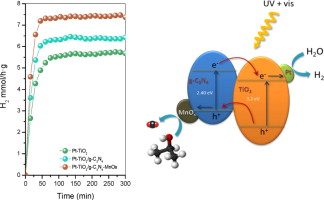
Pt-TiO2/g-C3N4-MnOx hybrid structures are synthesized by means of a simple impregnation method of Pt-TiO2 and g-C3N4-MnOx. From the wide structural and surface characterization we have stated that TiO2/g-C3N4 composites are formed by an effective covering of g-C3N4 by TiO2. The modification of composite by Pt and/or MnOx leads to improved photoactivities for phenol degradation reaction.…

In situ FT-IR study of the adsorption and photocatalytic oxidation of ethanol over sulfated and metallized TiO2

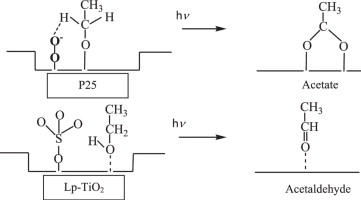
TiO2 Degussa P25, TiO2 prepared by sol–gel submitted to sulfation pre-treatment and some metallized catalysts obtained by photodeposition of Au or Pt over the sulfated TiO2, were evaluated in the reaction of ethanol photo-oxidation. FT-IR spectroscopy was used to investigate the surface features of the photocatalysts, identifying adsorbed species and following the evolution of intermediate…

Erbium doped TiO2–Bi2WO6 heterostructure with improved photocatalytic activity under sun-like irradiation

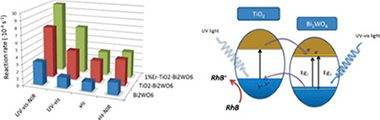
Erbium doped TiO2–Bi2WO6 have been synthesized by means of a surfactant free hydrothermal method having good photoactivities under sun-like excitation for the degradation of Rhodamine B. From the structural and morphological characterization it has been stated that the presence of Er3+ induces a progressive russelite cell contraction due to its incorporation in the Bi2WO6 lattice…

Preferential oxidation of CO in excess H2 over CuO/CeO2 catalysts: Characterization and performance as a function of the exposed face present in the CeO2 support

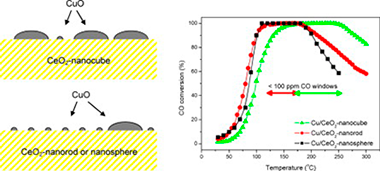
A series of oxidised copper-cerium nanostructured catalysts prepared by impregnation of copper over ceria supports synthesized by different methods (hydrothermal with varying preparation parameters, microemulsion/precipitation), in order to achieve different specific morphologies (nanocubes, nanorods and nanospheres), have been examined with respect to their catalytic properties for preferential oxidation of CO in excess H2 (CO-PROX). The…

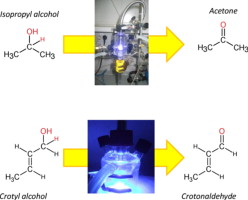
Selective photooxidation of alcohols as test reaction for photocatalytic activity

Twenty-four different titania-based systems synthesized through the sol–gel process varying the precursor (titanium isopropoxide or tetrachloride) and/or the ageing conditions (magnetic stirring, ultrasounds, microwave or reflux) were tested for liquid-phase selective photooxidation of 2-butenol (crotyl alcohol) to 2-butenal (crotonaldehyde) and gas-phase selective photooxidation of 2-propanol to acetone. To the best of our knowledge, the former…

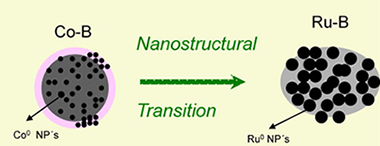
New insights into the synergistic effect in bimetallic-boron catalysts for hydrogen generation: The Co–Ru–B system as a case study

Catalysed sodium borohydride hydrolysis is a high-potential method to produce hydrogen for portable applications. Co–B catalysts are the most chosen because they are easily prepared, cheap and efficient. The addition of small amounts of Ru produces a significant enhancement in catalytic activity. In the present work a series of Co–Ru–B catalysts with variable Ru content…