


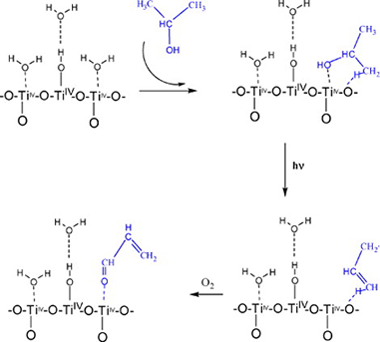
The photocatalytic efficiency of different TiO 2 catalysts in the degradation of 2-propanol in gas phase has been studied. The obtained efficiencies have been compared considering the distribution of rutile-anatase phases, surface area, particle size, distribution of surface hydroxyl groups and Brönsted or Lewis acid centres. The catalysts used were Degussa-P25 (TiO 2-P25), Hombikat, Millennium, Kemira and s/g-TiO 2, a catalyst prepared by a sol-gel method. The best photocatalytic behaviours have been obtained with those catalysts with higher surface area and the presence of only anatase phase (Hombikat and Millennium). A progressive deactivation of TiO 2-P25 and s/g-TiO 2 has been observed during the photocatalytic process. FTIR studies indicated that degradation mechanisms depended on the catalyst employed. Deactivation processes observed in TiO 2-P25 have been correlated with the formation of carboxylates.