


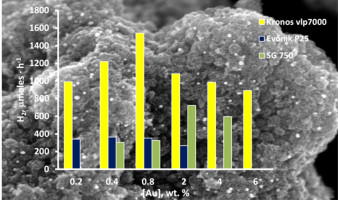
H2 production from methanol/water photo-splitting was compared using various commercial photocatalysts (Evonik P25 (P25), Hombikat UV-100 (HB) and Kronos vlp7000 (KR)) and others synthesised with a sol–gel-hydrothermal (HT) process and a sol–gel method followed by calcination (SG400 and SG750). All photocatalysts had been surface modified with Au at different concentrations, from 0.2 to 6.0 wt.%, using the photodeposition method. A complete characterisation study of the different photocatalysts was performed (BET, XRD, TEM, SEM-EDX, FTIR, UV–vis Reflectance Diffuse Spectra and aggregate size). The experiments were conducted for 3.5 h using 1 g L−1 of photocatalyst with methanol (25 vol.%) as sacrificial agent. In addition to H2 generation, production of the main intermediates, formaldehyde and formic acid, and of CO2 was also evaluated. The commercial photocatalyst KR at 0.8 wt.% Au had the highest H2 production of all the photocatalysts studied with 1542.9 μmol h−1. Of the photocatalysts synthesised by our group, SG750 at Au loading of 2.0 wt.% gave the highest H2 production of 723.1 μmol h−1. The SG750 photocatalyst at Au loading of 2.0 wt.% also had the highest H2 production yield per unit of surface area at 45.5 μmol g h−1 m−2.