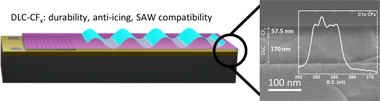
Acoustic Wave-Powered Durable Icephobic Duplex Coating Design with Superior Deicing Performance

Piezoelectric thin film-based surface acoustic wave (SAW) deicing technology has recently emerged as an attractive and energy-efficient alternative with direct applications across multiple industrial sectors. However, the generation of SAWs on piezoelectric thin films, such as ZnO, faces diverse challenges, including its low long-term stability and variable wetting properties upon exposure to UV radiation and…

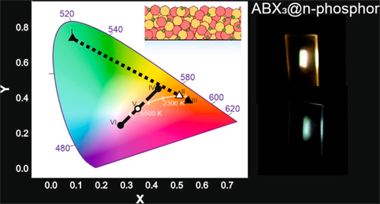
Tunable White Light Emission from Transparent Nanophosphor Films Embedding Perovskite Lead Halide Nanostructures

Exploring synergistic interactions between nanomaterials that can enhance their collective properties in ways that individual components cannot achieve represents an avenue for advancing beyond the current state of the art. This approach is particularly relevant in the context of ABX(3) nanocrystals, where pursuing cooperation could help to overcome current challenges associated with light generation. Transparent…

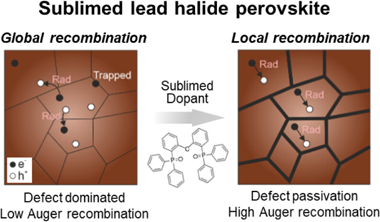
Strong Grain Boundary Passivation Effect of Coevaporated Dopants Enhances the Photoemission of Lead Halide Perovskites

Herein, we demonstrate that coevaporated dopants provide a means to passivate buried interfacial defects occurring at perovskite grain boundaries in evaporated perovskite thin films, thus giving rise to an enhanced photoluminescence. By means of an extensive photophysical characterization, we provide experimental evidence that indicate that the codopant acts mainly at the grain boundaries. They passivate…

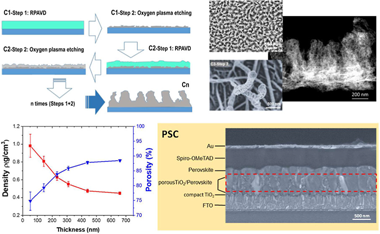
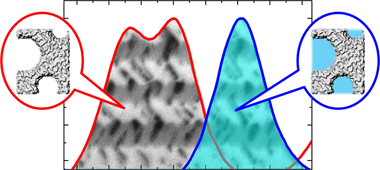
Conformal TiO2 Aerogel-Like Films by Plasma Deposition: from Omniphobic Antireflective Coatings to Perovskite Solar Cell Photoelectrodesh

The ability to control the porosity of thin oxide films is a key factor determining their properties. Despite the abundance of dry processes for synthesizing oxide porous layers, a high porosity range is typically achieved by spin-coating-based wet chemical methods. Besides, special techniques such as supercritical drying are required to replace the pore liquid with…

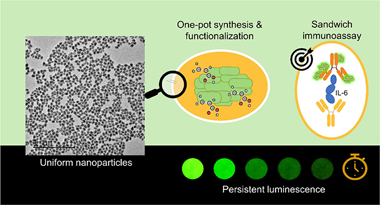
Persistent Luminescence Zn2GeO4:Mn2+Nanoparticles Functionalized with Polyacrylic Acid: One-Pot Synthesis and Biosensing Applications

Zinc germanate doped with Mn2+ (Zn2GeO4:Mn2+) is known to be a persistent luminescence green phosphor with potential applications in biosensing and bioimaging. Such applications demand nanoparticulated phosphors with a uniform shape and size, good dispersibility in aqueous media, high chemical stability, and surfacefunctionalization. These characteristics could be major bottlenecks and hence limit their practical applications.…

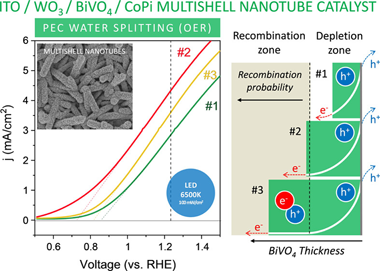
Photoelectrochemical Water Splitting with ITO/WO3/BiVO4/CoPi Multishell Nanotubes Enabled by a Vacuum and Plasma Soft- Template Synthesis

A common approach for the photoelectrochemical (PEC) splitting of water relies on the application of WO3 porous electrodes sensitized with BiVO4 acting as a visible photoanode semiconductor. In this work, we propose a new architecture of photoelectrodes consisting of supported multishell nanotubes (NTs) fabricated by a soft-template approach. These NTs are formed by a concentric…

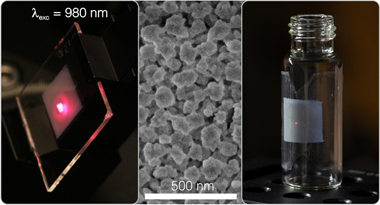
Highly Versatile Upconverting Oxyfluoride-Based Nanophosphor Films

Fluoride-based compounds doped with rare-earth cations are the preferred choice of materials to achieve efficient upconversion, of interest for a plethora of applications ranging from bioimaging to energy harvesting. Herein, we demonstrate a simple route to fabricate bright upconverting films that are transparent, self-standing, flexible, and emit different colors. Starting from the solvothermal synthesis of…

Form Birefringence in Resonant Transducers for the Selective Monitoring of VOCs under Ambient Conditions

In this work, we have developed a new kind of nanocolumnar birefringent Bragg microcavity (BBM) that, tailored by oblique angle deposition, behaves as a selective transducer of volatile organic compounds (VOCs). Unlike the atomic lattice origin of birefringence in anisotropic single crystals, in the BBM, it stems from an anisotropic self-organization at the nanoscale of…

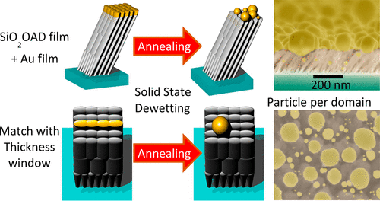
Solid-State Dewetting of Gold on Stochastically Periodic SiO2 Nanocolumns Prepared by Oblique Angle Deposition

Solid-state dewetting (SSD) on patterned substrates is a straightforward method for fabricating ordered arrays of metallic nanoparticles on surfaces. However, a drawback of this procedure is that the patterning of substrates usually requires time-consuming and expensive two-dimensional (2D) fabrication methods. Nanostructured thin films deposited by oblique angle deposition (OAD) present at the surface a form…