


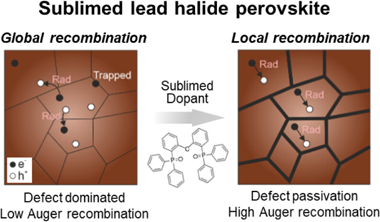
Herein, we demonstrate that coevaporated dopants provide a means to passivate buried interfacial defects occurring at perovskite grain boundaries in evaporated perovskite thin films, thus giving rise to an enhanced photoluminescence. By means of an extensive photophysical characterization, we provide experimental evidence that indicate that the codopant acts mainly at the grain boundaries. They passivate interfacial traps and prevent the formation of photoinduced deep traps. On the other hand, the presence of an excessive amount of organic dopant can lead to a barrier for carrier diffusion. Hence, the passivation process demands a proper balance between the two effects. Our analysis on the role of the dopant, performed under different excitation regimes, permits evaluation of the performance of the material under conditions more adapted to photovoltaic or light emitting applications. In this context, the approach taken herein provides a screening method to evaluate the suitability of a passivating strategy prior to its incorporation into a device.