Electrochemical Energy Storage Applications of CVD Grown Niobium Oxide Thin Films

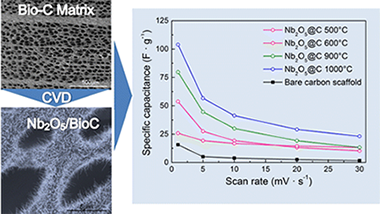
We report here on the controlled synthesis, characterization, and electrochemical properties of different polymorphs of niobium pentoxide grown by CVD of new single-source precursors. Nb2O5 films deposited at different temperatures showed systematic phase evolution from low-temperature tetragonal (TT-Nb2O5, T-Nb2O5) to high temperature monoclinic modifications (H–Nb2O5). Optimization of the precursor flux and substrate temperature enabled phase-selective growth…

Template-Assisted Hydrothermal Growth of Aligned Zinc Oxide Nanowires for Piezoelectric Energy Harvesting Applications

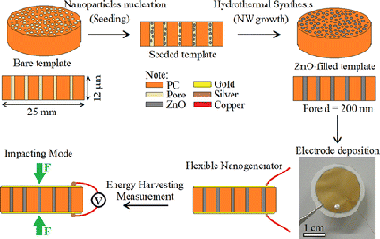
A flexible and robust piezoelectric nanogenerator (NG) based on a polymer-ceramic nanocomposite structure has been successfully fabricated via a cost-effective and scalable template assisted hydrothermal synthesis method. Vertically aligned arrays of dense and uniform zinc oxide (ZnO) nanowires (NWs) with high aspect ratio (diameter similar to 250 nm, length similar to 12 mu m) were…

Growth Assisted by Glancing Angle Deposition: A New Technique to Fabricate Highly Porous Anisotropic Thin Films

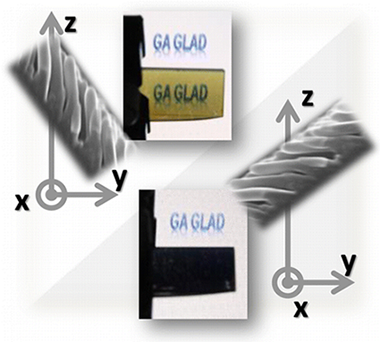
We report a new methodology based on glancing angle deposition (GLAD) of an organic molecule in combination with perpendicular growth of a second inorganic material. The resulting thin films retain a very well-defined tilted columnar microstructure characteristic of GLAD with the inorganic material embedded inside the columns. We refer to this new methodology as growth…

Fabrication of Optical Multi layer Devices from Porous Silicon Coatings with Closed Porosity by Magnetron Sputtering

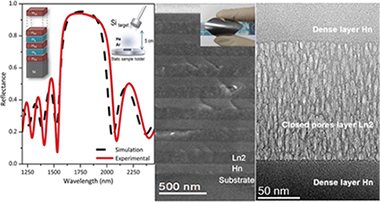
The fabrication of single-material photonic-multilayer devices is explored using a new methodology to produce porous silicon layers by magnetron sputtering. Our bottom-up methodology produces highly stable amorphous porous silicon films with a controlled refractive index using magnetron sputtering and incorporating a large amount of deposition gas inside the closed pores. The influence of the substrate…

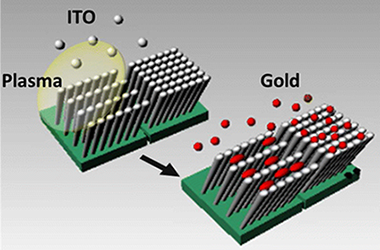
Anisotropic In-Plane Conductivity and Dichroic Gold Plasmon Resonance in Plasma-Assisted ITO Thin Films e-Beam-Evaporated at Oblique Angles

ITO thin films have been prepared by electron beam evaporation at oblique angles (OA), directly and while assisting their growth with a downstream plasma. The films microstructure, characterized by scanning electron microscopy, atomic force microscopy, and glancing incidence small-angle X-ray scattering, consisted of tilted and separated nanostructures. In the plasma assisted films, the tilting angle…

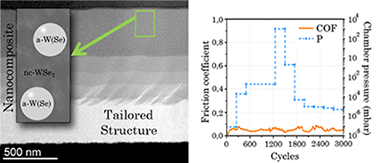
Self-lubricity of WSex nanocomposite coatings

Transition metal chalcogenides with lamellar structure are known for their use in tribological applications although limited to vacuum due to their easy degradation in the presence of oxygen and/or moisture. Here we present a tailored WSex coating with low friction (0.07) and low wear rates (3 × 10⁻⁷ mm3 Nm–1) even in ambient air. To understand the low…

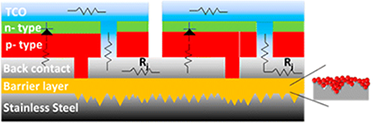
Ceramic Barrier Layers for Flexible Thin Film Solar Cells on Metallic Substrates: A Laboratory Scale Study for Process Optimization and Barrier Layer Properties

Flexible thin film solar cells are an alternative to both utility-scale and building integrated photovoltaic installations. The fabrication of these devices over electrically conducting low-cost foils requires the deposition of dielectric barrier layers to flatten the substrate surface, provide electrical isolation between the substrate and the device, and avoid the diffusion of metal impurities during…

Bending Induced Self-Organized Switchable Gratings on Polymeric Substrates

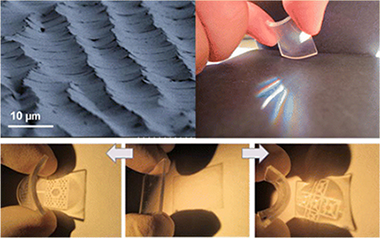
We present a straightforward procedure of self-surface patterning with potential applications as large area gratings, invisible labeling, optomechanical transducers, or smart windows. The methodology is based in the formation of parallel micrometric crack patterns when polydimethylsiloxane foils coated with tilted nanocolumnar SiO2 thin films are manually bent. The SiO2 thin films are grown by glancing…

Liquids Analysis with Optofluidic Bragg Microcavities

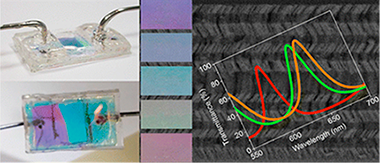
Porous Bragg microcavities formed by stacking a series of porous nanocolumnar layers with alternate low (SiO2) and high (TiO2) refractive index materials have been prepared by physical vapor deposition at glancing angles (GLAD). By strictly controlling the porosity and refractive index of the individual films, as well as the relative orientation of the nanocolumns from…