Additive-free superhard B4C with ultrafine-grained dense microstructures

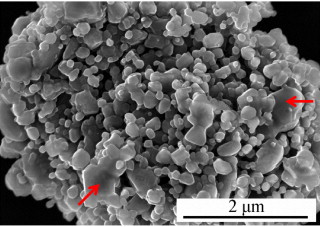
A unique combination of high-energy ball-milling, annealing, and spark-plasma sintering has been used to process superhard B4C ceramics with ultrafine-grained, dense microstructures from commercially available powders, without sintering additives. It was found that the ultrafine powder prepared by high-energy ball-milling is hardly at all sinterable, but that B2O3 removal by gentle annealing in Ar provides…

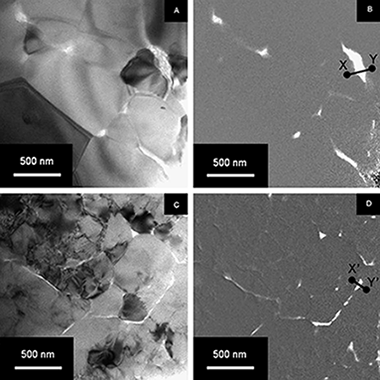
Processing of Swnt-Reinforced Yttria Stabilized Zirconia by Spark Plasma Sintering and Microstructure Characterization

Single wall carbon nanotube reinforced yttria stabilized zirconia ceramic materials have been obtained by means of spark plasma sintering technique. Single wall carbon nanotubes were treated in an acid solution before mixing with zirconia powders to obtain a uniform distribution of both powders. This method allows obtaining ceramic materials with a grain size between 200…

A first study of the high-temperature plasticity of ceria-doped zirconia polycrystals

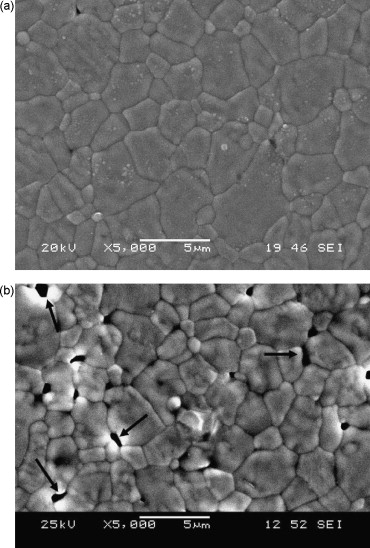
Ceria zirconia ceramic alloys were sintered by high-temperature annealing, considering several synthesis temperatures to obtain a full-dense ceria zirconia ceramic material using a temperature as low as possible. It was found that fully density is achieved at temperatures of 1450 degrees C. Monolithic specimens were crept under compression at high temperatures. The creep results fitted…

Segregation-induced grain boundary electrical potential in ionic oxide materials: A first principles model

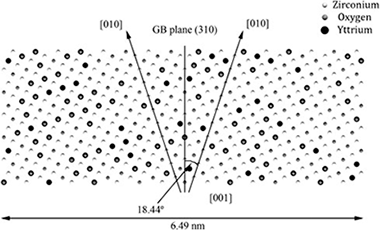
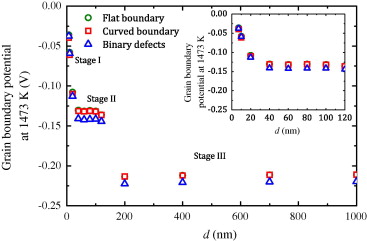
A first principles continuum analytical model for cationic segregation to the grain boundaries in complex ceramic oxides is presented. The model permits one to determine the electric charge density and the segregation-induced electric potential profiles through the grain and can be extrapolated to the range of nanostructured grain sizes. The theoretical predictions are compared with…

Microstructural Effects on the Creep Deformation of Alumina/Single-Wall Carbon Nanotubes Composites

The enhanced high-temperature creep resistance in alumina/single-wall carbon nanotubes (SWNTs) composites has been attributed to the unprecedented grain-boundary structure of these composites, where the SWNTs bundles segregated at the alumina grain boundaries partially impede grain-boundary sliding. In this study, the effect of SWNTs distributions at alumina grain boundaries on the creep behavior of alumina/SWNTs composites…

Microstructural Effects on the Creep Deformation of Alumina/Single-Wall Carbon Nanotubes Composites

The enhanced high-temperature creep resistance in alumina/single-wall carbon nanotubes (SWNTs) composites has been attributed to the unprecedented grain-boundary structure of these composites, where the SWNTs bundles segregated at the alumina grain boundaries partially impede grain-boundary sliding. In this study, the effect of SWNTs distributions at alumina grain boundaries on the creep behavior of alumina/SWNTs composites…