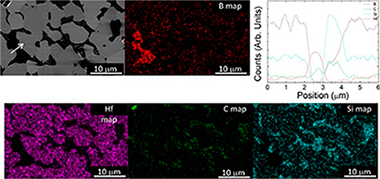
High temperature creep of 20 vol%. SiC-HfB2 UHTCs up to 2000 degrees C and the effect of La2O3 addition

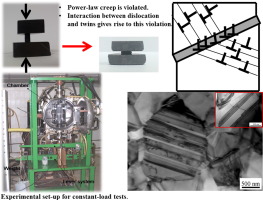
High temperature compressive creep of SiC-HfB2 UHTCs up to 2000 °C has been studied. Microstructural analysis after deformation reveals formation of new phases in the Hf-B-Si and Hf-B-Si-C systems, which are responsible for the poor creep resistance. RE oxide additions have a negative effect reducing the creep resistance of SiC-HfB2 UHTCs. A simplistic analysis for the required creep…

Carbon nanofibers replacing graphene oxide in ceramic composites as a reinforcing-phase: Is it feasible?

In recent years, the interest of graphene and graphene-oxide has increased extraordinarily due to the outstanding properties concurring in this material. In ceramic science, the possibility of combining excellent electrical conductivities together with an enhancement of mechanical properties has motivated the research in fabrication of graphene oxide-reinforced ceramic composites despite the intrinsic difficulties for sintering.…

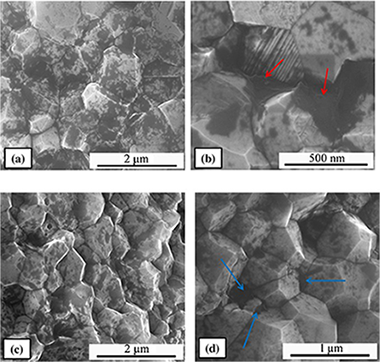
High-temperature creep of carbon nanofiber-reinforced and graphene oxide-reinforced alumina composites sintered by spark plasma sintering

Alumina (Al2O3) ceramic composites reinforced with either graphene oxide (GO) or carbon nanofibers (CNFs) were prepared using Spark Plasma Sintering. The effects of GO and CNFs on the microstructure and in consequence on their mechanical properties were investigated. The microstructure of the sintered materials have been characterized quantitatively prior to and after the creep experiments…

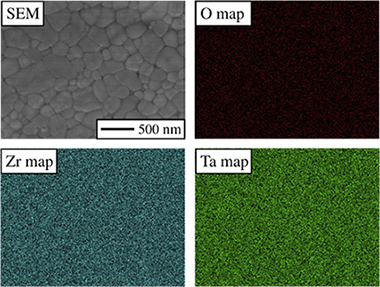
Ceramics of Ta-doping stabilized orthorhombic ZrO2 densified by spark plasma sintering and the effect of post-annealing in air

16 mol% Ta-doped ZrO2 powders were synthesized and densified by spark-plasma sintering (SPS) in vacuum, followed by post-SPS annealing in air, thus obtaining two ultrafine-grained ceramics consisting of Ta-doping stabilized orthorhombic ZrO2. The as-SPSed ceramic is black because it is actually a suboxide essentially with reduced cations and abundant oxygen vacancies, whereas the post-annealed ceramic…

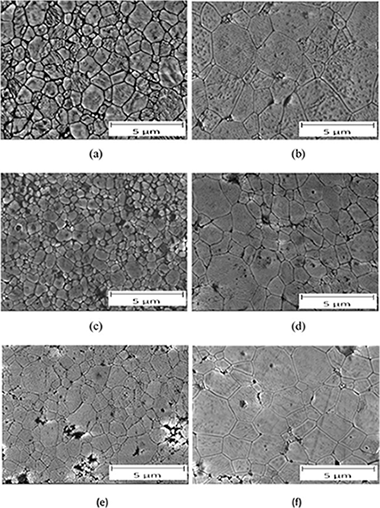
Spark plasma sintering of fine-grained alumina ceramics reinforced with alumina whiskers

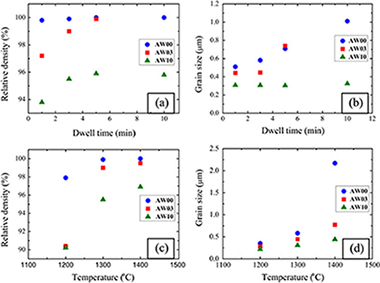
Densification of alumina whisker-reinforced alumina ceramics by spark plasma sintering (SPS) has been investigated with the aim of obtaining a fine-grained microstructure and also studying the effect of whisker addition on the room-temperature mechanical properties. It was found that whisker addition retards slightly the sinterability of alumina by whisker hindering of particle rearrangement. Besides, the…

Cerámicas Nanoestructuradas a Base de Carburo de Boro y Nitruro de Titanio para Aplicaciones Estructurales

El proyecto tiene como misión la fabricación de forma controlada científicamente de nanocerámicos de carburo de boro y de nitruro de titanio mediante la técnica de chispa de plasma. Se estudiarán las propiedades mecánicas de ambos cerámicos a temperatura ambiente (dureza y tenacidad), así como su plasticidad a alta temperatura (resistencia a la fluencia, deformación…

Procesado y caracterización microestructural, mecánica y eléctrica de compuestos cerámica-grafeno

En la actualidad se plantean interesantes expectativas sobre los compuestos cerámica/grafeno, propuestos para aplicaciones en catálisis, almacenamiento y conversión de energía, protección del medio ambiente y biotecnología. Pero aún se requieren importantes esfuerzos para dar respuesta a cuestiones abiertas. Hay que incidir en aspectos como la resistencia a la cizalla de las intercaras cerámica-grafeno -esencial…

High-temperature deformation of fully-dense fine-grained boron carbide ceramics: Experimental facts and modeling

Boron carbide ceramics are the hardest material in Nature after diamond and the cubic phase of boron nitride. Due to this fact, their room-temperature fracture properties are the object of intense research. Paradoxically, high-temperature deformation is essentially unknown, because very high temperatures and stresses are necessarily required and high-quality specimens have not been available until…

Ultra-fast and energy-efficient sintering of ceramics by electric current concentration

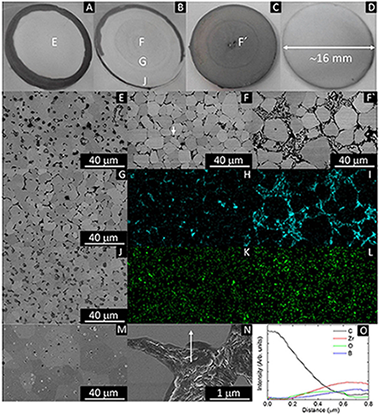
Electric current activated/assisted sintering (ECAS) techniques, such as electrical discharge sintering (EDS) or resistive sintering (RS), have been intensively investigated for longer than 50 years. In this work, a novel system including an electrically insulated graphite die for Spark Plasma Sintering (SPS) is described, which allows the sintering of any refractory ceramic material in less…

High temperature internal friction measurements of 3YTZP zirconia polycrystals. High temperature background and creep

This work focuses on the high-temperature mechanic properties of a 3 mol% yttria zirconia polycrystals (3YTZP), fabricated by hot-pressureless sintering. Systematic measurements of mechanical loss as a function of temperature and frequency were performed. An analytical method, based on the generalized Maxwell rheological model, has been used to analyze the high temperature internal friction background…