Neodymium doped lanthanide fluoride nanoparticles as contrast agents for luminescent bioimaging and X-ray computed tomography

The synthesis of uniform neodymium-doped lanthanum trifluoride nanoparticles with lenticular shape and a mean diameter around 45 nm by using a homogeneous precipitation method is reported. The luminescent properties of the synthesized samples in terms of their emission spectra and emission lifetime are analyzed as a function of the Nd content to find the optimum…

White, blue, violet, and other colors from Tm3+/Tb3+/Eu3+ co-doped polymorph SrAl2O4 films, deposited by ultrasonic spray pyrolysis technique

SrAl2O4: Tm3+, SrAl2O4: (Tb3+; Eu3+) and SrAl2O4: (Tb3+; Eu3+; Tm3+) films were deposited by ultrasonic spray pyrolysis (USP) method at 550. C and subsequently heat-treated at 800 degrees C. XRD characterization showed a monoclinic/hexagonal polymorph phase of these films with orthorhombic Sr4Al14O25 as secondary phase. The incorporation of Tm3+ ions in strontium aluminate host lattice…

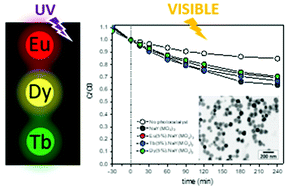
NaY(MoO4)(2)-based nanoparticles: synthesis, luminescence and photocatalytic properties

Abstract We report on a novel synthesis method, which produces NaY(MoO4)(2) nanoparticles having an almost spherical shape and hydrophilic character. The procedure is also suitable for the preparation of NaY(MoO4)(2)-based nanophosphors by doping this host with lanthanide cations (Eu3+, Tb3+ and Dy3+), which, under UV illumination, exhibit intense luminescence whose color is determined by the…

Nuevos agentes de contraste multimodales para el diagnóstico médico por imagen

El proyecto persigue el diseño de agentes de contraste (CAs) multimodales para el registro de imágenes para diagnóstico médico. Estos CAs estarán constituidos por nanopartículas inorgánicas basadas en lantánidos con propiedades adecuadas para el registro de imágenes mediante técnicas complementarias, con objeto de obtener información esencial para un diagnóstico médico más riguroso sin necesidad de…

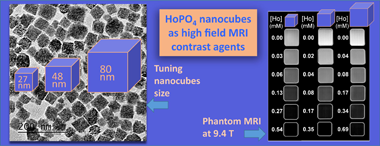
Holmium phosphate nanoparticles as negative contrast agents for high-field magnetic resonance imaging: Synthesis, magnetic relaxivity study and in vivo evaluation

The increasing use of high magnetic fields in magnetic resonance imaging (MRI) scanners demands new contrast agents, since those used in low field instruments are not effective at high fields. In this paper, we report the synthesis of a negative MRI contrast agent consisting of HoPO4 nanoparticles (NPs). Three different sizes (27 nm, 48 nm and 80 nm) of…

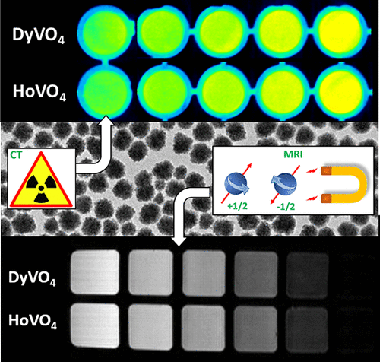
Dysprosium and Holmium Vanadate Nanoprobes as High-Performance Contrast Agents for High-Field Magnetic Resonance and Computed Tomography Imaging

We describe a wet chemical method for the synthesis of uniform and well-dispersed dysprosium vanadate (DyVO4) and holmium vanadate (HoVO4) nanoparticles with an almost spherical shape and a mean size of ∼60 nm and their functionalization with poly(acrylic acid). The transverse magnetic relaxivity of both systems at 9.4 T is analyzed on the basis of…

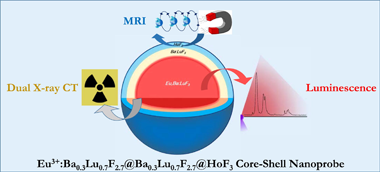
Design of a nanoprobe for high field magnetic resonance imaging, dual energy X-ray computed tomography and luminescent imaging

The combination of different bioimaging techniques, mainly in the field of oncology, allows circumventing the defects associated with the individual imaging modalities, thus providing a more reliable diagnosis. The development of multimodal endogenous probes that are simultaneously suitable for various imaging modalities, such as magnetic resonance imaging (MRI), X-ray computed tomography (CT) and luminescent imaging…

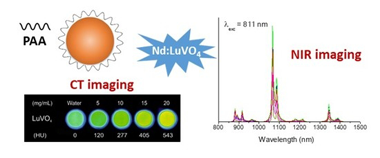
Bimodal Nd-Doped LuVO4 Nanoprobes Functionalized with Polyacrilic Acid for X-Ray Computed Tomography and NIR Luminescent Imaging

Uniform Nd3+-doped LuVO4 nanophosphors have been synthesized for the first time in literature by using a poliol-based method at 120 degrees C from Nd3+ and vanadate precursors. After optimizing the Nd doping level, these phosphors present intense luminescence in the near-infrared biological windows. The X-ray attenuation capacity of the optimum nanophosphor has been found to…