Encapsulation of Upconversion Nanoparticles in Periodic Mesoporous Organosilicas

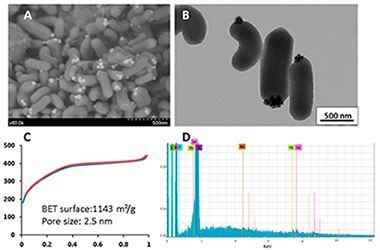
(1) Background: Nanomedicine has recently emerged as a promising field, particularly for cancer theranostics. In this context, nanoparticles designed for imaging and therapeutic applications are of interest. We, therefore, studied the encapsulation of upconverting nanoparticles in mesoporous organosilica nanoparticles. Indeed, mesoporous organosilica nanoparticles have been shown to be very efficient for drug delivery, and upconverting…

Monodisperse Gold Cuboctahedral Nanocrystals Directly Synthesized in Reverse Micelles: Preparation, Colloidal Dispersion in Organic Solvents and Water, Reversible Self-Assembly and Plasmonic Properties

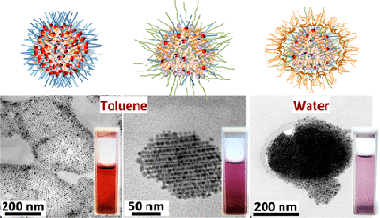
The synthesis of organic-solvent-dispersible gold nanoparticles in reverse micelles of didodecyldimethylammonium bromide (DDAB) is revisited in the present investigation. Some parameters of synthesis, specifically the reaction volume and the concentration of the reducing agent, were slightly modified obtaining directly monodisperse gold nanocrystals (AuNCs) without the need to use additional active surfactants or additional treatments such…

From structure to luminescence investigation of oxyfluoride transparent glasses and glass-ceramics doped with Eu3+/Dy3+ ions

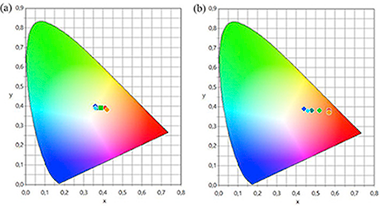
Glasses and glass-ceramics with nominal composition 73 TeO2- 4BaO-3Bi(2)O(3)-18SrF(2)-2RE(2)O(3) (where RE = Eu, Dy) have been synthesized by conventional melt-quenching technique and subsequent heat treatment at 370 degrees C for 24 h in air atmosphere. Various Eu3+ to Dy3+ molar ratio have been applied to investigate luminescence properties in both glass and glass-ceramic matrices. Especially,…

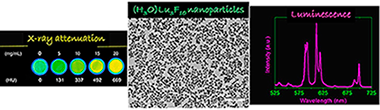
Synthesis, functionalization and properties of uniform europium-doped sodium lanthanum tungstate and molybdate (NaLa(XO4)(2), X = Mo,W) probes for luminescent and X-ray computed tomography bioimaging

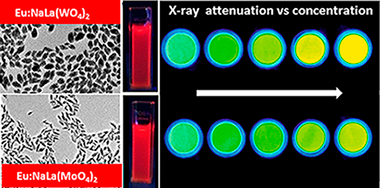
A one-pot simple procedure for the synthesis of uniform, ellipsoidal Eu3+-doped sodium lanthanum tungstate and molybdate (NaLa(XO4)(2), X = W, Mo) nanophosphors, functionalized with carboxylate groups, is described. The method is based on a homogeneous precipitation process at 120 degrees C from appropriate Na+ Ln(3+) and tungstate or molybdate precursors dissolved in ethylene glycol/water mixtures…

Nanopartículas multifuncionales para la obtención de bioimágenes mediante luminiscencia, resonancia magnética y tomografía computerizada de Rayos X

El proyecto persigue la preparación de nanoparticulas (NPs) multifuncionales con propiedades mejoradas y caracteristicas (tamaño, estabilidad coloidal y toxicidad) adecuadas que puedan emplearse en  más de una modalidad de obtención de imágenes de órganos, tejidos y células, cuyo principal interés radica en que mediante un único tipo de sonda se podría obtener información complementaria esencial…

Biocompatibility assessment of up-and down-converting nanoparticles: implications of interferences with in vitro assays

The safety assessment of nanoparticles (NPs) is crucial during their design and development for biomedicine. One of the prerequisite steps during this evaluation is in vitro testing that employs cell-based assays not always validated and well-adapted for NPs. Interferences with in vitro assays may arise due to the nano-related optical, oxidative, fluorescent, surface and catalytic properties of NPs. Thus,…

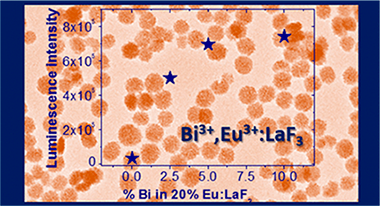
Enhancing Luminescence and X-ray Absorption Capacity of Eu3+:LaF3 Nanoparticles by Bi3+ Codoping

Bi3+ codoping has been proposed in this work with a twofold objective, namely, enhancing the luminescence emission of Eu3+:LaF3 nanoparticles (NPs) and increasing their X-ray attenuation capacity, with the purpose of obtaining a bimodal bioprobe for luminescence bioimaging and X-ray computed tomography. The synthesis method, reported here for the first time for LaF3 particles, allowed…