High-temperature creep of carbon nanofiber-reinforced and graphene oxide-reinforced alumina composites sintered by spark plasma sintering

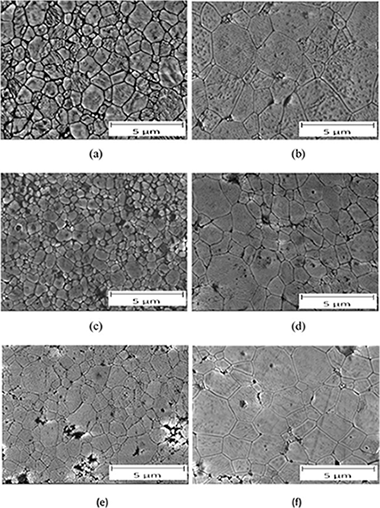
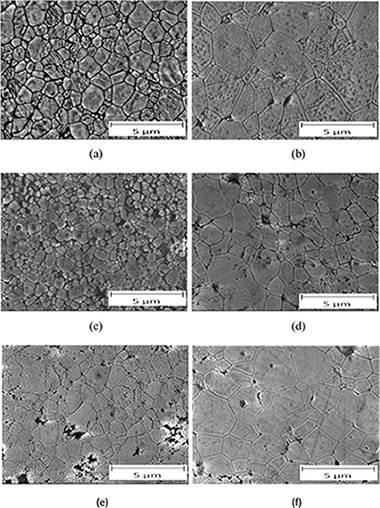
Alumina (Al2O3) ceramic composites reinforced with either graphene oxide (GO) or carbon nanofibers (CNFs) were prepared using Spark Plasma Sintering. The effects of GO and CNFs on the microstructure and in consequence on their mechanical properties were investigated. The microstructure of the sintered materials have been characterized quantitatively prior to and after the creep experiments…

The Oxy-CaL process: A novel CO2 capture system by integrating partial oxy-combustion with the Calcium-Looping process

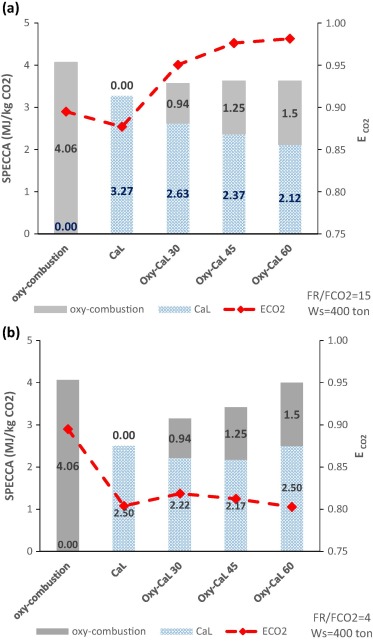
This paper proposes a novel CO2 capture technology from the integration of partial oxy-combustion and the Calcium -Looping capture process based on the multicycle carbonation/calcination of limestone derived CaO. The concentration of CO2 in the carbonator reactor is increased by means of partial oxycombustion, which enhances the multicycle CaO conversion according to thermogravimetric analysis results…

Analysis of Ni species formed on zeolites, mesoporous silica and alumina supports and their catalytic behavior in the dry reforming of methane

The presented investigation is focused on the analysis of Ni species formed on microporous (zeolites MFI and FAU) and mesoporous materials (Al-MCM- 41 and SBA-15) and alumina supports and their catalytic behavior in the dry reforming of methane. The paper lays emphasis on the relationship between the catalytic behavior of Ni-based catalysts and their textural/structural…

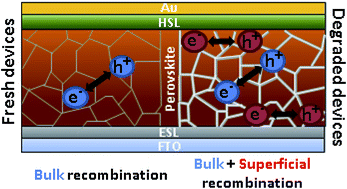
Impact of moisture on efficiency-determining electronic processes in perovskite solar cells

Moisture-induced degradation in perovskite solar cells was thoroughly investigated by structural (SEM, EDS, XRD and XPS) and device characterization (impedance and intensity modulated photocurrent spectroscopy) techniques. Both the influence of the perovskite composition and the nature of the hole selective material were analyzed. The degradation rate was found to be significantly slower for mixed perovskites…

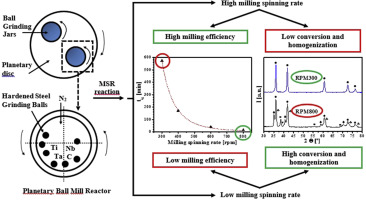
Effect of the impact energy on the chemical homogeneity of a (Ti,Ta,Nb)(C,N) solid solution obtained via a mechanically induced self-sustaining reaction

A titanium-tantalum-niobium carbonitride solid solution, (Ti,Ta,Nb)(C,N), was synthesised in a planetary mill via a mechanochemical process that involves a mechanically induced self-sustaining reaction (MSR) from stoichiometric Ti/Ta/Nb/C mixtures that are milled under a nitrogen atmosphere. The influence of the spinning rate of the planetary mill, which determines the impact energy of the milling process, on…

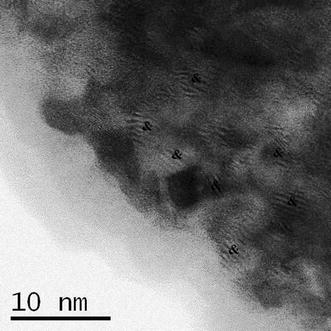
Non-isothermal Characterization of the Precipitation Hardening of a Cu-11Ni-19Zn-1Sn Alloy

The precipitation hardening of a Cu-11Ni-19Zn-1Sn alloy has been studied by means of Differential Scanning Calorimetry (DSC), High-Resolution Transmission Electron Microscopy (HRTEM), and hardness measurements. The calorimetric curves, in the range of temperatures analyzed, show the presence of one exothermic reaction followed by an endothermic one. The exothermic DSC peak is due to the segregation…

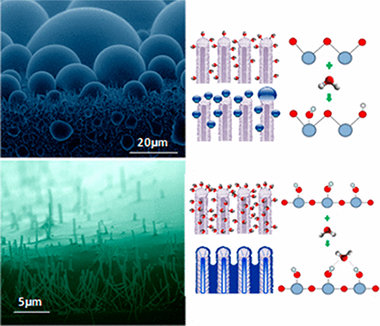
In Situ Determination of the Water Condensation Mechanisms on Superhydrophobic and Superhydrophilic Titanium Dioxide Nanotubes

One-dimensional (1D) nanostructured surfaces based on high-density arrays of nanowires and nanotubes of photoactive titanium dioxide (TiO2) present a tunable wetting behavior from superhydrophobic to superhydrophilic states. These situations are depicted in a reversible way by simply irradiating with ultraviolet light (superhydrophobic to superhydrophilic) and storage in dark. In this article, we combine in situ…

Non-enzymatic hydrogen peroxide detection at NiO nanoporous thin film-electrodes prepared by physical vapor deposition at oblique angles

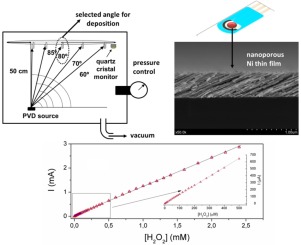
In this work we report a non-enzymatic sensor for hydrogen peroxide (H2O2) detection based on nanostructured nickel thin films prepared by physical vapor deposition at oblique angles. Porous thin films deposited on ITO substrates were characterized by X-ray diffraction analysis, scanning electron microcopy (SEMs), X-ray photoelectron spectroscopy (XPS) and electrochemical techniques such as Cyclic Voltammetry…