Simultaneous Production of CH4 and H-2 from Photocatalytic Reforming of Glucose Aqueous Solution on Sulfated Pd-TiO2 Catalysts

In this work, the simultaneous production of CH4 and H-2 from photocatalytic reforming of glucose aqueous solution on Pd-TiO2 catalysts under UV light irradiation by Light-Emitting Diodes (LED) was investigated. The Pd-TiO2 catalysts were prepared by the photodeposition method. The Pd content was in the range 0.5-2 wt% and a photodeposition time in the range…

Enhancement of stability and photoactivity of TiO2 coatings on annular glass reactors to remove emerging pollutants from waters

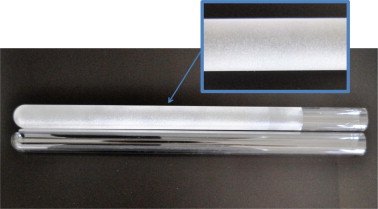
TiO2 coatings of highly photoactive lab-made titania were prepared on the outer wall of the inner tube of a glass tubular reactor by dip-coating method. The effect of decreasing the size of the aggregates to improve adhesion and photoactivity of the coatings to degrade phenol, diclofenac and isoproturon was also investigated. Chemical disaggregation of the TiO2 particles…

A comparative study of Bi2WO6, CeO2, and TiO2 as catalysts for selective photo-oxidation of alcohols to carbonyl compounds

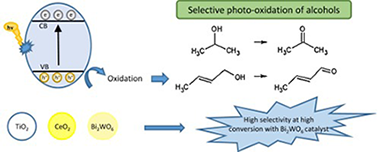
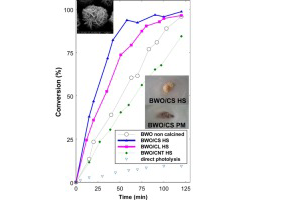
Several semiconductors based on ceria or bismuth tungstate were tested for selective oxidation of alcohols to carbonyl compounds in a search for photocatalysts more selective than TiO2. Gas-phase selective photo-oxidation of propan-2-ol to acetone and liquid-phase transformation of 2-buten-1-ol (crotyl alcohol) to 2-butenal (crotonaldehyde) were studied as test reactions. In both processes the highest selectivities…

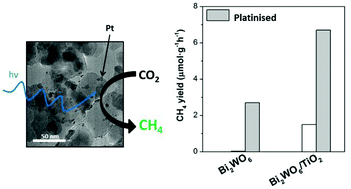
Photocatalytic propylene epoxidation on Bi2WO6-based photocatalysts

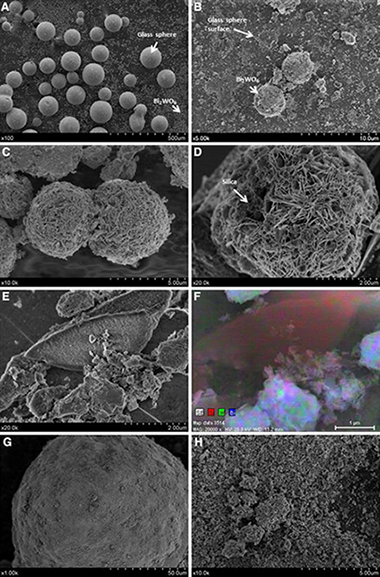
The photocatalytic epoxidation of propylene (PR) with molecular oxygen was carried out in a fluidized-bed reactor with several Bi2WO6-based materials under UV-A illumination. Three different photocatalysts were tested: one of single Bi2WO6 and two of coupled Bi2WO6-TiO2 heterostructures, thus showing that a mixed system of Bi2WO6 with commercial TiO2 Degussa-P25 leads to the best combination…

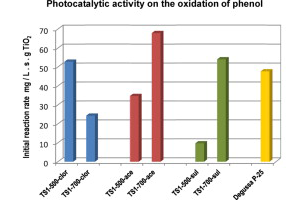
Effect of the type of acid used in the synthesis of titania–silica mixed oxides on their photocatalytic properties

TiO2–SiO2 mixed oxides were synthesized by the sol–gel technique using three different acids, i.e., acetic, sulfuric, or chlorhydric acid. Their photocatalytic behavior was evaluated on the phenol oxidation in liquid phase and correlated with the characterization results. It was found that the kind of acid used during the preparation strongly influences the phase composition and…

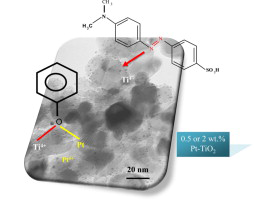
Correlation study between photo-degradation and surface adsorption properties of phenol and methyl orange on TiO2 Vs platinum-supported TiO2

Adsorption of phenol and methyl orange on the surface of TiO2 and Pt–TiO2 photocatalysts was investigated by FT-IR spectroscopy. It was found that platinum plays an important role in the adsorption properties of the studied substrates on TiO2. Platinum deposits modified the phenol-photocatalyst interaction providing new adsorption sites on TiO2 surface. On Pt–TiO2 photocatalysts, phenol…

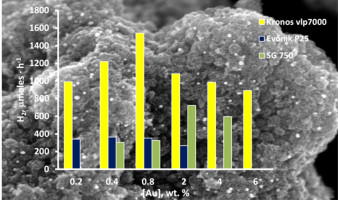
Production of hydrogen by water photo-splitting over commercial and synthesised Au/TiO2 catalysts

H2 production from methanol/water photo-splitting was compared using various commercial photocatalysts (Evonik P25 (P25), Hombikat UV-100 (HB) and Kronos vlp7000 (KR)) and others synthesised with a sol–gel-hydrothermal (HT) process and a sol–gel method followed by calcination (SG400 and SG750). All photocatalysts had been surface modified with Au at different concentrations, from 0.2 to 6.0 wt.%,…

Preparation of Titanium Oxide/Silicon Oxide (TiO2/SiO2) systems through the solvothermal method for applications in photocatalysis

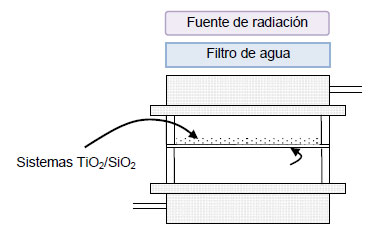
Sistemas Óxido de Titanio/Óxido de Silicio (TiO2/SiO2) fueron obtenidos por anclaje de TiO2 en SiO2. El fotocatalizador TiO2 se obtuvo por alcohólisis del TiCl4 con 2-propanol y posterior cristalización a presión autógena a 200 °C, excluyendo etapas de calcinación a altas temperaturas. Se emplearon diferentes relaciones SiO2/TiCl4 para determinar su influencia en la estabilidad, propiedades…