Absorption Enhancement in Organic-Inorganic Halide Perovskite Films with Embedded Plasmonic Gold Nanoparticles

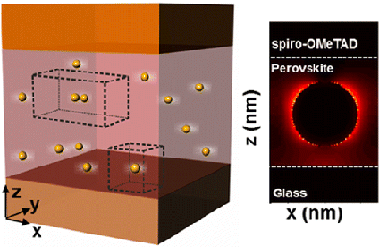
We report on the numerical analysis of solar absorption enhancement in organic-inorganic halide perovskite films embedding plasmonic gold nanoparticles. The effect of particle size and concentration is analyzed in realistic systems in which random particle location within the perovskite film and the eventual formation of dimers are also taken into account. We find a maximum…

Nanolevitation Phenomena in Real Plane-Parallel Systems Due to the Balance between Casimir and Gravity Forces

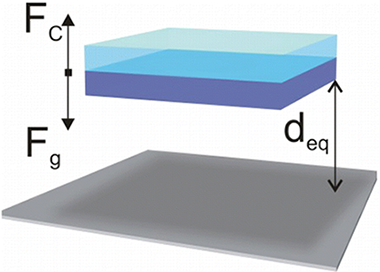
We report on the theoretical analysis of equilibrium distances in real plane-parallel systems under the influence of Casimir and gravity forces at thermal equilibrium. Due to the balance between these forces, thin films of Teflon, silica, or polystyrene in a single-layer configuration and immersed in glycerol stand over a silicon substrate at certain stable or…

Nanolevitation Phenomena in Real Plane-Parallel Systems Due to the Balance between Casimir and Gravity Forces

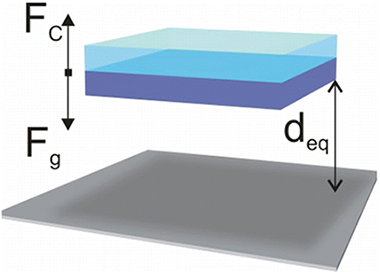
We report on the theoretical analysis of equilibrium distances in real plane-parallel systems under the influence of Casimir and gravity forces at thermal equilibrium. Due to the balance between these forces, thin films of Teflon, silica, or polystyrene in a single-layer configuration and immersed in glycerol stand over a silicon substrate at certain stable or…

«In Operando» X-ray Absorption Spectroscopy Analysis of Structural Changes During Electrochemical Cycling of WO3 and WxSiyOz Amorphous Electrochromic Thin Film Cathodes

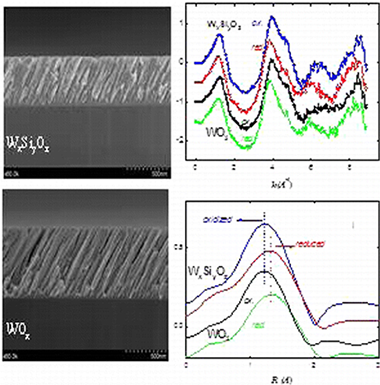
This work reports a X-ray absorption spectroscopy (XAS) study under in operando conditions of the structural and chemical changes undergone by WO3 and WxSiyOz thin films used as electrochromic cathodes. The electrochromic films were prepared by magnetron sputtering deposition at oblique angles and then characterized by a large variety of techniques. The voltammograms and chronoamperometric…

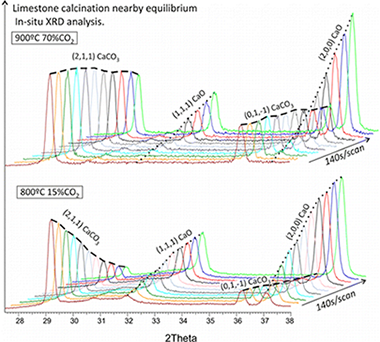
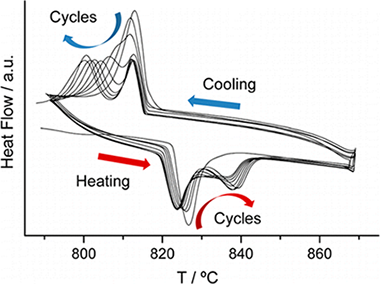
Limestone Calcination Nearby Equilibrium: Kinetics, CaO Crystal Structure, Sintering and Reactivity

In this work, we analyze limestone calcination kinetics at environmental conditions involving a CO2 partial pressure P close to the equilibrium pressure Peq by means of in situ X-ray diffraction (XRD) and thermogravimetric (TG) analyses. In contrast with previous empirical observations carried out mostly at conditions far from equilibrium (P/Peq ≪ 1), our results show that the decarbonation rate decreases as…

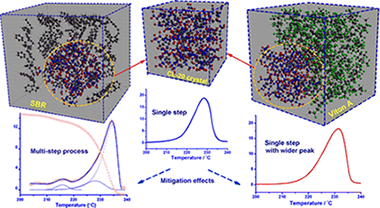
The Mitigation Effect of Synthetic Polymers on Initiation Reactivity of CL-20: Physical Models and Chemical Pathways of Thermolysis

In this paper, the thermal decomposition physical models of different CL-20 polymorph crystals and their polymer bonded explosives (PBXs) bonded by polymeric matrices using polyisobutylene (PIB), acrylonitrile butadiene rubber (NBR), styrene butadiene rubber (SBR), Viton A, and Fluorel binders are obtained and used to predict the temperature profiles of constant rate decomposition. The physical models…

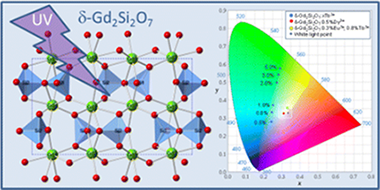
New Single-Phase, White-Light-Emitting Phosphors Based on delta-Gd2Si2O7 for Solid-State Lighting

Two new white-light (WL)-emitting phosphors (δ-Gd2Si2O7:Dy and δ-Gd2Si2O7:Eu,Tb) have been synthesized by the sol–gel method. The Gd-Ln3+ (Ln3+= Dy3+, Tb3+, Eu3+) energy-transfer band has been used to excite both phosphors, which provides an enhancement of the Ln3+ emissions. First, WL was generated from δ-Gd2Si2O7:xDy thanks to the particular ratio of the blue and yellow emissions…

The Flexible Surface Revisited: Adsorbate-Induced Reconstruction, Homocoupling, and Sonogashira Cross-Coupling on the Au(100) Surface

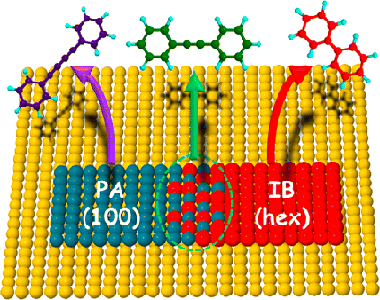
Phenylacetylene (PA) and iodobenzene (IB) are prototypical reactants in Sonogashira cross-coupling. Their adsorption behavior and reactivity on the Au(100) surface were studied by STM, temperature-programmed desorption and reaction, and DFT calculations that included the effect of dispersion forces. The two species exhibited very different behavior. Thus, even at 200 K, PA rearranged Au surface atoms…

Oxygen Optical Sensing in Gas and Liquids with Nanostructured ZnO Thin Films Based on Exciton Emission Detection

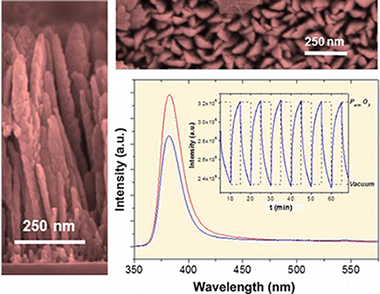
Transparent nanocolumnar porous ZnO thin films have been prepared by plasma-enhanced chemical vapor deposition. By controlling the H-2/O-2 ratio in the plasma gas, the deposition conditions were optimized to obtain an intense exciton emission at around 381 nm and virtually no luminescence in the visible region associated with electronic states in the gap. The intensity…