Crystal Structure and Luminescent Properties of Eu3+-Doped A-La2Si2O7 Tetragonal Phase Stabilized by Spray Pyrolysis Synthesis

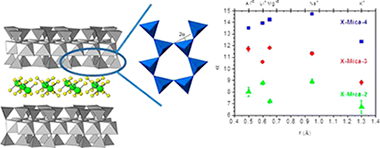
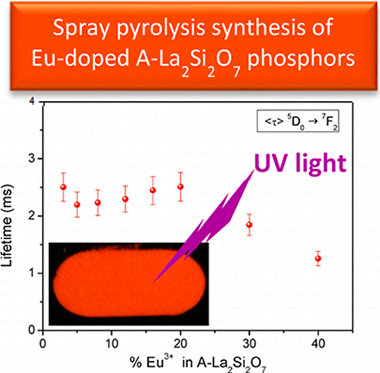
Pure A-La2Si2O7 powder has been synthesized through a spray pyrolysis method followed by calcination at 1100 degrees C for 15 h. The crystallographic structure, refined from the synchrotron powder diffraction pattern of the sample, showed tetragonal symmetry with space group P4(1), a = 6.83565(1) angstrom, and c = 24.84133(1) angstrom. The Si-29 and La-139 NMR…

Monoclinic–Tetragonal Heterostructured BiVO4 by Yttrium Doping with Improved Photocatalytic Activity

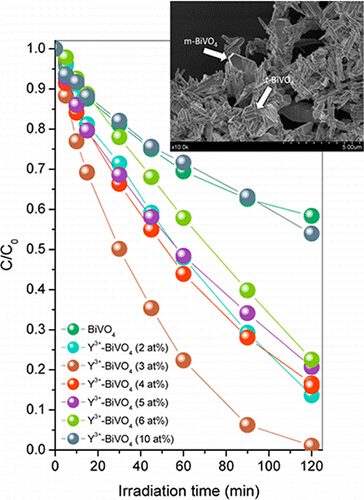
Yttrium-doped BiVO4 has been synthesized by means of a surfactant free hydrothermal method having good photoactivities under sun-like excitation for the degradation of Methylene Blue (MB). From the structural and morphological characterization it has been stated that the presence of Y3+ induces the progressive stabilization of the tetragonal phase and the slight higher surface area…

Solution Properties of the System ZrSiO4–HfSiO4: A Computational and Experimental Study

ZrSiO4 and HfSiO4 are of considerable interest because of their low thermal expansions, thermal conductivities, and the optical properties of HfSiO4. In addition, silicate phases of both are studied as model radioactive waste disposal materials. Previous first principles calculations reported near ideal mixing in the Zr1–xHfxSiO4 system, with a very weak propensity for phase separation.…

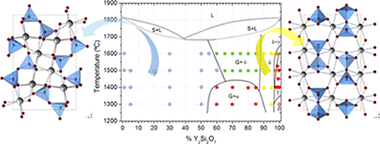
Revealing Structural Detail in the High Temperature La2Si2O7–Y2Si2O7 Phase Diagram by Synchrotron Powder Diffraction and Nuclear Magnetic Resonance Spectroscopy

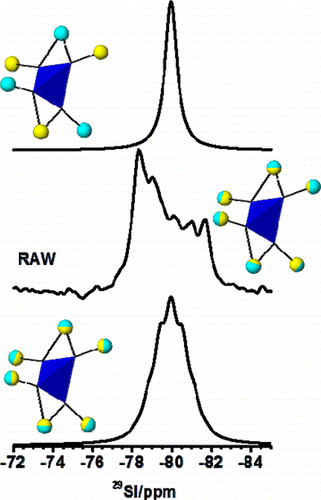
High resolution synchrotron powder XRD, 89Y CPMG NMR, and 139La MAS NMR spectroscopy have been applied to eventually draw the phase diagram of the La2Si2O7–Y2Si2O7 system. The diagram presents a solid solubility region of G-(La,Y)2Si2O7, which extends to the La0.9Y1.1Si2O7 composition at any temperature of this study. Compositions richer in Y show two-phase domains, with…

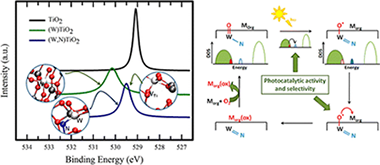
Making Photo-selective TiO2 Materials by Cation–Anion Codoping: From Structure and Electronic Properties to Photoactivity

Photoselective oxidation yielding high-added value chemicals appears as a green novel process with potential to be explored. In this study we combine spectroscopic XPS (N 1s and O 1s) and multiwavelength Raman data with density functional theory calculations to explore the structural and electronic properties of W,N-codoped TiO2 anatase surfaces and interpret the outstanding photocatalytic…

Effect of diffuse light scattering designs on the efficiency of dye solar cells: An integral optical and electrical description

Herein, we present an integral optical and electrical theoretical analysis of the effect of different diffuse light scattering designs on the performance of dye solar cells. Light harvesting efficiencies and electron generation functions extracted from optical numerical calculations based on a Monte Carlo approach are introduced in a standard electron diffusion model to obtain the…

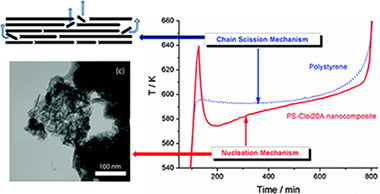
Nanoclay Nucleation Effect in the Thermal Stabilization of a Polymer Nanocomposite: A Kinetic Mechanism Change

The enhanced thermal stability of polymer-clay nanocomposites over the original polymers is one of their most interesting features, and it has been profusely studied within the last decades. Here, a thorough kinetic analysis of polystyrene and a montmorillonite-polystyrene nanocomposite has been performed making use of state-of-the-art kinetic procedures. It has been found that the degradation…