


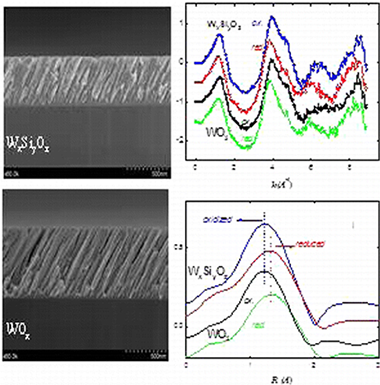
This work reports a X-ray absorption spectroscopy (XAS) study under in operando conditions of the structural and chemical changes undergone by WO3 and WxSiyOz thin films used as electrochromic cathodes. The electrochromic films were prepared by magnetron sputtering deposition at oblique angles and then characterized by a large variety of techniques. The voltammograms and chronoamperometric diagrams in both aqueous and organic electrolyte media revealed a total reversibility of the electrochromic behavior, a low response time, and a high coloration efficiency for the two types of thin films. The in operando X-ray absorption study of the films working in aqueous solutions revealed that when they were electrochemically cycled the average WO distances reversibly varied by a Delta d of 0.06 and 0.08 angstrom for, respectively, WO3 and WxSiyOz. These changes are discussed by assuming the reduction of W6+ cations and the transformation of W-O double bonds into single WO bond structures during the electrochemical cycling of the films.