Enhanced low-temperature CO2 methanation over La-promoted NiMgAl LDH derived catalyst: Fine-tuning La loading for an optimal performance

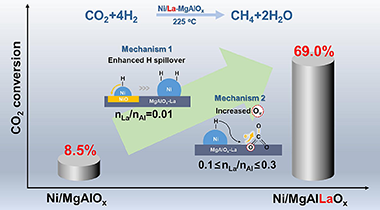
LDH-derived Ni-based catalysts are gathering momentum due to their excellent thermal stability but their lowtemperature CO2 methanation is limited. In this study, various concentrations of La were introduced into the LDH-derived Ni-based catalysts for CO2 methanation, and the underlying mechanisms were investigated. The optimal Ni/La-0.2-MgAlOx catalyst presented a CO(2)conversion level of 69.0 % at 225…

Evaluation of Pt/TiO2-Nb2O5 systems in the photocatalytic reforming of glucose for the generation of H2 from industrial effluents

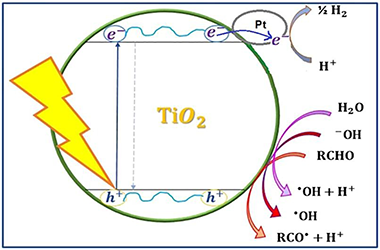
Different Pt-TiO2-Nb2O5 systems were synthesized and studied in the photocatalytic reforming of glucose for the generation of H2. The physicochemical properties of the synthesized photocatalysts were analyzed using different characterization techniques from which it was found that fluoridation and sulphation have different effects on the oxides under study such as a protective effect on the crystalline…

A profitability study for catalytic ammonia production from renewable landfill biogas: Charting a route for the next generation of green ammonia

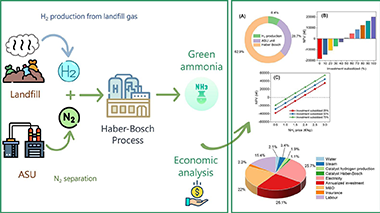
This study introduces a novel techno-economic approach to renewable ammonia production using landfill biogas. The proposed process involves bio-hydrogen generation from landfill biogas, nitrogen production via air separation, and the Haber-Bosch process. Building on our prior research, which demonstrated the economic competitiveness of renewable hydrogen production from landfill gas, we extend our investigation to analyze the feasibility of producing…

Catalytic performance of cobalt supported onto APTES functionalized TiO2 for Fischer-Tropsch reaction

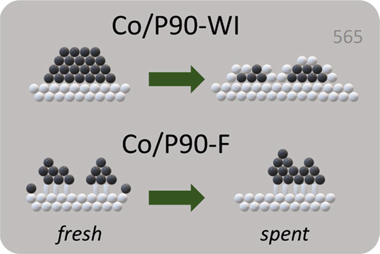
Cobalt supported TiO2 catalysts have been prepared by wet-impregnation and by immobilization over APTES (3-aminopropyl triethoxysilane) grafted TiO2. Impregnated system showed better catalytic performance after reduction at 260 degrees C but significant deactivation is observed. On the contrary, functionalized catalyst showed better catalytic performance after reduction at 400 degrees C with notable stability. We have…

In-situ DRIFTS steady-state study of CO2 and CO methanation over Ni-promoted catalysts

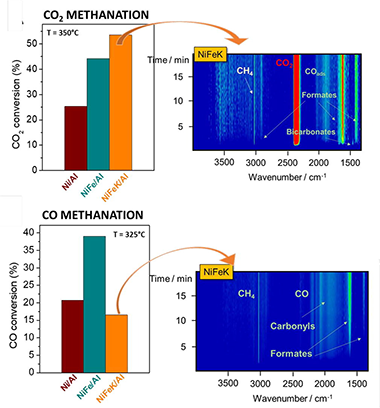
Promoting the performance of catalytic systems by incorporating small amount of alkali has been proved effective for several reactions whilst controversial outcomes are reported for the synthetic natural gas production. This work studies a series of Ni catalysts for CO2 and CO methanation reactions. In-situ DRIFTS spectroscopy evidenced similar reaction intermediates for all evaluated systems…

Ni-Phosphide catalysts as versatile systems for gas-phase CO2 conversion: Impact of the support and evidences of structure-sensitivity

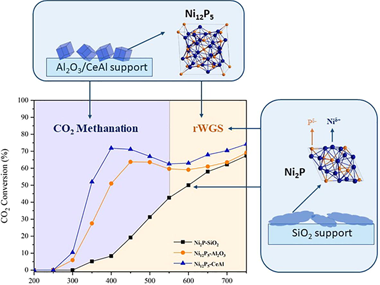
We report for the first time the support dependent activity and selectivity of Ni-rich nickel phosphide catalysts for CO2 hydrogenation. New catalysts for CO2 hydrogenation are needed to commercialise the reverse water-gas shift reaction (RWGS) which can feed captured carbon as feedstock for traditionally fossil fuel-based processes, as well as to develop flexible power-to-gas schemes…

Catalytic reforming of model biomass-derived producer gas

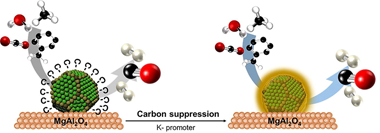
This work includes a complete study of the reaction of reforming a simulated producer gas stream comparing a Ni-based catalyst with another one promoted with potassium to enhance the resistance to coke formation. Although coke deposition is unavoidable in the presence of tars in the stream, the analysis of different reaction parameters revealed that operating…

Pursuing efficient systems for glucose transformation to levulinic acid: Homogeneous vs. heterogeneous catalysts and the effect of their co-action

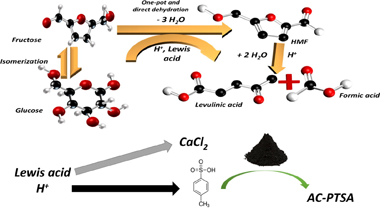
Exploring available catalytic systems to understand their behavior is a must to properly design efficient catalysts aiming to definitively drive biomass from laboratory to industrial scale. Glucose transformation to levulinic acid involves cascade reactions with specific requirements, different active sites in each case and secondary reactions hard to avoid which are intrinsically linked to the…