


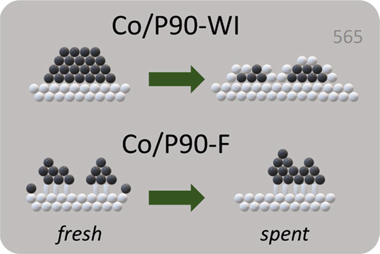
Cobalt supported TiO2 catalysts have been prepared by wet-impregnation and by immobilization over APTES (3-aminopropyl triethoxysilane) grafted TiO2. Impregnated system showed better catalytic performance after reduction at 260 degrees C but significant deactivation is observed. On the contrary, functionalized catalyst showed better catalytic performance after reduction at 400 degrees C with notable stability. We have stated from CO-DRIFT operando analysis that impregnated system is strongly affected by negative SMSI (strong metal-support inter-action) upon reduction at higher temperature. While immobilization on APTES hinders the loss of metal active sites. The study of spent catalysts denotes that Co is redispersed in the impregnated catalyst while functionalized trends to form agglomerates.