


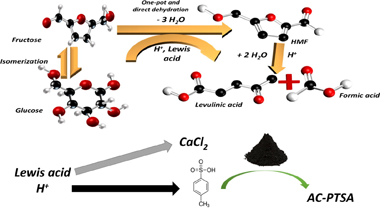
Exploring available catalytic systems to understand their behavior is a must to properly design efficient catalysts aiming to definitively drive biomass from laboratory to industrial scale. Glucose transformation to levulinic acid involves cascade reactions with specific requirements, different active sites in each case and secondary reactions hard to avoid which are intrinsically linked to the catalyst’s nature and reaction conditions. In the present work, homogeneous, heterogeneous and heterogeneous/homogeneous catalysts are considered with the unique goal of improving levulinic acid yield while understanding the catalytic behaviour of cost-effective catalysts. The choice of the catalytic systems and the effect of the main reaction parameters on activity and selectivity is studied and discussed.