Synthesis of all equiatomic five-transition metals High Entropy Carbides of the IVB (Ti, Zr, Hf) and VB (V, Nb, Ta) groups by a low temperature route

The six possible equiatomic five-transition metal High Entropy Carbides (HECs) of the IVB (Ti, Zr, Hf) and VB (V, Nb, Ta) groups of the periodic table, i.e., TiZrHfVNbC5, TiZrHfVTaC5, TiZrHfNbTaC5, TiZrVNbTaC5, TiHfVNbTaC5 and ZrHfVNbTaC5, were successfully obtained via a powder metallurgy route at room temperature, specifically, by one-step diffusion mechanosynthesis starting from the elemental constituents…

Low temperature synthesis of an equiatomic (TiZrHfVNb)C5 high entropy carbide by a mechanically-induced carbon diffusion route

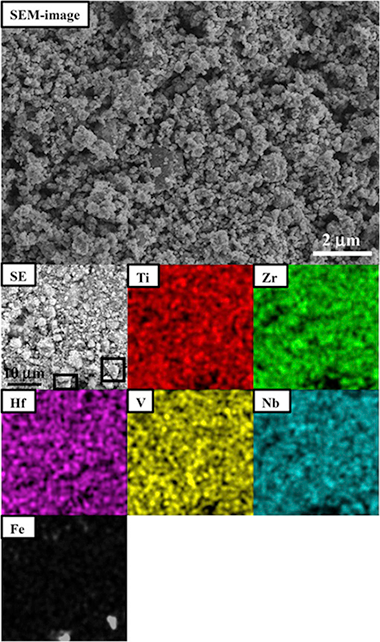
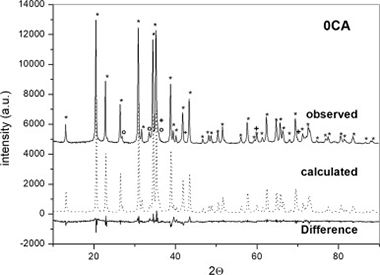
A novel, homogeneous, nanostructured and equiatomic (TiZrHfVNb)C-5 High Entropy Carbide (HEC) was successfully synthesised in a powder form by a mechanosynthesis process from the elemental mixture. This synthesis method for HECs, not previously reported, is simple, reproducible and carried out at room temperature. During milling, the transition metals (Ti, Zr, Hf, V and Nb) alloying…

The influence of mechanical activation process on the microstructure and mechanical properties of bulk Ti2AlN MAX phase obtained by reactive hot pressing

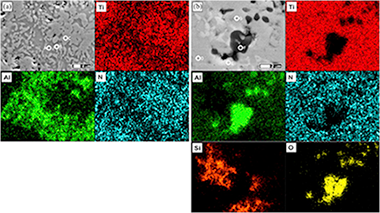
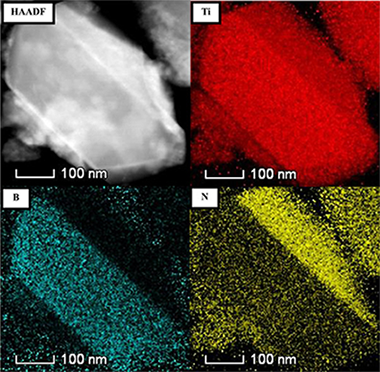
The effect of mechanical activation process on the microstructure and mechanical properties of bulk nanostructured Ti2AlN compound has been investigated in this work. The mixture of Ti and AlN powders was prepared in a 2:1 molar ratio, and a part of this powder was subjected to a high-energy milling process under argon atmosphere for 10…

Mechanically induced combustion synthesis and thermoelectric properties of nanostructured strontium hexaboride (SrB6)

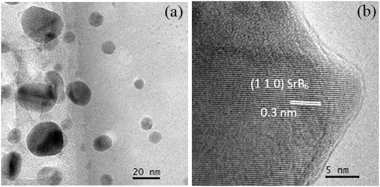
The nanoparticles of strontium hexaboride (SrB6) were synthesized by a mechanically induced magnesiothermic combustion in the Mg/B2O3/SrO system. Ignition time in this system was recorded to be 23 min of milling. X-ray diffraction(XRD), X-ray photoelectron spectroscopy (XPS), and high-resolution transmission electron microscopy (HRTEM) techniques were used to characterize the combustion product. Thermal analysis was employed to assess the formation mechanism. It was revealed that Mg initially reduced…

Insight into the BiFeO3 flash sintering process by in-situ energy dispersive X-ray diffraction (ED-XRD)

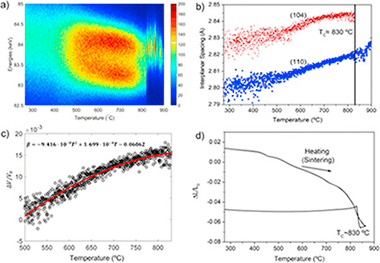
The sintering mechanism of BiFeO3 has been investigated in-situ by energy dispersive X-ray diffraction (ED-XRD) using a high-energy white collimated X-ray beam from the Advanced Photon Source (Argonne National Laboratories). Such radiation is very penetrating thereby allowing measurements of the sample even when placed inside the flash sintering set up. Additionally, the fast ED-XRD measurements permit monitoring the flash sintering process by…

Grain-boundary diffusion coefficient in alpha-Al2O3 from spark plasma sintering tests: Evidence of collective motion of charge disconnections

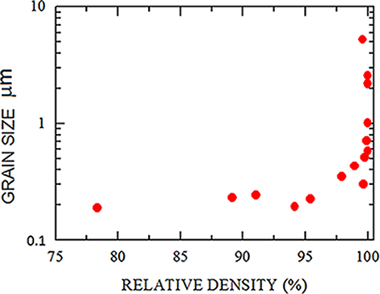
The sintering of fine-grained a-alumina by spark plasma sintering (SPS) was performed to study grain growth under SPS conditions. Grain growth is found to be extensive at relative densities above 95%. A grain growth versus dwell time analysis during SPS allows for the determination of the grain-boundary diffusion coefficient. This study shows that the remarkable…

The role of carbon nanotubes on the stability of tetragonal zirconia polycrystals

The effect of single walled carbon nanotubes (SWNT) at zirconia grain boundaries on the stability of a tetragonal zirconia polycrystalline matrix has been explored in as-sintered composites and after low temperature hydro thermal degradation (LTD) experiments. For this purpose, highly-dense 3 mol% Y2O3-doped tetragonal zirconia polycrystalline (3YTZP) ceramics and SWNT/3YTZP composites were prepared by spark…