Electrical conduction mechanisms in graphene nanoplatelet/yttria tetragonal zirconia composites

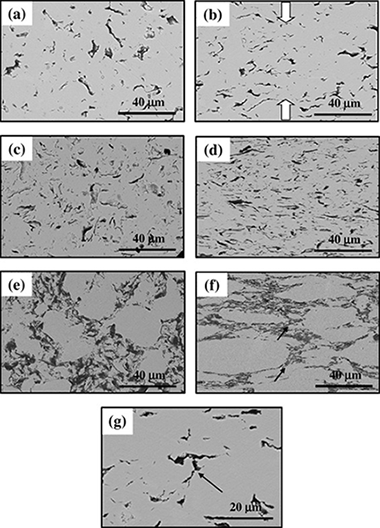
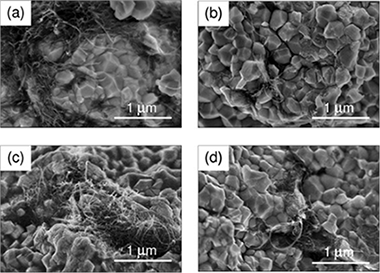
Yttria tetragonal zirconia polycrystalline (3YTZP) ceramic composites with 5, 10 and 20 vol% graphene nano-platelets (GNPs) were prepared by spark plasma sintering (SPS) and their electrical conductivity as a function of temperature was characterized. The composites exhibit anisotropic microstructures so the electrical conductivity studies were carried out in two directions: perpendicular (sigma(perpendicular to)) and parallel…

Synthesis of vaterite CaCO3 as submicron and nanosized particles using inorganic precursors and sucrose in aqueous medium

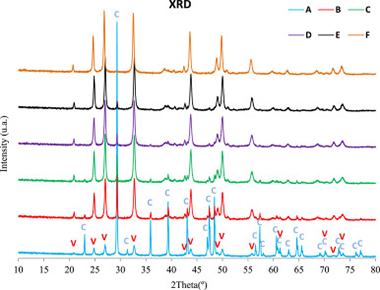
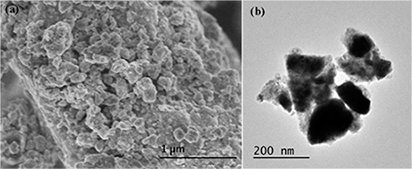
It is reported the synthesis of CaCO3 vaterite as stable nanoparticles and submicron-sized by a simple and relatively rapid procedure. XRD, SEM and FTIR techniques have been used to characterize the precipitated products. The synthesis is based on chemical precipitation of inorganic salt precursors, calcium nitrate tetra hydrate and sodium bicarbonate, and using the disaccharide…

Investigation of use of coal fly ash in eco-friendly construction materials: fired clay bricks and silica-calcareous non fired bricks

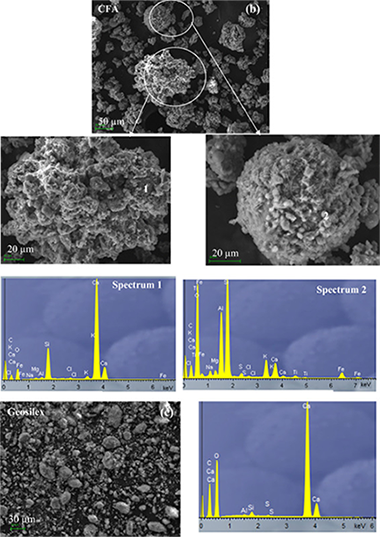
The use of coal fly ash (CFA) as raw material for the manufacture of two construction materials, fired clay bricks and silica-calcareous non-fired bricks, was investigated. Fired clay bricks were manufactured using a commercial clay and different waste ratios (0-50 wt%), moulded at 10 MPa and fired at 1000 degrees C (4 h). Silica-calcareous non…

LaFeO3 ceramics as selective oxygen sensors at mild temperature

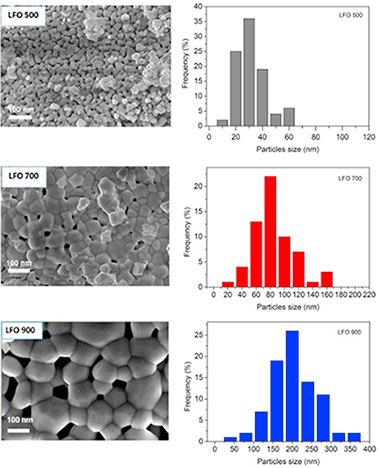
In this study, an investigation about the oxygen sensing properties of lanthanum orthoferrite (LaFeO3) ceramics is reported. LaFeO3 nanoparticles were synthesized by using tartaric sol-gel route and annealed in air at different temperatures (500, 700 and 900 degrees C). The samples have been characterized by using thermal analysis (TA), BET surface area and porosity, Fourier-transform…

A new combustion route for synthesis of TaB2 nanoparticles

Tantalum diboride (TaB2) nanoparticles were synthesized through a mechanically induced self-sustaining reaction (MSR). In this method, the ternary system of Mg/Ta2O5/B was employed in which, magnesium was used as a reducing agent for reduction of tantalum oxides in a combustive regime. The processing route of TaB2 by the solid-state combustion was very short-term and the…

Effect of acid-treatment and colloidal-processing conditions on the room temperature mechanical and electrical properties of 3YTZP/MWNT ceramic nanocomposites

Different colloidal powder processing routines have been used to prepare composites of 3 mol% Y2O3 -ZrO2 (tetragonal zirconia polycrystals, 3YTZP) with 2.5 vol% multiwall carbon nanotubes (MWNT) with the aim of achieving a homogeneous distribution of the MWNTs in the ceramic, eliminating agglomerates but also minimizing carbon nanotube (CNT) damage during processing. Modifications of the acid treatment applied to…

Dense graphene nanoplatelet/yttria tetragonal zirconia composites: Processing, hardness and electrical conductivity

Yttria tetragonal zirconia ceramic composites with 1, 2.5, 5 and 10 vol% nominal contents of graphene nanoplatelets (GNPs) were fabricated and characterized. First, the GNP dispersion in isopropanol was optimized to de-agglomerate the GNPs without damaging their structure. Then, submicrometric fully dense composites were obtained via spark plasma sintering (SPS) at 1250 degrees C with…

High-temperature creep of carbon nanofiber-reinforced and graphene oxide-reinforced alumina composites sintered by spark plasma sintering

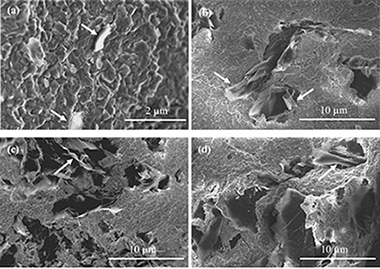
Alumina (Al2O3) ceramic composites reinforced with either graphene oxide (GO) or carbon nanofibers (CNFs) were prepared using Spark Plasma Sintering. The effects of GO and CNFs on the microstructure and in consequence on their mechanical properties were investigated. The microstructure of the sintered materials have been characterized quantitatively prior to and after the creep experiments…

Recycling of construction and demolition waste generated by building infrastructure for the production of glassy materials

The use of waste materials generated by construction and demolition industry to yield valuable glassy materials, i.e. enamel for glazed ceramic tiles and cellular glasses is presented in this study. Both types of materials are produced by one-step treatment at moderate temperatures after simple waste chemical composition adjust. The enamels are manufactured directly from the…