Assessment of pilot-plant scale solar photocatalytic hydrogen generation with multiple approaches: Valorization, water decontamination and disinfection

The main goal of the present study was to explore pilot-scale combination of H-2 generation with simultaneous water disinfection or decontamination. Performance of a TiO2-CuO mixture for solar-to-hydrogen (STH) con-version was studied, focusing on treatment optimization (catalyst dose, proportion of semiconductors in the mixture and concentration of the sacrificial agent). Experiments were performed in a…

Assessment of pilot-plant scale solar photocatalytic hydrogen generation with multiple approaches: Valorization, water decontamination and disinfection

The main goal of the present study was to explore pilot-scale combination of H-2 generation with simultaneous water disinfection or decontamination. Performance of a TiO2-CuO mixture for solar-to-hydrogen (STH) con-version was studied, focusing on treatment optimization (catalyst dose, proportion of semiconductors in the mixture and concentration of the sacrificial agent). Experiments were performed in a…

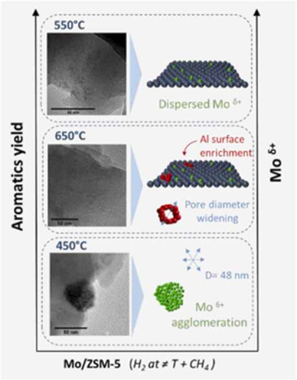
Unraveling the Mo/HZSM-5 reduction pre-treatment effect on methane dehydroaromatization reaction

Reduction pre-treatment at different temperatures were performed over Mo/HZSM-5 system before methane dehydroaromatiztion reaction. We have shown the crucial effect of reduction temperature on the final catalytic performance. Outstanding improvement in the aromatics conversion has been attained. Thus, H-2 formation form methane cracking reaction seems to be hindered for pre-treated catalysts. As a consequence, the…

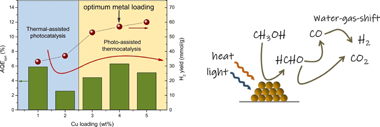
Tuning the co-catalyst loading for the optimization of thermo-photocatalytic hydrogen production over Cu/TiO2

We have optimized the H-2 production by methanol thermo-photocatalytic reforming in the gas phase using Cu/TiO2 catalyst by tuning metal loading. Metal co-catalyst has been deposited by means of chemical reduction deposition. We have stated that thermo- and thermo-photocatalytic process leads to a notable H-2 production at 200 C. By in-situ FTIR studies we evidenced…

Shepherding reaction intermediates to optimize H-2 yield using composite-doped TiO2-based photocatalysts

Optimization of Pt-promoted TiO2-based is key to promote the photocatalytic production of hydrogen using sacrificial alcohol molecules. Combination of doping and surface decoration of the mentioned base photoactive material is here exploited to maximize hydrogen yield. Using the quantum efficiency parameter, it is shown that the resulting composite system can boost activity up to 7.3…

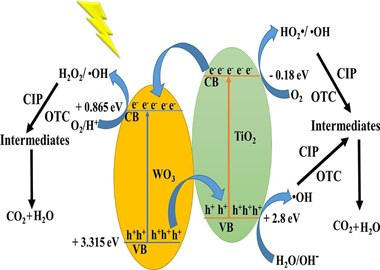
Enhanced photocatalytic activity of TiO2/WO3 nanocomposite from sonochemical-microwave assisted synthesis for the photodegradation of ciprofloxacin and oxytetracycline antibiotics under UV and sunlight

The TiO2/WO3 photocatalysts were prepared by a simple assisted sonochemical -microwave combination. The wide surface and structural characterization of synthesized material confirmed that the adopted preparation method resulted in nanoparticulated crystallite anatase phase of TiO2 with a large surface area (> 200 m(2)/g), and the dispersion of WO3 on the surface of TiO2. The photoactivity…

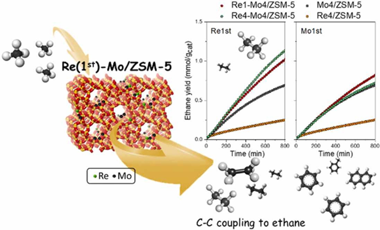
Characterization of Re-Mo/ZSM-5 catalysts: How Re improves the performance of Mo in the methane dehydroaromatization reaction

In this study, the promoting effect of rhenium addition as a co-dopant on Mo/ZSM-5 catalysts system has been analysed. Hence, bimetallic (Re-Mo/ZSM-5) catalysts have been synthesized using a sequential impregnation methodology. The catalytic performance for direct aromatization of methane reaction has been determined and correlated with their physical and chemical state combining multiple characterization techniques.…