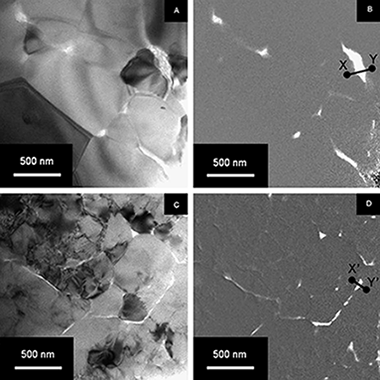
Microstructural Effects on the Creep Deformation of Alumina/Single-Wall Carbon Nanotubes Composites

The enhanced high-temperature creep resistance in alumina/single-wall carbon nanotubes (SWNTs) composites has been attributed to the unprecedented grain-boundary structure of these composites, where the SWNTs bundles segregated at the alumina grain boundaries partially impede grain-boundary sliding. In this study, the effect of SWNTs distributions at alumina grain boundaries on the creep behavior of alumina/SWNTs composites…

Angular dependence of the intensity of light beams diffracted by colloidal crystals

An experimental and theoretical analysis of the angular dependence of the diffracted light beams emerging from three-dimensional colloidal photonic crystals is herein presented. Diffracted beams are identified according to their associated reciprocal-lattice vectors, and their intensities are obtained as a function of the zenithal and azimuthal incidence angles. Significant changes in the beam intensities are…

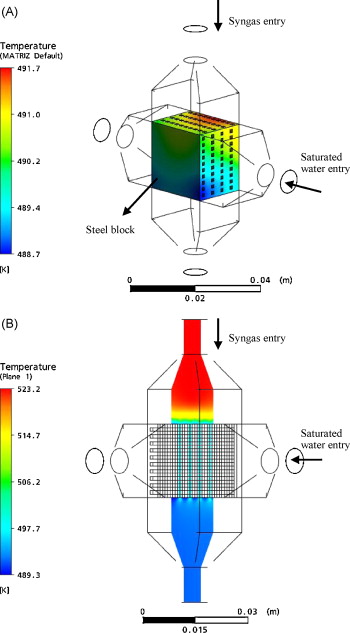
Computational fluid dynamics study of heat transfer in a microchannel reactor for low-temperature Fischer-Tropsch synthesis

A three-dimensional computational fluid dynamics (CFD) study of heat transfer in a microchannel reactor for the low-temperature Fischer-Tropsch synthesis (FTS) is presented. The microreactor studied is a steel block with 80 square microchannels of 1 mm of side arranged in cross-flow configuration for the transport of syngas and cooling water. Syngas space velocities in the…

Study of the morphology of NiO nanostructures grown on highly ordered pyrolytic graphite, by the Tougaard method and atomic force microscopy: a comparative study

We studied the morphology of the deposits of NiO grown on highly ordered pyrolytic graphite (HOPG), by means of inelastic peak shape analysis and atomic force microscopy. The results obtained by both techniques show an excellent agreement. The results indicate that NiO grows on HOPG by following the Stransky-Krastanov type of growth.

Murillo’s paintings revealed by spectroscopic techniques and dedicated laboratory-made micro X-ray diffraction

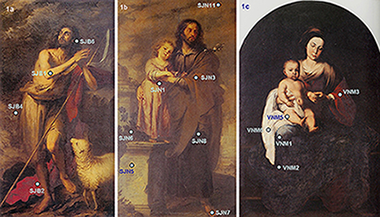
This paper describes one of the first case studies using micro-diffraction laboratory-made systems to analyse painting cross-sections. Pigments, such as lead white, vermilion, red ochre, red lac, lapis lazuli, smalt, lead tin yellow type I, massicot, ivory black, lamp black and malachite, were detected in cross-sections prepared from six Bartolome Esteban Murillo paintings by micro-Raman…

Microstructural characterization of ceramic-intermetallic composites using TEM related techniques

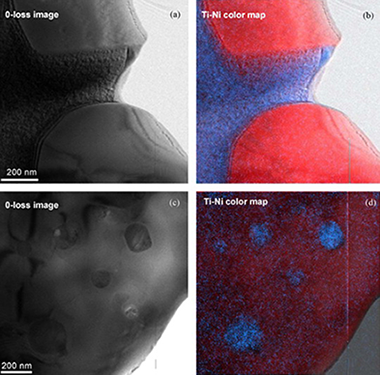
TiCxVy/Ni and TiCxNy/Ti-Co composites formed by ceramic and intermetallic binder phases were produced by pressureless sintering at 1400 degrees C from powders synthesized by a mechanically induced self-sustaining reaction (MSR) process. Four different composites were characterized using high-resolution electron microscopic techniques, in both scanning (SEM, HRSEM) and transmission (TEM, HRTEM, ED, EDS and EELS) modes…

Angular dependence of the intensity of light beams diffracted by colloidal crystals

An experimental and theoretical analysis of the angular dependence of the diffracted light beams emerging from three-dimensional colloidal photonic crystals is herein presented. Diffracted beams are identified according to their associated reciprocal-lattice vectors, and their intensities are obtained as a function of the zenithal and azimuthal incidence angles. Significant changes in the beam intensities are…

Computational fluid dynamics study of heat transfer in a microchannel reactor for low-temperature Fischer-Tropsch synthesis

A three-dimensional computational fluid dynamics (CFD) study of heat transfer in a microchannel reactor for the low-temperature Fischer-Tropsch synthesis (FTS) is presented. The microreactor studied is a steel block with 80 square microchannels of 1 mm of side arranged in cross-flow configuration for the transport of syngas and cooling water. Syngas space velocities in the…